
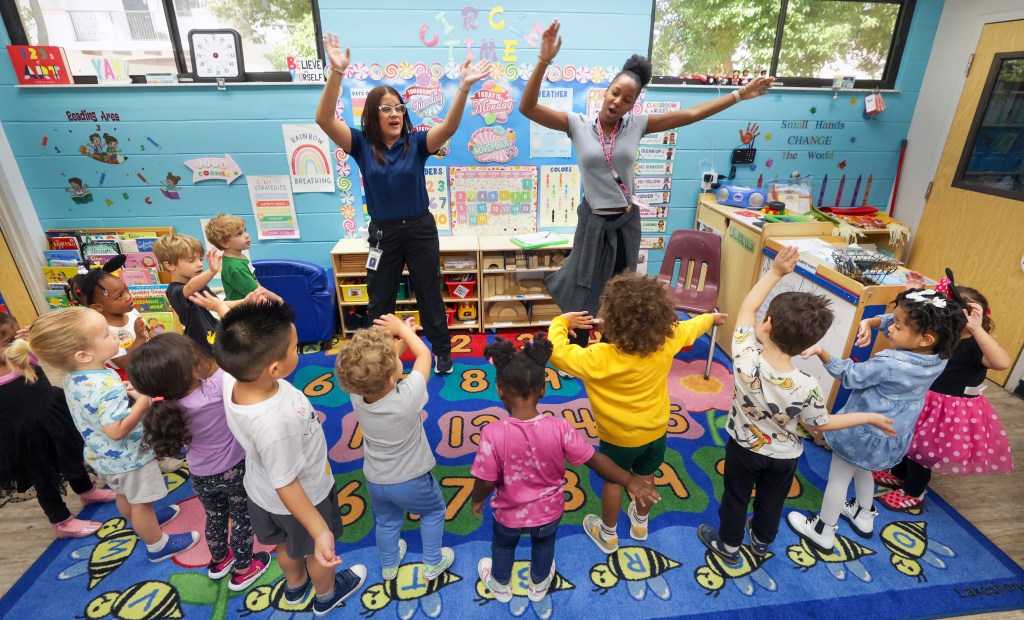
The number of children waiting for subsidized childcare in Florida has ballooned to nearly 26,000 this year as federal COVID-era funding ended and the state made more youngsters eligible for the help but chipped in no extra money.
As a result, many low-income families, already struggling with rising rents and food costs, cannot get assistance paying for childcare, a service they need to hold down jobs.
“I’ve been here 36 years, it’s the most distressing time for families that I’ve ever seen,” said Pat Cronon, owner of Hand ‘n Hand Child Enrichment in Orlando, which serves 43 children ages one month to five years.
Parents waiting for money from Florida’s School Readiness program, which administers federal subsidized childcare funds, now remain on a waitlist for about six months before they get help, Cronon said.
“It’s causing some families to leave their work because they cannot afford to pay while they wait,” she added.
The School Readiness program, which serves about 210,000 youngsters statewide, has had a waitlist for years, but pandemic relief money helped pare it down for a time. In 2019, 15,230 children were waiting, according to the Florida Department of Education, but that number dropped to about 4,200 by 2022.
Now, it has swelled to 25,968.
To qualify for School Readiness, a parent must be working or in school, and the family income must be below a certain threshold, which is now about $36,666 for a family of two and $53,920 for a family of four. The money families receive to help pay for childcare is provided on a sliding scale based on income.
“Across the state, there’s huge waitlists. There’s parents that qualify, that are working, that are meeting the threshold, but they can’t get services,” said Scott Fritz, CEO of the Early Learning Coalition of Orange County, the agency that administers the county’s funding.
The Orange coalition has a waitlist of more than 2,000 families.
The Florida Legislature in the spring passed a law that made more children eligible for subsidized childcare, concerned that the rising cost of living made the old income threshold unreasonable. But lawmakers did not allocate any more money for the program.
And federal funding, which makes up the bulk of the School Readiness program’s budget, fell by about $80 million this year.
A staff analysis of the approved legislation (HB 859) noted that without more money qualifying more children would result in “a corresponding increase to the waitlist.”
That is what happened.
“We should increase income eligibility. People have been saying that for a long time. But if you can’t increase the capacity then what are you going to do with those families? Nothing. They’re on the waitlist,” said Norin Dollard, senior policy analyst at the Florida Policy Institute.
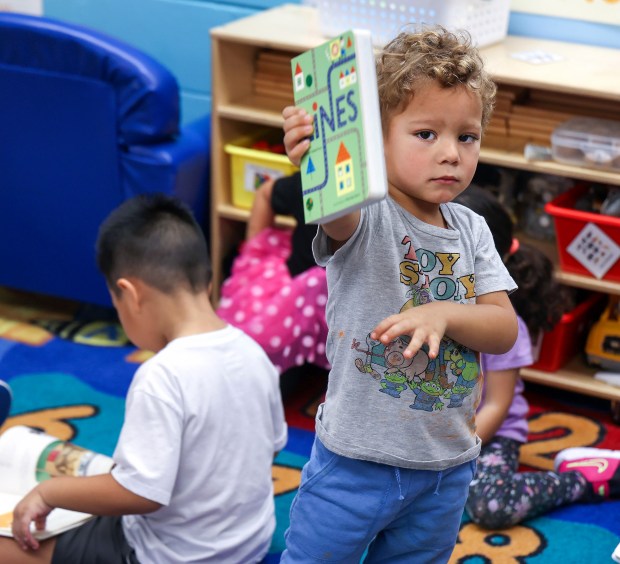 Sullivan Johnson offers his book to a visitor in the VPK 3-year-old classroom at Welbourne Nursery and Preschool in Winter Park, Tuesday, Nov. 18, 2025. Low-income families are finding access to early learning programs more difficult due to recent federal cuts in state-subsidized childcare. (Joe Burbank/Orlando Sentinel)
Brittany Jackson, a 30-year-old single mother with two children, ages 3 and 4, got School Readiness funding quickly several years ago when she lived in Orlando.
But when she moved to Jacksonville this year, she applied in March and did not get the help until August.
She could not pay the full cost of childcare and, without it, she missed so much work her boss demoted her to part-time.
“I would have to leave work early. And I was on a probationary period as well, because I just started that job,” Jackson said. “I was struggling. I was falling behind on bills and everything. It was just impossible.”
The Florida Department of Education said COVID relief money helped the state shrink the waiting list to its smallest number ever, so it is not surprising the list has grown now that that funding ended.
“While this reflects growing demand, it also demonstrates the strength of Florida’s School Readiness program and how many families want access to these services,” a spokesperson said in an email.
The waitlist varies from county to county, with densely populated areas usually having longer wait times.
Osceola went from no waitlist in 2024 to more than 450 children in line this year.
“I have no anticipated date for funds to be made available. So I have no anticipated date to enroll families off the waitlist,” said Amanda Kelkenberg, CEO of the Early Learning Coalition of Osceola County.
Owners of childcare centers serving low-income families say the funding shortfall has led to a drop in attendance.
“It’s affected our enrollment a great deal, because families can’t afford tuition even with both parents working. It’s really sad when you think about it,” said Latonya Pelt, director of Welbourne Nursery and Preschool in Winter Park.
The weekly tuition at Welbourne ranges from $240 to $315 depending on a child’s age.
She said she has families coming to tour her center who want to enroll their kids, but they are stuck on the waitlist for state funding. About half her families rely on School Readiness. Her attendance has dropped from 64 kids last year to 52 this year.
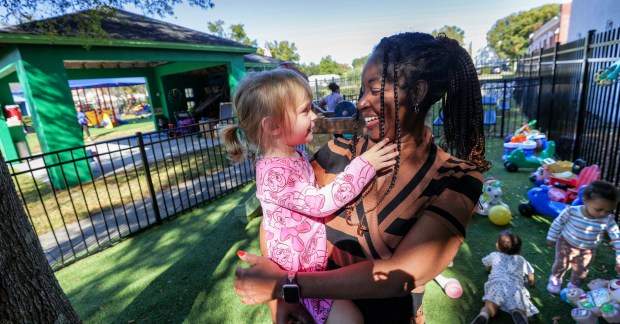 Bridgette Andersen, 1, chats with Latonya Pelt, executive director at Welbourne Nursery and Preschool in Winter Park, Tuesday, Nov. 18, 2025. Low-income families are finding access to early learning programs more difficult due to recent federal cuts in state-subsidized childcare. (Joe Burbank/Orlando Sentinel)
Nearly all the families at Early Education Station in MetroWest rely on School Readiness. That center’s enrollment went from about 75 kids last year to 50 this year.
“It’s a very big drop,” said owner Wanda Barkley. She said if she cannot get her number up, she will have to make some tough decisions. “I’m looking into transitioning into retirement earlier.”
Mikala B’Williams, 25, landed in a domestic abuse shelter in Seminole County in July after an incident with her 2-year-old son’s father. Under state law, that moved her to the top of the waiting list, and she got School Readiness funding in two weeks.
“It was definitely very important that my son go in so quickly, so I could start working again,” she said.
The program also means her son is getting the benefits of preschool.
“I didn’t go to school until I was in kindergarten, and that’s when I learned my ABCs and my numbers. But he already knows the ABC song and he knows how to count to like seven or eight,” she added. “And he’s speaking more in sentences now. Expressing himself really well.”
Jackson, the mother who moved to Jacksonville, said during her time on the waitlist she would go to the Early Learning Coalition of Duval, which administers the program, and tearfully plead for help.
Angel Carro, the coalition’s CEO, said her agency has about 1,500 children on the waitlist, so many parents face the same problem.
“A couple of years ago, we had enough funding that we were able to pull families off the waitlist as soon as they applied,” Carro said. “This last spring we had to slow down our enrollments because of the upcoming budget cuts we were anticipating.”
As the sole supporter of two young children, Jackson said she didn’t understand why a program meant to help families like hers could be so hard to access.
“They would always say, ‘We don’t have funding’,” she said. “And it just didn’t make sense to me.”