
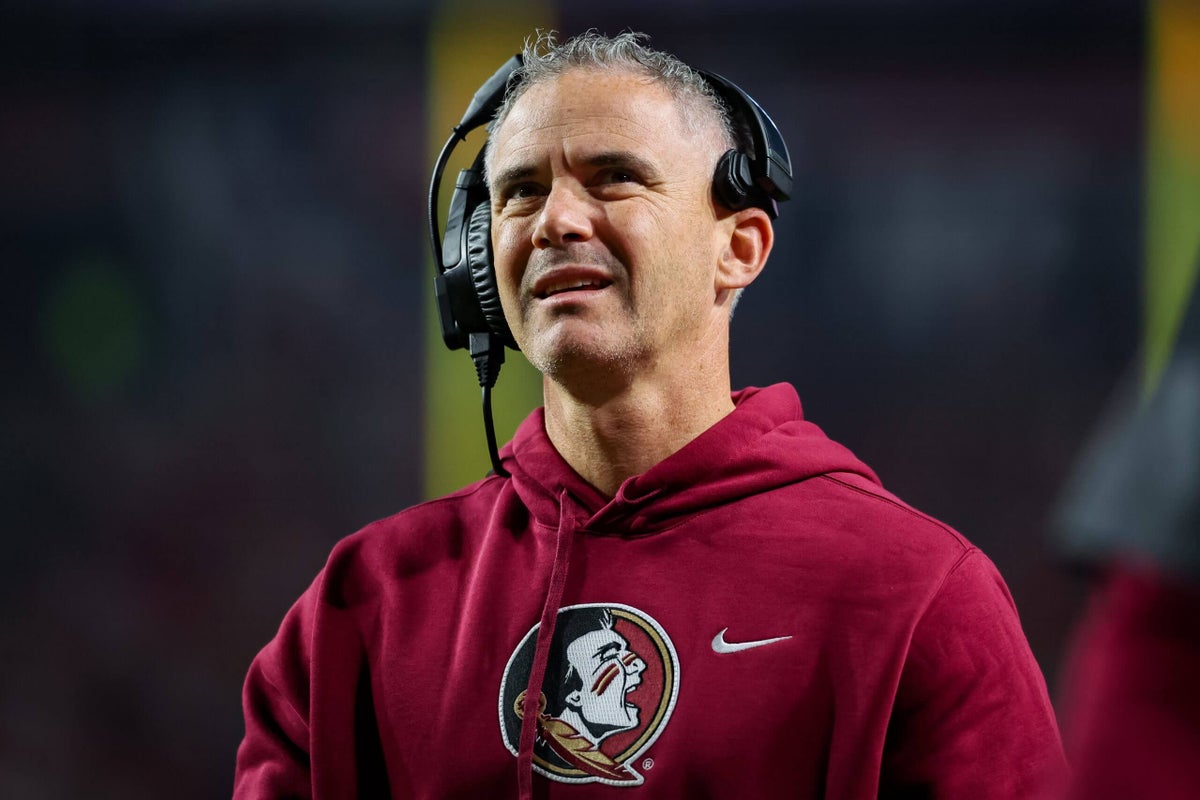
After Florida State announced Sunday head coach Mike Norvell would return for 2026, it’s worth revisiting what the Seminoles said the last time they made an in-season announcement about an embattled head coach with an unimpressive record but enormous buyout.
“Frankly, 6-6 isn’t good enough …”
That’s what then-athletic director David Coburn said the day after he fired Willie Taggart and signed off on a buyout (up to $18 million) that still ranks among the largest ever. Taggart was 4-5 in Year 2 and coming off a double-digit loss to middling Miami. Norvell is 5-6 in Year 6 and coming off a double-digit loss to middling NC State.
Florida State’s board of trustees chairperson, Peter Collins, said in a statement Sunday that the on-field results “have been far from acceptable to the FSU standard.” But by retaining Norvell, who replaced Taggart after the 2019 season, FSU has accepted that standard: 6-6 is now, apparently, good enough. Maybe the Seminoles literally moved their goalposts during their recent nine-figure renovation to Doak Campbell Stadium.
The argument would be different if this season looked like an aberration. It’s not. If 6-6 isn’t good enough, then Norvell has failed in four of his six years. Even if we blame his 3-6 inaugural season on the COVID-19 shutdown that began his first spring, he still went 5-7 the next year and 2-10 last year. Now he must beat Florida this weekend to make a bowl game.
This season has been particularly baffling. Florida State beat mighty Alabama by 14 in the opener but lost to Stanford’s interim coach last month. Friday at NC State, the Noles muffed a kick that bounced off an FSU player’s helmet and was recovered by the punter … then muffed another punt moments later. It was a damning showing for a coach who promised on Day 1 that special teams would form the Seminoles’ backbone and for a program that should be strong enough to overcome a bad break or two, especially six years into a regime.
Norvell’s entire tenure has been similarly confounding: The same coach and same staff that went 13-0 in 2023 suffered one of the largest collapses in college football history the next year. Take the broader view, though — the kind of “comprehensive assessment” current athletic director Michael Alford promised last month — and you can find a logical explanation. What if 13-0 and 2-10 were both flukes? Split the difference, and Norvell is a six-to-eight-win coach. That’s what his 38-33 record says he is. That’s what he’ll likely be this season.
And that’s good enough for Florida State, apparently.
The Seminoles, of course, had other factors to consider beyond the record. More than 55 million of them, depending on when his buyout would have taken effect and the mitigation that would have come from Norvell’s next job. FSU administrators acknowledged as much in Sunday’s announcement. Alford cited the investment of hundreds of millions of dollars into football facilities and other upgrades while stressing their responsibility to put FSU in the best position possible “not just today, but for years to come.” Collins brought up administrators’ “responsibilities as stewards of program revenues” and the need to figure out how to best allocate finite resources.
“We will address performance deficiencies in the program,” Collins said. “These deficiencies may include structural changes to the very large and complex program FSU football has become, and these areas are where we will focus and invest.”
Translation: $60 million can and should be better spent on players or front-office changes instead of paying Norvell and the rest of the coaching staff not to coach.
Perhaps they’re right. This era of player compensation is too new to give us many historical precedents, but after Oklahoma doubled down on Brent Venables in the offseason, the Sooners are one win away from the College Football Playoff. Florida State might have better luck trying to find its own John Mateer with that approach than entering a crowded coaching market that already includes Florida, Penn State, LSU and Auburn.
But what evidence does FSU have to show that Norvell is the right person to lead that run? His recruiting classes have consistently ranked among the Seminoles’ worst in the Rivals/247Sports era. Tuesday marks the two-year anniversary of his last road win. He has lost 17 of his last 22 games against FBS opponents and 13 of his last 16 conference games in a pedestrian ACC. His overall conference record of 22-26 (.458 winning percentage) isn’t much better than Taggart’s (6-8 record, .429 winning percentage).
Despite the on-field improvements from last year’s rock bottom, Florida State still sits outside the top 25 nationally in advanced metrics like ESPN’s SP+. It’s possible coaching continuity and more roster turnover will lead to a leap forward next fall, or that additional investments could address other issues lurking under the hood. It’s also possible that FSU will waste a year in limbo as the landscape hurdles toward the next round of conference realignment. The massive contract extension Florida State gave — and probably had to give — Norvell to keep Alabama from poaching him to replace Nick Saban left the Seminoles with no good options Sunday.
The one they chose is an about-face from where FSU was six years ago when Coburn fired Taggart. The administration has changed since then, but the expectations of a three-time national championship program were supposed to remain the same. They haven’t, no matter what the press releases say. While 6-6 wasn’t good enough for Taggart, the Seminoles just showed that mediocrity is acceptable for the man hired to replace him.