
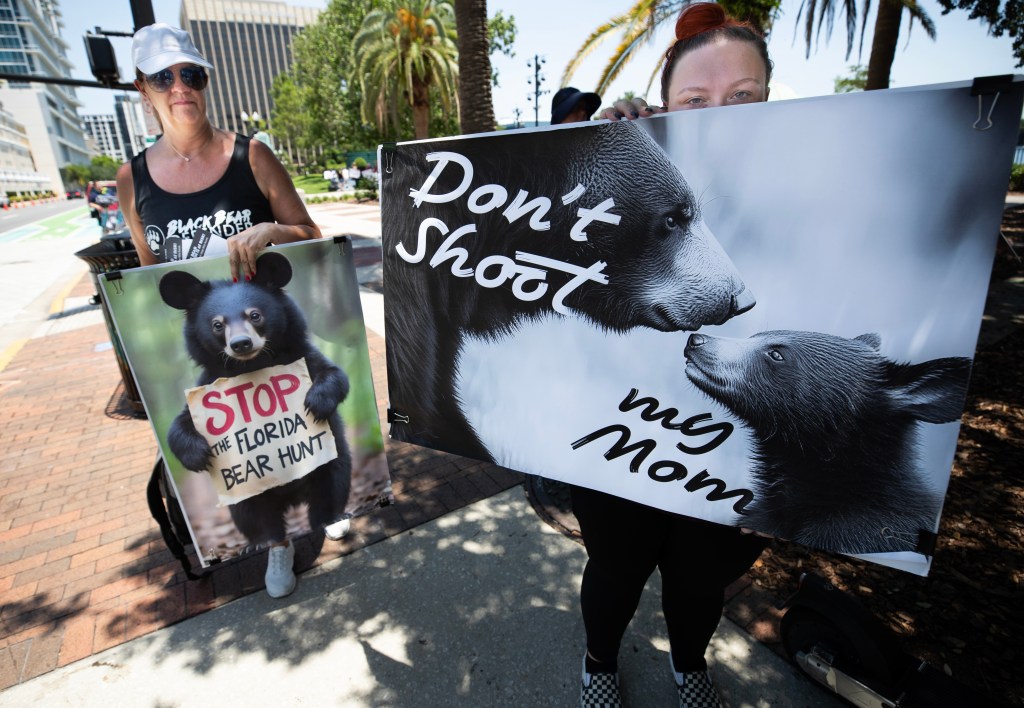
With Florida’s first bear hunt in a decade just two weeks away, opponents say they’ve used a combination of tactics to protect bears from bullets — and are heading to court Monday in Tallahassee hoping to persuade a judge to stop the shooting altogether.
Bear Warriors United, a Central Florida-based, not-for-profit group, sued the Florida Fish & Wildlife Conservation Commission in September, about a month after the state wildlife agency governing board green-lighted a limited, annual winter hunt of bears, Florida’s largest land mammal.
Bear hunt foes also say they have claimed about 45 of the 172 bear permits FWC issued through a lottery system. Those 45 “tags” entitling the holder to take one bear will go unused, they say, reducing the total harvest by more than one-quarter.
“The 45 includes one hunter who signed an agreement not to use his permit for a fee because he was short of cash to pay bills,” said Steve Rosen, a South Florida businessman who calls himself a “rescuer.” The hunter, he added, “will remain anonymous as will the amount I paid him.”
Bear Warriors United, represented by Volusia county attorney Raquel Levy, has asked Circuit Judge Angela Dempsey seated in Leon County for a temporary injunction to halt the hunt, which Fish & Wildlife officials have termed a “harvest,” set for Dec. 6 through Dec. 28.
An FWC spokesperson said the 172 bear-hunt permits include 18 to kill a bear in the Central Florida hunting zone.
Lawyers for FWC have argued in court filings that Bear Warriors’ long-shot plea should fail because the wildlife agency’s commissioners “relied on substantial science and experience to inform its decision that the Florida black bear population could sustain a hunt.” The agency estimates Florida’s bear population at over 4,000, and says it will calculate each year how many can be harvested.
Asking for a dismissal, the FWC said it had “determined that the black bear’s population has expanded in several areas, resulting in an increased presence of bears outside of suitable bear habitats, which is compounded by human population growth and expansion.”
Agency officials estimate bear populations in four of its seven multi-county “bear management units” are home to at least 200 bears with Central Florida boasting the most — about 1,200 in a region that includes Orange, Lake, Marion, Seminole and Volusia counties.
Hunting is not allowed in any of the three regions with fewer than 200 bears.
Outside of those limits, the state is right to permit a limited hunt of its bears as a tool for managing the species’ growth, said Maria Davidson, who heads the large carnivore program for the pro-hunting group, Safari Club International, which will assist FWC with its defense.
Florida black bears were classified by the state wildlife agency as a threatened species from 1974, when the estimated numbers of bruins dwindled to a few hundred, until 2012. Their rebound is often touted by Fish & Wildlife and its supporters as a success story.
“But once bear populations have recovered to a certain extent, they, just like all other wildlife populations, need to be managed at suitable numbers within suitable habitat,” Davidson said in a phone interview, asserting a harvest will help keep bears within their core habitats.
Rules for Florida proposed bear hunt: ‘It’s going to be a massacre’
Arguing against the hunt, Levy dismissed the notion that Florida has too many bears.
“If people are seeing more bears, people intuitively might say there must be a rapidly increasing number of bears,” she said. “But that’s not the case. Development is shrinking their habitat and so the bears that we’re seeing are dying off because they have nowhere to go.”
Opponents are hopeful they will prevail in court or at least spur Gov. Ron DeSantis to intervene, said Susannah Randolph, chapter director of Sierra Club Florida, which brought bus loads of bear advocates to Tallahassee last week for a rally on the issue.
“There’s always hope as long as you’re fighting,” she said.
The governor, who appointed the Fish & Wildlife commissioners, hasn’t publicly questioned the agency’s plans for the bear hunt.
But in September, when DeSantis staged a press conference to announce a sales-tax “holiday” on guns, ammunition and other hunting accessories, the governor stood in front of a scowling stuffed grizzly bear, its claws extended, at G FIVE Feed & Outdoor in Plant City.
He should care about what the public thinks, foes of the hunt said.
“There are enough voices. We just need a governor that’s going to listen to those voices,” said Katrina Shadix, founder of Bear Warriors United. “Eighty percent of Floridians are against the Florida black bear hunt. And this should have never gotten as far as it has.”
The hunt was approved in the wake of the state’s first confirmed fatal bear attack. A bear mauled 89-year-old Robert Markel who was found in May about 100 yards from his home in Collier County in southwest Florida near Naples. The bear also killed Markel’s dog.
Hunting foes argue the state can curb dangerous interactions between people and bears with better education and with non-lethal measures, including bear-proofing garbage cans to deter bears from wandering into neighborhoods to forage in trash for food.
Bear-resistant containers have proven to be an effective deterrent in Seminole County, once a hub for human-bear clashes.
But many hunters nonetheless support the opportunity to take a shot at a bear.
The 2015 hunt, scheduled for seven days in October, was open to anyone who applied for a bear-hunting license but was shut down after just two days as eager hunters killed 304 bears, including juvenile bears and lactating sows that were supposed to be off limits.
The harvest limit was 320 bears.
Rules for the upcoming hunt are intended to limit killing of female bears, said George Warthen, FWC’s chief conservation officer. He noted December is when most female bears, especially those pregnant or caring for cubs, tend to be denning while males are more active.
shudak@orlandosentinel.com
This article was written with information contributed by The News Service of Florida.