
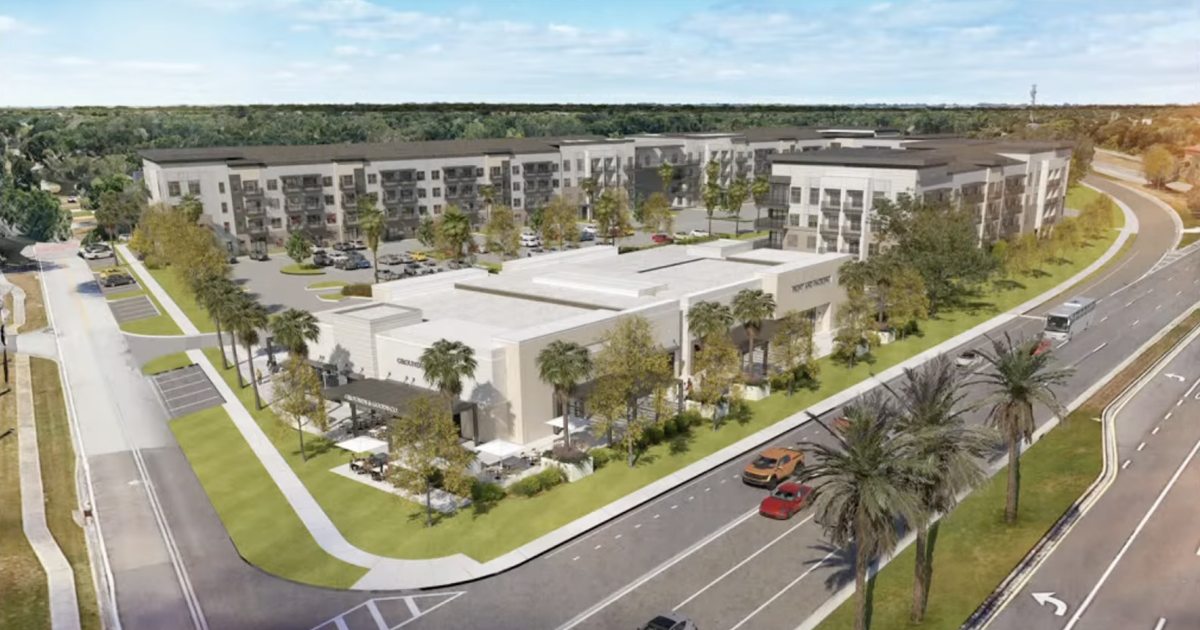
OLDSMAR — Despite a wave of public criticism, the City Council voted 4-1 on Nov. 18 to approve a revised conceptual plan for the city’s downtown redevelopment, allowing the Stanbery Development Group to advance negotiations.
The vote came despite public testimony condemning the plan for the 100 State St. site as too dense, aesthetically generic, and a drain on the city’s infrastructure and historic center.
The vote is not a final commitment to construction, but a critical green light that allows the project to proceed to the next phase: an estimated 14 steps of detailed analyses, including traffic and stormwater studies that must validate the project’s feasibility.
Jon Meyer and Marc Hays from the Stanbery Development Group presented the updated design as a compromise, highlighting a slight reduction in density and massing. Hays framed the new layout as addressing direct feedback from earlier council work sessions, even referring to a presentation slide as, “We Heard You!”
The revised plan calls for 240 residential units, a minor decrease from earlier concepts. The apartments will be housed in a single building lowered to four stories, down from a five-story proposal. The blueprint also expands the dedicated public plaza area to 2 acres and increases the ground-floor retail to over 21,000 square feet.
However, this structural tweaking did little to satisfy residents who see the apartment count as a fixed threat to the quality of life in Oldsmar. The public’s concern was unanimous: the density is incompatible with the small-town infrastructure.
The most volatile point of contention was parking, which quickly revealed the financial compromises in the revised plan. Resident after resident pointed to the lack of dedicated, sufficient parking for the estimated 480 to 800 new residents and the hundreds of patrons expected for the new retail and plaza events.
Resident Pamela Geary Florence, known as “Pammy,” led the charge, asking, “My question to you is, where do the residents in Oldsmar park? You were saying close all that down and make it more of a public place and whatever, but where do we park?”
The reason for the deficit became clear when council member Valerie Tatarzewski asked why the structured parking component was abandoned. Mayor Katie Gannon offered a definitive, discouraging reply: “The parking garage is no longer financially feasible at this point.”
Maria Barreiro, a longtime Oldsmar resident, pleaded against the urbanization, stating that 240 apartments would bring too many people for the existing small-town grid.
“Eight-hundred people in this area, the traffic is horrible. … We cannot go out of the house. We cannot go anywhere,” Barreiro lamented. “No, no, there’s no parking. There’s no parking for everybody.”
Council member Andrew Knapp, who cast a yes vote, nonetheless acknowledged the severity of the issue. He estimated the developers’ drawings showed only about 400 spaces — a number he called “a little low” when accounting for residents, retail employees, and event visitors. Knapp concluded, “We need to figure out how that goes, whether that’s a deck or reconstituting the layout.”
Public anxiety was further exacerbated by the fear the city was sacrificing its identity for a generic building and giving up its core civic center.
Resident Ginger Tatarzewski offered a powerful critique of the architectural style.
“It is the same as every other city in the United States. Everybody has one of these,” she argued, urging the council to demand more. “Please take time and look around and shop. Make these guys do something. … There’s nothing that says Oldsmar about this at all.”
The fate of the existing city hall was confirmed at the meeting.
City Manager Felicia Donnelly informed the public that the building is functionally obsolete — it leaks, fails to meet floodplain requirements, and is prohibitively expensive to repair. The plan now involves relocating city hall services, potentially combining them with a storm-hardened Emergency Operations Center at the Municipal Services Center site on Commerce Street.
Nicole Mackin expressed frustration at the displacement of the community’s civic anchor.
“I’m really wondering where is City Hall going because it’s not going to seem like a downtown without City Hall downtown,” she said, adding that the entire project looked like “an event at this apartment complex” rather than an Oldsmar gathering. Mackin warned that the city risks following the path of Safety Harbor, where she noted longtime residents have left because it has “lost the small-town feel.”
In a spirited moment, Hays addressed the public’s fear that the retail space would be taken over by undesirable businesses. Underscoring this concern, resident Grace Baboukis asked, “Will the city have any kind of restriction to prevent medical offices from coming in and snatching up all the retail? … I want to have a beer, not a colonoscopy.”
Hays issued a categorical assurance, promising targeted leasing to attract quality establishments. “Medical offices, no one needs to worry about coming to our project to get a colonoscopy, there is no thought along those lines. Never has been, never will be,” Hays said. “It’s going to be a targeted approach. … We know how to cut a deal with the yoga studio. We know how to cut a deal with the coffee shop.”
The majority of the council argued that the vote was not an endorsement of the final building, but a necessary step to see the actual, high-cost technical data. Council members Sean Swauger and Knapp emphasized that the project is intended to be a catalyst for the entire State Street corridor.
“This is kind of the start of what I think people aspire to have as a downtown versus a town center project,” Knapp said, pointing out that other grayed-out parcels would likely be redeveloped only after this major project breaks ground.
Mayor Gannon echoed this sentiment, underscoring the necessity of moving forward to answer the public’s questions with data, not speculation.
“I’m interested in moving forward with the revised version and continuing negotiations so we can see the traffic modality plan, so we can see the stormwater plan, so we can do the parking calculations,” she said.
Vice Mayor Steve Graber justified the vote as a pragmatic compromise given the strong community identity already present.
The dissenting vote was cast by Tatarzewski, who aligned with the residents who maintain that the development remains an unacceptable risk to the city’s character.
The Stanbery plan now enters its toughest stage, where the financial and engineering realities of traffic, parking, and stormwater — issues Donnelly confirmed are currently lacking sufficient data — will either validate the council’s decision or vindicate the public’s apprehension.