
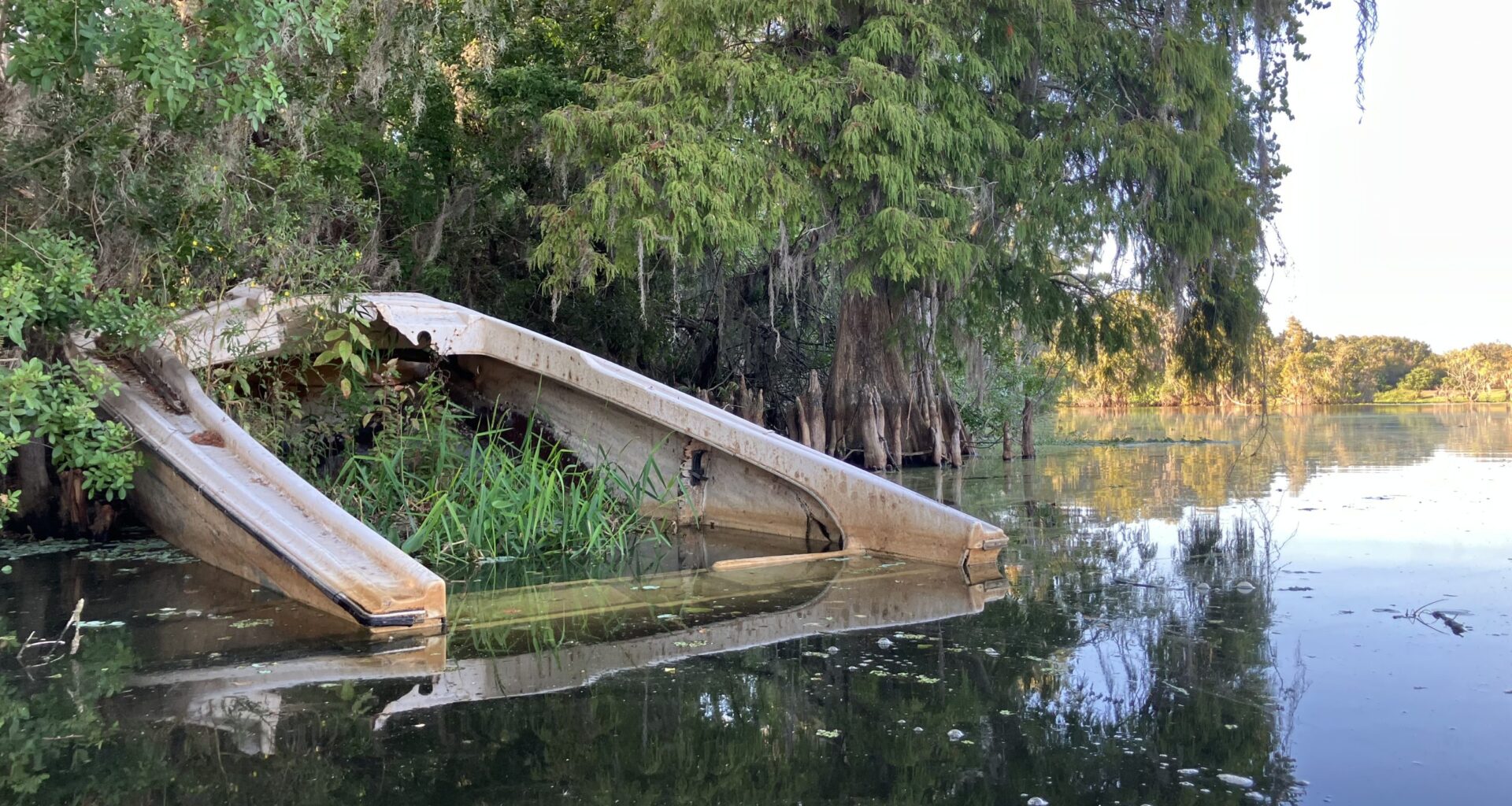
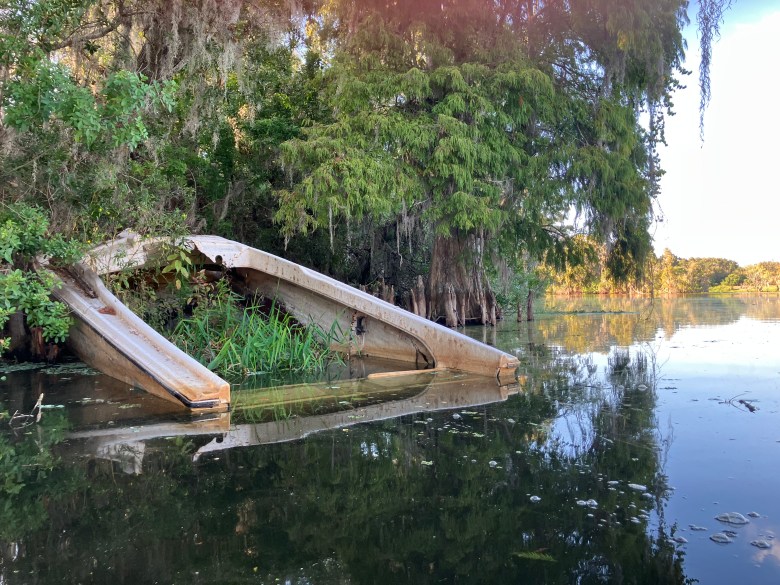
 The Hillsborough River in Tampa, Florida on Oct. 29, 2025. Credit: Thomas Hallock / Creative Loafing Tampa Bay
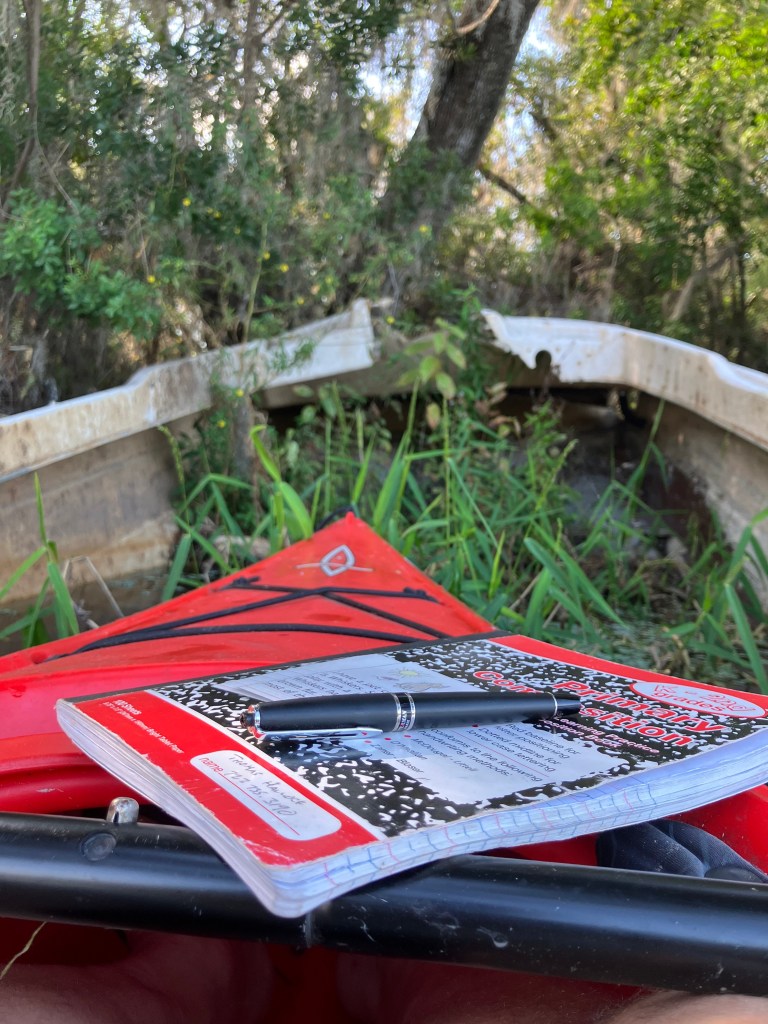
With the last day of hurricane season approaching, Nov. 30, I pull my kayak into an abandoned skiff. The back (the entire stern really) has washed away. I am sitting in a boat in a boat, at Riverhills Park, at a fork between river and canal. Half on water, half on land. The hull serves as a makeshift planter, and a showy yellow primrose of some kind has taken root in the cracked fiberglass.
At this point of its 57-mile career, the Hillsborough wavers in its direction. The river has jagged southwest through its wilder stretches, the standard paddling routes upstream, and goes suburban through Temple Terrace. (“Terrace,” Merriam-Webster reminds me, is “a row of houses or apartments on raised ground or a sloping site”). The channel now unspools into a dizzying triple oxbow, scribbling out a supine letter “E,” before dropping due south downtown.
One could easily get lost here. I have launched my kayak at Riverhills Park and turned right, thinking I was going downstream, paddling towards the 56th Street bridge and by a fraying American flag (planted in the muck by some patriotic boater?) only to find myself going up—back towards the river’s blackwater origins in the Green Swamp.
I came here to write. In search of object lessons. For reminders that, however much we try to shape the flow, nature inevitably assumes control. I paddle past ghost docks and crumbling seawalls; through cypress stands that are like secret chapels in the middle of the river, shelter to long-legged waders and shitting anhingas.
Once lodged in the hull of the derelict, half-submerged skiff, I fish out a composition tablet and fountain pen. I feel thankful, writerly-pretentious, and after last year’s storms, still wary.
The story of Florida has always been—will always be—the magical flux between water and land. A squirrel in front of me leans for acorns from an oak branch arcing over the shoreline. Cypress trunks mark high water from the last big storm. A grave vine trails into the quicksilver black current. From behind, I hear rush hour traffic on Harney Road. I check the map on my phone. Interstates 4 and 75, both blocked predictably red.
This is pure Tampa.
Twenty-five years ago, USF’s Florida Studies Program hired me to develop a course called “Rivers of Florida.” The Hillsborough, we agreed at the time, told a classic Florida story. Unspoiled at its headwaters; downstream, abandoned industrial sites and failed urban renewal.
Over the years, I’ve led more than my share of class trips along this river. But its sheer beauty—the egrets and herons, gators knobbing just below the surface—also led to impossibly dull student writing.
So I stopped taking students here. I could not bear reading yet one more heartfelt paeon to the “real” Florida, one more Nature Sermon, one more parable of the Urban-versus-Wild, the Paradise ruined by invasives like you and me.
The stories felt rote. With ChatGPT, I can churn out the nature essay in seconds: Once, Florida was a mosaic of wild splendor—endless sawgrass prairies rippling under the sun, mangroves tangled in tidal whispers, and crystal springs bubbling like liquid glass from the earth. But the rhythm of nature is faltering. Highways slice through wetlands where herons once nested, and new subdivisions rise on land that once drank the summer rains ….
All the clichés are in place. Florida, once “a mosaic of wild splendor.” The streams that bubble up “like liquid glass.” Then the “But.” The highways “slicing through wetlands,” the subdivisions where “once drank the summer rains.”
The algorithm spits out these images because the story has been told so many times before. And because of this cliché, the “pristine wilderness,” we stop looking for nature in our everyday lives.
 The Hillsborough River in Tampa, Florida on Oct. 29, 2025. Credit: Thomas Hallock / Creative Loafing Tampa Bay
Which brings me back to the half-sunken hull, banked near the Harney Canal. This fork of the river has history. After Hurricane Donna drowned the state in 1960, the Florida legislature created water management districts—including the Southwest Florida Water Management District, our beloved “Swiftmud.” Through happy coincidence, at the time, land was cheap and the new scholarly field of Ecology shaped policy. When the state passed the Water Resources Act in 1972, rather than creating more dikes and levees, as in south Florida, the government sank its resources into buying land.
This is good, of course, a reminder that politicians (across partisan stripes) can balance economy and environment. Because of their foresight, the Hillsborough continues to bless us, practically every visit, with almost every long-legged wader in the Audubon field guide.
What’s not to love?
Well. For me, this split between “urban” and “nature.” Is there another river in the United States where wildness nests so closely to a city center? What do we make of this proximity?
Pay attention to boundaries, I tell the students, mind the edges. How and where do natural and built environs converge? What can I learn from my boat in a boat?
It’s getting dark. The sun has dropped below the tree line. I paddle back, past the cypress islands to Riverhills Park, where I launched. I tether my kayak to the roof of my Subaru and drive back to my Channelside apartment: down 56th, right on Hillsborough, I-275 into Tampa. From the rail-straight Interstate, the Hillsborough disappears from view.
This disappearance should unsettle us. We must mind the exchange, the points where water meets land, where river meets canal, and most of all, where the winding channel has been forgotten. We neglect the edges at our peril. Not this season, maybe next, a rising tide will surge past the seawalls. And our lives, like the kayak on my car, will be turned upside down.
Thomas Hallock is an English Professor at the University of South Florida, where he teaches mostly on the St. Petersburg campus. He is currently co-editing a two-volume anthology of Florida literature.
Subscribe to Creative Loafing newsletters.
Follow us: Google News | NewsBreak | Reddit | Instagram | Facebook | BlueSky
This article appears in Nov. 20 – 26, 2025.
Related