
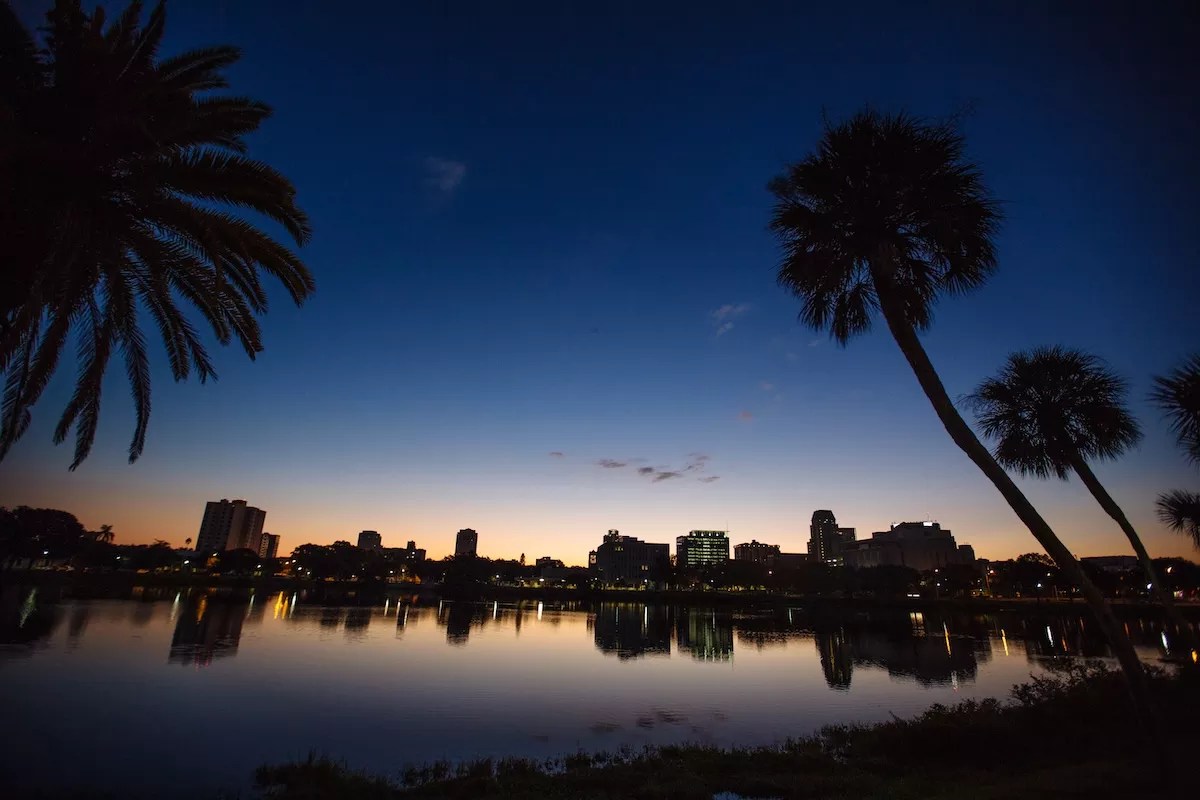
It’s a cool spring morning in St. Petersburg, and I’m up to my chest-wadered knees in the cola-colored waters of Mirror Lake. Behind me, I can feel the sun lifting over the city skyline, weaving through an eclectic mixture of historic buildings, modern high-rises, and cranes-building-more-high rises to cast its welcome warmth on my back. In front of me lies a three-foot patch of scraped earth, where I’ve been shoveling and raking away the tough roots of St. Augustine grass that once grew right up to the water’s edge, preparing the ground for pollinator-friendly native plants. All around me a large band of volunteers pulls roots, drops Black and Mild tops into garbage bags with mechanical claws, and patrols the shoreline in canoes to snatch stray plastic bags and snack wrappers out of the bullrushes that fringe the lake. We are a stalwart troop of eco-warriors, battling what Jim Bays, President of Stewards of our Urban Lakes (SoUL) refers to as “the continuing inflow of new debris”—a whole lot of litter—and “the invasion of aquatic emergent plants.” Weeds.
As we do, we’re trudging and squelching through hallowed ground. Pausing to catch my breath, I glance across the parkway that runs along the lake’s edge and spot the pebbly gray facade of the Tomlinson building, dedicated in 1924 as St. Petersburg Junior High School (funded by Edwin High Tomlinson, the same city booster that developed St. Pete’s bygone Fountain of Youth attraction). After years of serving as a vocational training center, the old landmark is now being redeveloped as affordable housing for Pinellas County’s educators. Along the same winding road lies a cavalcade of St. Pete’s centenarian structures: a 1915 Carnegie Library, the 1920 founding site of St. Petersburg High School (now also converted to apartments), St. Pete’s iconic 1924 Shuffleboard Club, and even its 1937 City Hall. It’s no wonder—especially with new developments like the 18-story Reflection condo tower shouldering in nearby—that the city chose to declare Mirror Lake its newest historic district last December.
But notably absent from the line-up of Mirror Lakes’ historic structures is the city’s first waterworks. A water tower and pumphose were constructed on the lake’s southeastern shore in 1899, the same year the city passed an ordinance forbidding cows to graze freely along its newly paved Central Avenue. While the site has given way to many other worthy edifices—including the Bernie McCabe Second District Court of Appeal Courthouse currently under construction—the absence of the waterworks makes it easy to forget a very salient fact: Mirror Lake was the city’s first municipal water supply.
A shriek snaps me out of my reverie. A runaway beach wagon filled with pulled weeds and gardening equipment barrels down the sloping grass, heading for a gaggle of screaming teens at the waterline. A gallant young man swoops in to intercept, his long dreads swinging behind him. “Just doing my part,” he says, flashing a winning smile as he pulls the offending cart up the hill.
Teen hijinks are nothing new here. Early photographs of Mirror Lake (then called Weir Lake) date from the 1870s, when H. A. Weir acquired 40 acres along its shore. They show a broad, shallow waterway bordered by tall pines and a troop of teens and tweens in long flannel swimsuits lined up on a rustic dock, ready to take a plunge (alligators be damned!). The lake appears again on the 1888 plat of the City, but this time with a new name: Reservoir Lake. At this point, St. Petersburgers were still gathering their water from wells and cisterns, but it was clear that the city’s developers had an important supporting role in mind for the erstwhile swimming hole.
It would be the War Department, rather than the City, that would first tap the Reservoir: in 1898, in the midst of the Spanish-American war, the city permitted the federal government to pipe Mirror Lake’s flow down to its Railroad Pier for transport to serve troops in Tampa, where water supplies were brackish and unpalatable. The following year, the city switched on its first municipal supply, serving hotels and businesses along Central Avenue and First Avenue North. Only six years later, Reservoir Lake’s supply began to run short. The city was forced to look elsewhere, drilling deep wells around the lake—and later, around nearby Crescent Lake—to keep the waterworks humming and the tap water flowing.
Reservoir Lake then began its shift away from its role as water resource and entered a more genteel phase of its existence: a central city park. The marshes along its edge were dredged to give the lake a more uniform shape; the roadway around it paved and trimmed with elegant gas street lights; the ubiquitous St. Augustine grass planted in a green swathe around its shore. By 1915, the St. Petersburg Daily Times felt compelled to explain to the growing number of tourists in St. Pete that “there is no longer any connection” between Reservoir lake at the city’s water supply. This transformation was soon made official by the city park board’s decision—spurred on by pioneer conservationist and St. Pete Audubon founder Katherine Bell Tippets—to change the waterway’s name again, this time to something a little more (if you’ll pardon the pun) polished: Mirror Lake.
Today, nobody would dream of drinking Mirror Lake’s waters.
Like most urban lakes, its serene beauty masks a less visible function as a sink for all kinds of pollutants, byproducts of the city’s development. Decades of trash washed into the lake have sunk to the bottom. At the same time, fertilizers, animal wastes, petrochemicals, and even human waste—the area is home to a significant population of unhoused folks who lack good bathroom options a lot of the time—have drained into the lake as runoff.
Together, all these elements have contaminated the lake’s sediment, forming a muddy archive of the city’s history and development (and, of course, sending excess nutrients downstream to the bay). By the eco-conscious 1970s, piled-up litter and repeated fish kills led one concerned neighbor to post a sign in the park reading: “In memory of Mirror Lake. Not Gone, but going. Rest in peace.”
Reports of the lake’s demise were somewhat exaggerated. It survived well into the 1990s, when the city began to treat it with an alum injection system, which adds aluminum sulfate salt to incoming stormwater. The alum combines with heavy metals and phosphates in the water to form heavy “floc” molecules which sink to the bottom, keeping the water above relatively clean. Bays notes that, despite the litter, Mirror Lake is, water quality-wise, one of the cleanest urban lakes in St. Petersburg.
Still, I’m not exactly reaching for my eco-friendly metal straw.
But I am thirsty. So I perch on a low wall above the embankment to take a water break. Before long, an older man in a broad straw hat approaches, takes a seat nearby. I’d noticed him circling the lake earlier, chatting with some of the other volunteers. From the confident way he’d smiled and gestured out over the lake, I’d assumed he was one of the team leaders. Up close, that same grin reveals damaged teeth, some missing altogether; his eyes have a friendly sparkle, but one is clouded over, like a cataract. His broad hat and clothes are threadbare and pungent. We chat a little about the weather, about the new plantings that will come in around the lake, before the conversation drifts to his church, which he kindly and repeatedly invites me to join. I thank him, explaining that I’m already spiritually affiliated. As I return to my shoveling and raking, I wonder if, perhaps, he lives out here by the lake.
By 1930, St. Pete’s thirst had outstripped local waterways’ ability to supply it. So the city, together with the newly formed Pinellas Water Company, invested in a new supply system that could pump up to 14 million gallons of ground water per day from the Cosme well field (located northwest Hillsborough County). The new system required 26 miles of 36-inch pipe, a portion of it sunk into the bottom of Old Tampa Bay, to deliver water to a newly constructed pumping station in the north St. Pete neighborhood of Washington Terrace. This massive undertaking—heralded by the St. Petersburg Times as “the very latest development in hydraulic engineering”—was celebrated with an elaborate Soft Water Carnival attended by 10,000 thirsty citizens, featuring a barbecue in Williams Park, a formal ball at the Coliseum, an old-timey nail-driving contest, and a “water carnival” of 100 gushing sprinklers for the city’s children.
It’s hard to imagine anyone getting that excited about drinking water now.
And ironically, this colossal infrastructural achievement, which brought high quality water to taps, tubs, and toilets throughout the city at the turn of a handle (almost as easily as simply wishing for it!) may be part of the reason why. After 95 years of conjuring plentiful potable water from wellfields most of us have never seen and couldn’t locate without Google Maps, it might be fair to say we’ve lost our appreciation for the everyday miracle of having enough—really, more than enough—water.
 Mirror Lake in St. Petersburg, Florida. Credit: Photo via Felix Mizioznikov/Shutterstock In her book “Blue Revolution: Unmaking America’s Water Crisis,” renowned Florida journalist Cynthia Barnett explores both the origins and the consequences of this curious condition of having all the water we want, whenever we want it. For too long, she argues, water has been treated as a commodity—and a very cheap one, at that—rather than the critical ecological actor that it is. “Big pipe” projects that characterize 20th century water development have focused on moving and treating the millions of gallons per day that cities require. But they’ve also shifted our collective focus toward meeting an ever-increasing demand, rather than considering its environmental consequences. Barnett writes: “The old path—finding a pristine new source of water, conveying it with pumps, using it once, cleaning it up, then flushing it away—has led us to insufficient water supplies, unsustainable consumption of energy to move water around and chemicals to treat it, dispersion of nutrients, particularly phosphorous, into our waters, and financially unstable utilities.”
St. Petersburg’s own water history bears out this idea. By the mid-1990s, the Sunshine City’s water needs, coupled with those of surrounding cities and counties, had grown to an insupportable demand on the region’s groundwater. Decades of population growth, drought, and over-permitting pulled water out of the aquifer faster than seasonal rains could recharge it, and lakes and wetlands were beginning to dry up. Tampa Bay municipalities and counties traded lawsuits in what would become known as the region’s “water wars,” leading to the foundation of Tampa Bay Water. This utility currently supplies Hillsborough, Pasco, and Pinellas counties along with St. Petersburg, New Port Richey, and Tampa with a mixture of groundwater, river water, and desalinated seawater. Our “big straw” is really more of a carefully operated skill crane, balancing the pressures of demand against drought, water quality, and the energy cost of preparing and moving water. It’s a calculation very few of us are privy to, and yet one on which everyday life depends.
Standing knee-deep in St. Pete’s first official reservoir, watching my fellow volunteers swig ice-cold water from Nalgenes, Hydro Flasks, and other highly specialized and expensive water drinking equipment, I’m struck by the irony of cleaning up a polluted lake in a city where good drinking water is so cheap it’s practically free. In a neighborhood where luxury high rises overshadow homeless shelters, a historic district where unsheltered residents seek shade and cooling by the edge of a once celebrated lake. In a state, no less, where it is not really legal to live outside if you have no other options. But it is definitely legal for Nestle to siphon off millions of gallons of water from our aquifer to sell for $2 a bottle.
There’s something in all of this that doesn’t quite add up, something important that’s been forgotten. Here in Florida, we may build our lifestyle and our identity around the water, but we’ve long since ceased to recognize that water is life.
Maybe that’s what brought me out here today, pushed me to wiggle into these sweaty frog pants to pull weeds for two hours. Maybe that’s what drives some of us to harvest rain in barrels, or shelve our fertilizers for the rainy summer months—or even rip out our lawns entirely to replace with native plants or xeriscape. Maybe that’s what motivates folks to actually read those periodic water quality reports that come to our mailboxes, or to spend hours studying the former courses of urban waterways on old maps. It’s a longing to recognize, to respect the water that flows through our city and gives life to our bay. To somehow just do our part.
Maybe. As I pile up my tools and peel the sodden work gloves from my hands, I take in the glassy sweep of the lake, the green shade of trees along the shoreline, the glittering skyline beyond. I wonder what picture these waters will reflect in the next 50 years.
Readers and community members are always welcome to send letters to the editors Please let us know if we may consider your submission for publication.
Subscribe to Creative Loafing newsletters.
Follow us: Google News | NewsBreak | Reddit | Instagram | Facebook | BlueSky
This article appears in Aug 7-13, 2025.
Related