
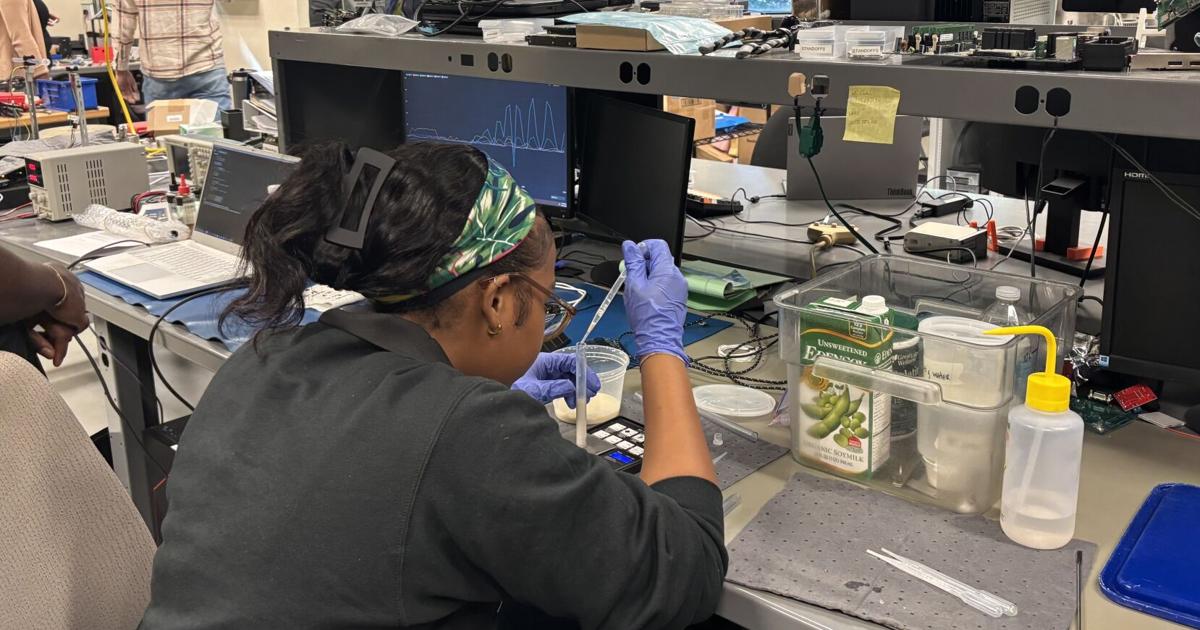

Jaida Smith, junior hospitality management major, works on the proportions to make tofu at UCF’s Space Institute on Oct. 31.
Aryah Britt
A group of students at the Rosen College of Hospitality Management is using tofu to shape how astronauts and eventual space tourists eat beyond Earth.
As part of UCF’s Student Spaceflights Experiment Program, which began in September, six students are collecting data to send their tofu experiment into space on a SpaceX rocket to the International Space Station in the summer of 2026.
The students use a vibration simulator to mimic the vibrations and conditions of a rocket launch to study how tofu made from soy milk, gelatin and nigari reacts to microgravity.
The goal is to discover whether it can be created and sustained in space, a major step toward building sustainable food systems for future space missions.
As space exploration organizations continue to explore life beyond Earth, UCF is preparing its students for the future of space innovation. One day, students will work for NASA and other space agencies.
“The purpose is to make sure students have the capabilities to contribute to the future of space exploration,” said Dr. Amy Gregory, program founder and interim chair of the Department of Foodservice and Lodging Management.
According to NASA’s website, NASA recently finalized its Low Earth Orbit Strategy, outlining 13 goals and 44 objectives across seven key areas, including commercial infrastructure, STEM engagement and scientific research.
With the International Space Station scheduled to retire as early as 2030, NASA plans to maintain a continuous human presence in orbit, relying on commercial space stations such as Blue Origin’s Orbital Reef, which received $130 million in funding through NASA’s Commercial Low-Earth Orbit Development program in 2021, according to Space.com.
At UCF, those global plans meet students’ curiosity and drive to explore. UCF currently leads more than 40 NASA-affiliated projects totaling more than $67 million in funding, advancing innovations across engineering, medicine and hospitality, according to UCF Hospitality.
“We are the only school working in food-related projects,” said Dr. Cesar Rivera-Crozado, director of food and beverage operations at Rosen College.
Producing and serving food in orbit is a unique challenge. Rivera-Crozado explained how, without gravity, ingredients can float, crumble or fail to mix properly, such as bread or tortillas.
The students’ tofu experiment focuses on how protein curds form under extreme conditions.
“We are really conducting a shake task to see how the shaking from the launch would affect the tofu during delaunch,” said Jaida Smith, a junior hospitality management major and member of the space experiment program.
Rivera-Crozado explained that, because tofu is high in protein and made from minimal ingredients like soy milk and a coagulant called nigari and gelatin, it becomes an ideal candidate for space preparation.
Tofu is a rich source of plant-based protein, iron, calcium and essential amino acids, while being low in calories and cholesterol-free. Its nutritional value makes it not only a sustainable food choice on Earth but also a promising source of nutrients for long-term space exploration.
“Food isn’t just about eating; there’s a comfort factor,” Gregory said. “So, we could actually deliver high-nutrient meals in something that’s more satisfying to eat than something that’s drying out.”
This experiment depends on figuring out what measurements will work together to make tofu in space.
“It is all about space tofu,” said Micah Pratt, a sophomore hospitality management major and member of the student space experiment program. “Finding out how it reacts in microgravity and seeing if it will be able to coagulate basically form into curds, and if it’s able to coagulate between the natural stable-based soy and the nigari.”
In order to coagulate, the measurements have to be accurate, driving Pratt to have a lot of questions about whether to follow the instructions based on how to make it is made on Earth.
Pratt explained that, for here on Earth, the instructions for Nigari included one tablespoon for every four cups of soy milk. Although the measurement could be different in space where there is no gravity and only microgravity, this has led Pratt to experiment with a variety of measurements.
“Should we increase the amount of the nigari in order to mix with the soy milk so that we actually see the results?” Pratt said. “But at the end of the day, we don’t know how things actually work up in space, but we know how to work on Earth.”
Questioning everything is how development happens, and the students have an opportunity to further improve food in space.
Smith said being able to experience and learn something as big as this gave her a new perspective on how her field connects with space science.
Graduate student Mary Cortes, who focuses on management and helps Gregory oversee the experiments, said she feels the same.
“It is a huge honor to be a part of this. I am beyond thrilled to see what the future of space exploration holds, especially within the hospitality field,” Cortes said.
Students taking part in experiments gain a new understanding of how to develop food systems for space.
Gregory said the student-driven aspect of the tofu project represents the kind of curiosity that propels innovation.
“When you have students doing it, there’s almost this innocence and lack of knowledge that’s very refreshing, like little kids asking why and how or what if,” Gregory said. “That curiosity is what drives discovery.”