
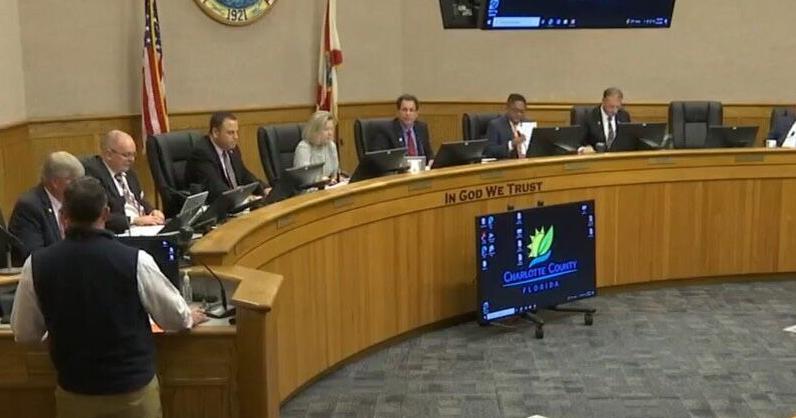
Charlotte County commissioners agreed on a direction for the future of Englewood Beach and the adjoining Chadwick Park, instructing Community Services Director Tommy Scott to proceed with design and permitting for a plan that will reshape the storm-damaged shoreline amenities.
Scott presented the Board of County Commissioners with five options to replace pavilions, boardwalks, restrooms and showers that were damaged or destroyed by hurricanes Ian, Adalia, Helene and Milton. After initially leaning toward a lower-cost option, commissioners ultimately supported a midrange design recommended by Giffels-Webster Engineers. The plan reduces the overall length of boardwalks while still offering elevated sunset views, one of the park’s signature features.
At first, commissioners appeared ready to approve Alternative 4, which would have eliminated boardwalk sections entirely and relied solely on walkovers for beach access. Its price —$924,000 — was significantly lower than the $1.5 million Alternative 3 recommended by the engineering firm.
But board members hesitated in the moments before the vote. Commission Chair Joe Tiseo said removing boardwalks would deprive residents and visitors of the sweeping waterfront views they have enjoyed without having to walk onto the sand.
Although the main pavilion and restroom area under any plan would include an elevated space, removing the linear boardwalks would eliminate the ability to stroll along the shoreline, Tiseo said. He also cautioned that choosing the cheaper option could backfire if the county later discovered that Federal Emergency Management Agency reimbursement would have covered the higher-cost project.
Commissioners might regret that they saved nearly $600,000, only to learn later that FEMA reimbursement would have paid for the higher-priced project, Tiseo said.
Commissioner Ken Doherty, who is an engineer, recommended allowing Scott to move ahead with the design and permitting phase for Alternative 3, giving the county more time to receive updated construction estimates and clarity on FEMA’s obligations. At that point, he said, commissioners could make adjustments if needed.
If Alternative 3 moves forward as designed, the northernmost and southernmost sections of the existing boardwalk would be removed. The remaining boardwalks would connect the central walkovers to the middle pavilion and restroom facility. The design calls for raising the elevation by 1 to 4 feet and adding an ADA-compliant ramp at the restroom building.

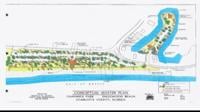
A conceptual master plan shows existing and proposed amenities at Englewood Beach and Chadwick Park. Charlotte County commissioners endorsed a midrange redesign that reduces boardwalk length while preserving key features.
Charlotte County government
Pros of the plan, Scott said, include enhanced ADA access, improved storm resilience compared with a full boardwalk system and preservation of key user amenities. The drawbacks include the loss of some boardwalk segments and continued vulnerability during major storms.
Englewood Beach did not have modern amenities until 2001, when Charlotte County secured funding to build a restroom facility, boardwalk, overlook pavilions, picnic shelters and related structures. Commissioner Bill Truex recalled visiting the beach in 1977, when one would walk directly onto the beach. The 2001 upgrades marked the first significant investment in formal infrastructure.
Among the five options presented was Alternative 5, which proposed eliminating pavilions entirely while adding ADA ramps. But Scott said securing a Coastal Construction Control Line permit would be difficult. Without permanent structures, shifting sand could accumulate and block ADA access, he said. At $172,000, it was the least expensive option.
Commissioner Chris Constance noted that Boca Grande Beach does not have a boardwalk and argued that repeated hurricane cycles could wipe out infrastructure regardless of the design. In two to five years, if the county has another hurricane event, “we’re starting from square one,” he said, explaining his initial support for Alternative 4.
Despite differing views, commissioners agreed to proceed with the engineering firm’s recommended plan. Giffels-Webster rated each of the five alternatives using criteria, including storm resiliency, FEMA compliance, environmental protection, public use and safety, ADA access and cost-effectiveness.
The most expensive proposal — Alternative 2 — would reconstruct the former beach park structures at a higher elevation for $2.151 million. Alternative 1, which would restore the original layout and footprint, was estimated at $2 million and ranked as the most vulnerable to storm damage.
By advancing Alternative 3 into the design and permitting phase, commissioners signaled their support for a balanced approach, one that retains much-loved features while aiming for greater resilience along one of Charlotte County’s most visited beachfronts.