
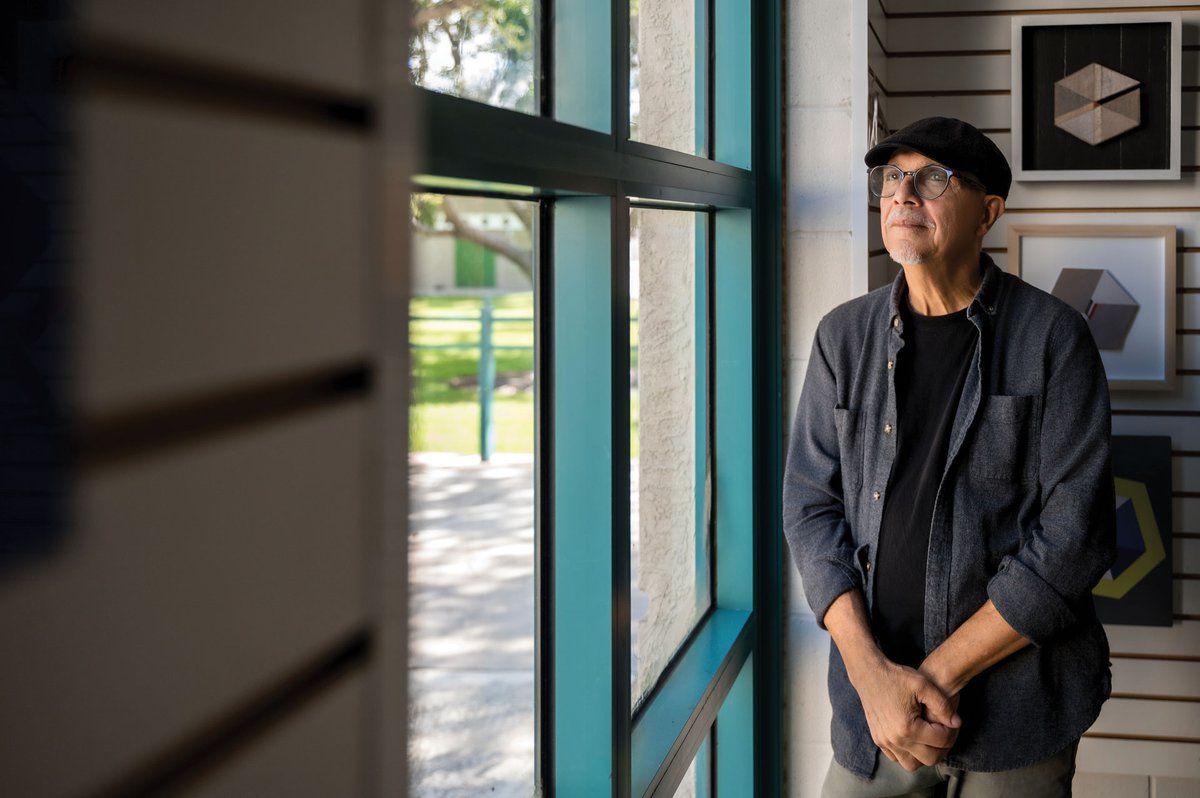
Orlando Acosta is a master of limitation. The entirety of his abstract oeuvre centers on a single subject: the cube. Working digitally on his laptop at a temporary workshop at Naples Art Institute, he designs geometric compositions that he prints onto aluminum and acrylic panels. He starts with the cube’s strict geometry, then pushes its edges, angles and proportions off balance. Stretching one line or tilting a plane shifts the perspective, so the shape still reads as three-dimensional even as it warps. The resulting abstractions seem to project from the wall, sometimes through illusion, sometimes through actual depth.
After traveling through Southern Florida for exhibitions, Orlando made Naples his home in 2021. Here, he once again found inspiration through limitation. When he left his home in Venezuela, he left his studio behind. Resources were limited in his new hometown, so he picked up work as a house painter and found ways to adapt his creative practice at home. To satisfy his persistent desire to create art, he purchased a laptop and started working digitally. This opened a new avenue: dye-sublimation printing, which uses heat to transfer designs onto aluminum and acrylic panels. The process yields crisp, permanent surfaces that echo the clean precision of contemporary architecture.
If you spent any time at Naples Art Institute over the past few months, you’ve likely seen Orlando’s work. Over the summer, he completed a small residency at the center; his works, printed on acrylic and aluminum panels, ranging from postcard to poster size, are sold in the gift shop. Most recently, he was featured in the center’s biannual juried showcase, displaying Ambiguity – Look carefully and tell me? (2025) at the Naples Invitational.
Ambiguity encapsulates the artist’s curiosity. Black and gray shapes printed on the flat, 2-foot-tall hexagonal panel create the illusion of a three-dimensional cube. A thin fuchsia line mimics the shadow cast by the cube’s primary planes, while the panel’s own shadow on the wall blurs the line between what’s there—and what’s not. For Orlando, the cube presents a vessel for infinite possibility, a form that can be endlessly constructed and deconstructed without losing its essential nature. By restricting himself to this single geometric subject, he finds an endlessly iterable field of study. “The more limits I place on the work, the more interest it sparks in me,” he says.
Born in Venezuela in 1954, Orlando entered the world during an era of artistic flux for his South American nation. By the time he came of age, geometric abstractionist and kinetic art pioneer Jesús Rafael Soto had become the country’s leading artistic voice, transforming a landscape once steeped in tradition into a hotbed for modern experimentation. The movement reshaped how young artists were taught. At the Rafael Monasterios School of Visual Art in Maracay, professors introduced Orlando to contemporary ideas that set him on his path to abstraction.
Unlike some of his classmates, who went straight into exhibitions, Orlando took a circuitous path. He spent the 1970s in design and illustration, working on a children’s literature initiative for the country’s education ministry and other governmental bodies and later apprenticing with Italian-Brazilian illustrator Gian Calvi. These projects revealed his other side—a storyteller’s imagination.
For years, he balanced his illustrative and graphic practices, teaching, taking on ad campaigns and nudging clients toward abstraction. Eventually, he launched his own studio, where he learned to think in systems: how color weights a composition, how a line divides space, how symmetry can suggest calm or tension. By 2005, those principles had distilled into a single form: the cube.
His art remained private for a decade until a visiting artist friend saw the models on his wall and urged him to show them. In 2017, Acosta was named a finalist in the Origins in Geometry Biennial, a collective exhibition at the Museum of Geometric and MADI Art in Dallas, Texas. And the following year, his works were exhibited at Art Palm Beach 2018.
Materiality still drives his approach. Before moving to the U.S., Orlando’s process was more physical. In Venezuela, he built forms from acrylic, cutting and gluing them into origami-like cubes that cast physical shadows. Those early experiments in structure laid the groundwork for his current geometric abstractions.
Materiality is central to his work. Rather than working with traditional canvas, he looks to contemporary industrial substances: aluminum, acrylic. This intentional approach roots his art in the built environment, connecting to the glass towers and metal facades of modern architecture.
Though his practice spans decades, Orlando resists the posture of mastery. He approaches each work like a student—curious, methodical, always learning. Frank Verpoorten, executive director and chief curator at Naples Art Institute, speaks of Orlando as an artist and scholar, someone whose knowledge of art history informs his contemporary practice. This juxtaposition of whimsy and practicality presents a more nuanced perspective on the artist’s overall work and career. “With my illustrations, I seek to communicate,” he says. “With my abstract artwork, I seek to resolve visual problems; it’s something more personal.”