
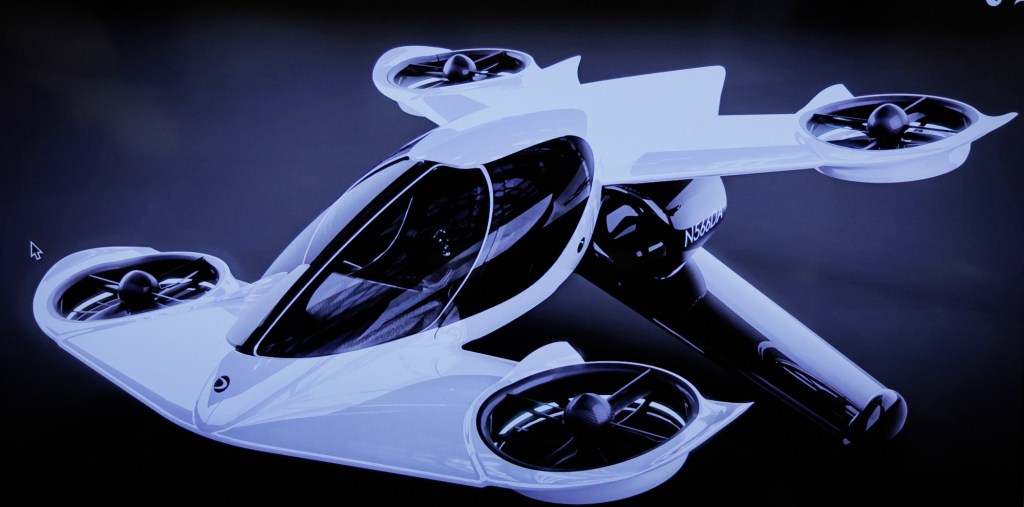
By the end of 2026, Interstate-4 could resemble a scene out of Back to the Future as flying cars make their way from Orlando to Tampa, the Florida Department of Transportation predicted Thursday.
“Advanced air mobility is now officially a mode of transportation in the state of Florida, and we are essentially in the age of flying cars,” FDOT Secretary Jared Perdue said. “This is the age of the Jetsons.”
At the Florida Automated Vehicle Summit at the Omni Resort in ChampionsGate, FDOT laid out its plans to be the first in the nation to make “eVTOL” or electric vertical take-off and landing vehicles, a viable option for commercial travel.
The announcement comes at an earlier date than previously thought. In February, The Greater Orlando Aviation Authority took initial steps toward seeking partners to develop eVTOL landing pads, or vertiports, at the airport with a 2028 target for the finished product.
But construction on FDOT’s first vertiport just off I-4 in Polk County finished Wednesday, said Will Watts, FDOT chief operating officer at the summit.
The SunTrax campus in Auburndale, the state agency’s dedicated research headquarters for air and ground transportation, will be the testing site for flying car technology, with future expansions already in the works.
The facility is the first in the nation dedicated to researching and developing both road and air transportation technology, Watts said. A second vertiport to establish an aerial test track within the campus is beginning construction this week, Watts said.
“We’re working to establish the first aerial highway network in the U.S. that connects metro areas throughout the state,” Watts said. “The first corridor will be I-4 to connect Tampa to Orlando.”
Watts said FDOT’s main focus will be on intercity travel, with support from the state helping expedite the process. In June, Gov. Ron DeSantis signed SB 1662, which establishes FDOT’s plans for advanced air mobility and flying cars and paves the way for funding the construction of vertiports.
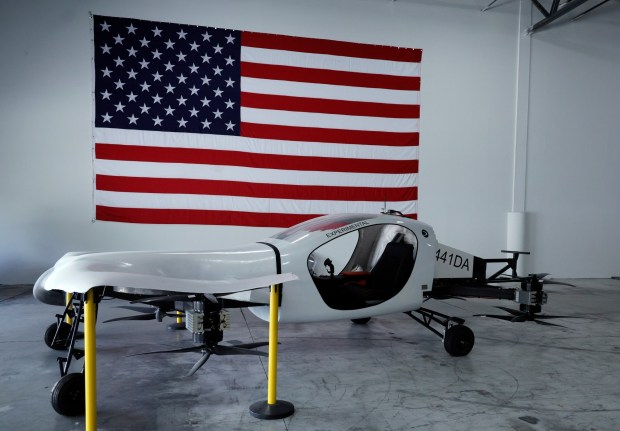 The Doroni H1-X flying car prototype is seen Sunday, May 5, 2024, in Pompano Beach. (Joe Cavaretta/South Florida Sun Sentinel)
FDOT forecasts between 220,000 and 1.4 million trips during the first year of flying cars, Watts said. That figure is expected to grow to between 11.2 million and 18.7 million trips by 2050, he said.
Former state Sen. Jeff Brandes, who created the Automated Vehicle Summit, said the technology for flying cars already exists. The only thing holding it back now is the amount of power needed to charge the vehicles and making their ranges longer.
“Imagine … I’ve got to put a ton of energy on and take a ton of heat off of the aircraft very quickly, and especially if I’m at an airport where five of them are all landing and charging at the same time,” Brandes said. “I’m using enough energy to power the Empire State Building in a very short period of time to get this power.”
The cost for passengers and where to land is still being worked out along with other logistics, Brandes said. But charging them and the energy needed for charging is still the biggest hurdle.
“They want to try to get it competitive with Uber pricing,” Brandes said. “So we’ll see if they’re able to do that, but electric vehicles should be cheaper.”
But Florida is uniquely qualified for the success of flying cars, he added. Legislation such as SB 1662, a large population and good weather make it the perfect breeding ground for the start of flying cars in the country, he said.
“It’s doesn’t snow here,” Brandes said. “We don’t get icing, so it’s not going to be a major issue in Florida for these altitudes.”
Despite being a new way to travel, it likely won’t decrease old-fashioned ground congestion on I-4, Brandes said. Each eVTOL vehicle can only carry between six and eight passengers. Autonomous vehicles will play a much larger role in reducing traffic, he said.
“There will be less accidents with automated vehicles, and accidents are the major contributor to the delays we all face,” Brandes said. “I think the simple truth is these technologies … coupled together, help make it better.”