
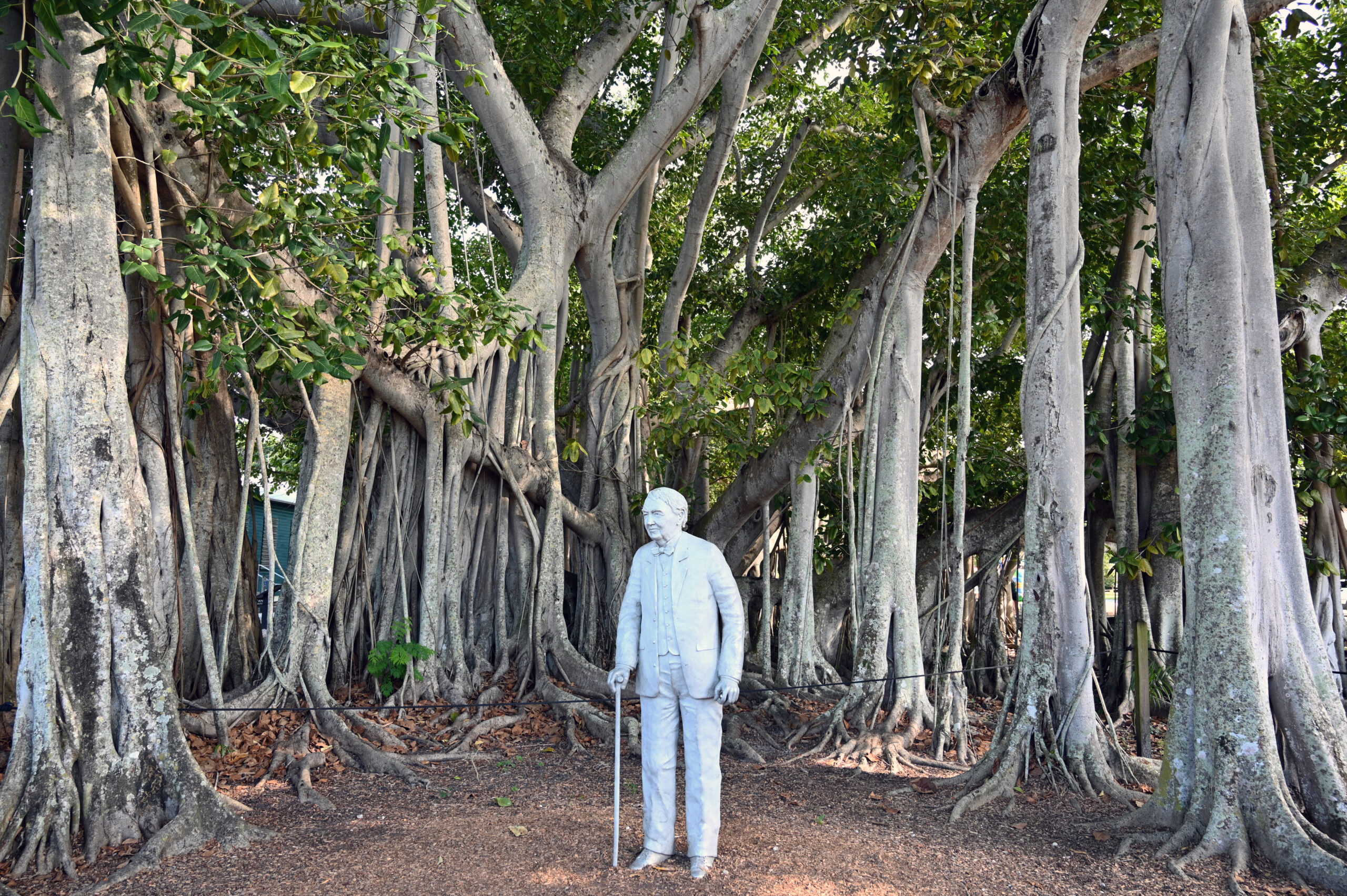
An upright statue of Thomas Edison stands before the nation’s largest banyan tree. This tree, planted in 1925, now encompasses nearly one complete acre. -CASEY BRADLEY GENT / FLORIDA WEEKLY
Entering the Edison Ford neighborhood within historic Old Fort Myers is like passing from everyday life, through the wardrobe in C.S. Lewis’ beloved “The Lion, the Witch and the Wardrobe,” into the magical land of Narnia. Edison Ford Park is the second-oldest subdivision in Fort Myers, located south of downtown along the east side of McGregor Boulevard. In April of 2026, Edison Park will celebrate its 100th Anniversary. Reminiscent of Lewis’ mythical Narnia, the Edison Ford neighborhood sits bathed in soft speckled sunlight from early morning to late evening. Along the winding paths and curving roadways, shade flourishes. Florida’s hot sun is tempered here by massive overhanging branches and shade. Like nearly every part of this storybook neighborhood, even the winding, meandering roadways are intentional.
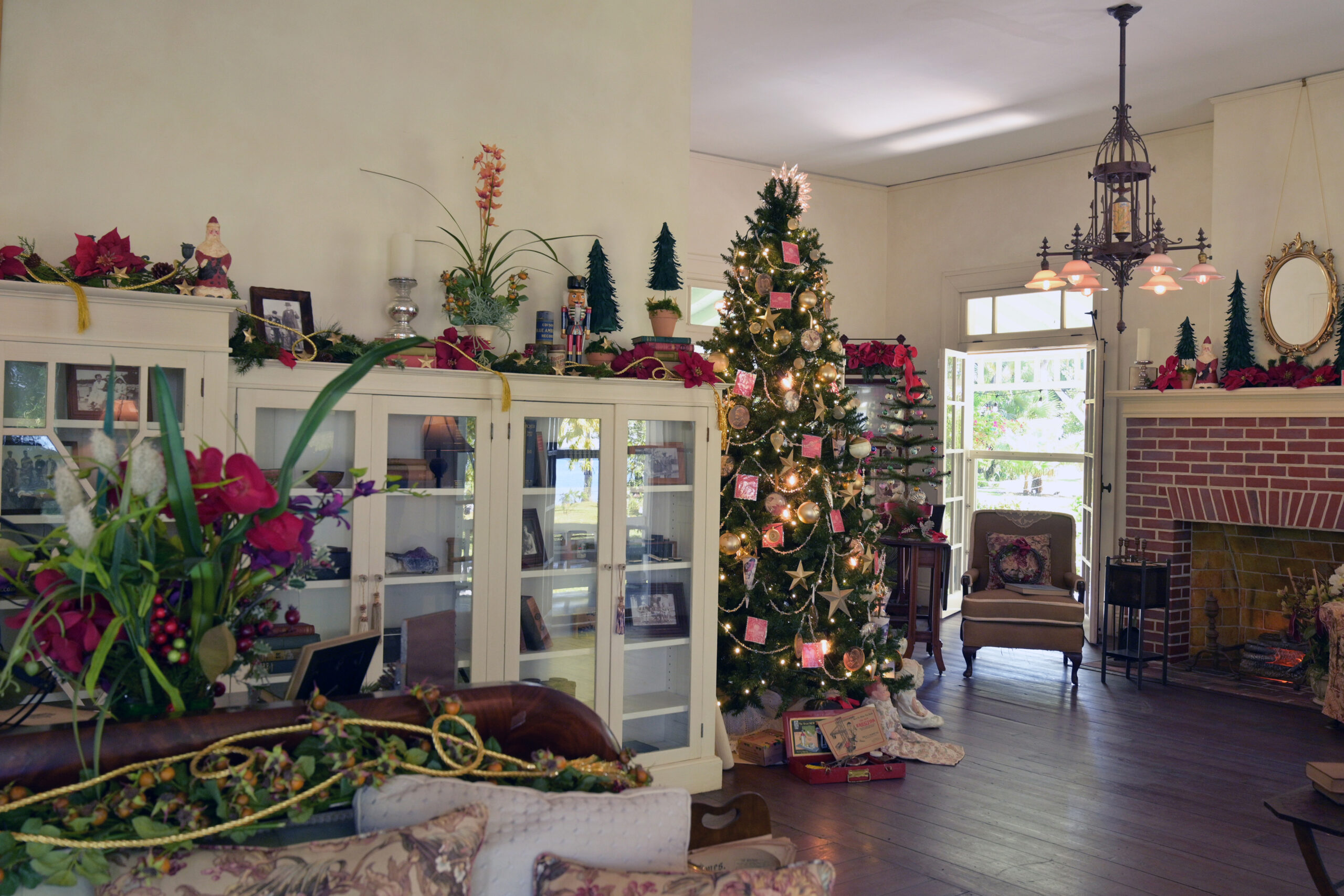
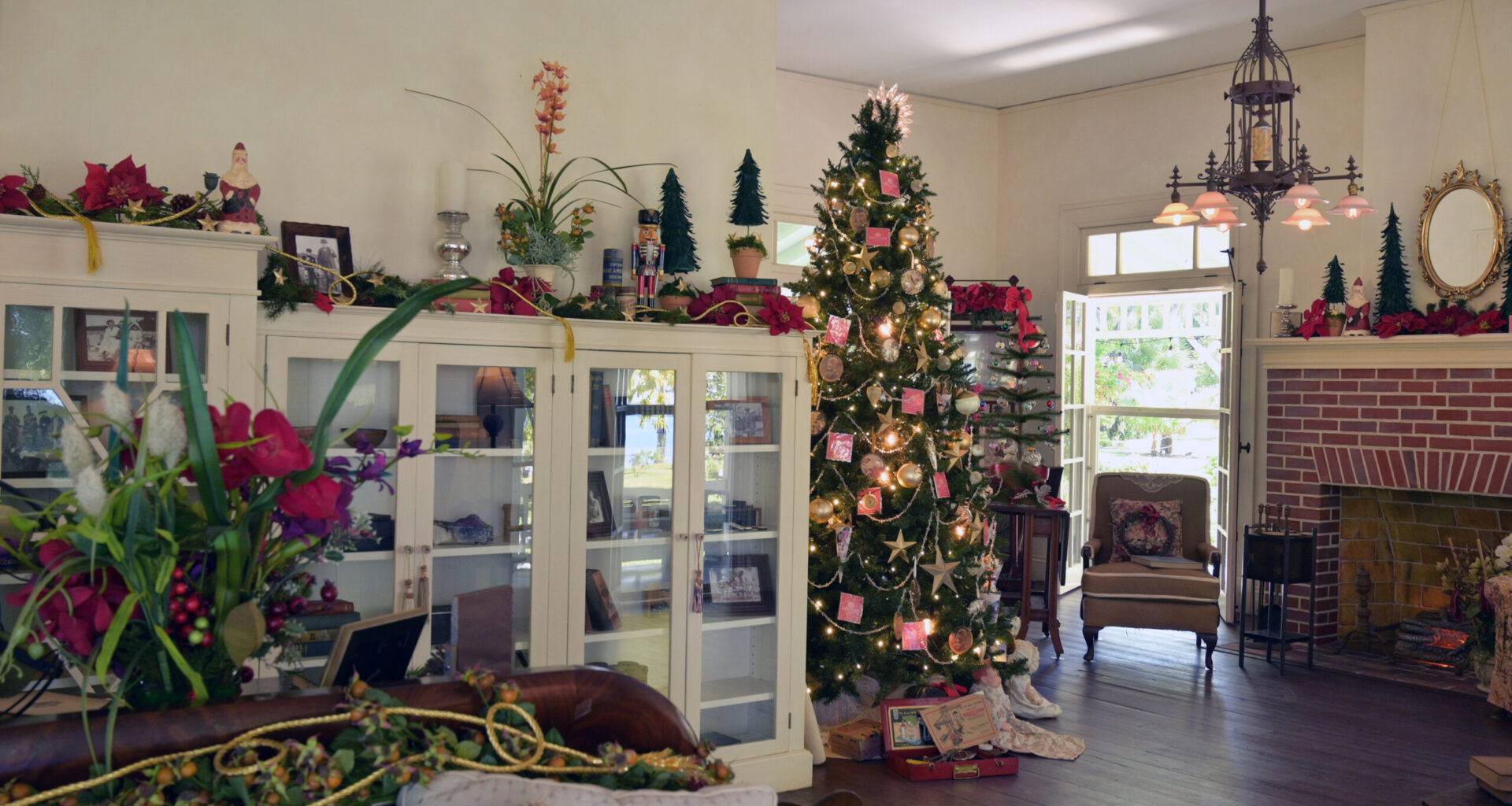
Inside of the twin houses on the Edison and Ford Winter Estates, Christmas decor has arrived a bit early. -CASEY BRADLEY GENT / FLORIDA WEEKLY
Cheri O’Mailia has lived in Edison Park for nearly three decades. One of her neighbors, who preferred not to be named, fondly referred to O’Mailia as a human time capsule. Inside her home, which was completed in 1940, the walls are adorned with historic photographs and pictures. And the walls displaying those artifacts? They are rock solid, quite literally formed from wire lathe and covered in concrete.
“When there’s a hurricane, people come to this house,” O’Mailia shared proudly, “The thick cement walls are sturdy and even cool to the touch.” Hardy construction was central to the first Edison Park homes, with the oldest ones in the neighborhood being built around 1926.
“Wheeler Brothers Construction built these first homes,” O’Mailia said. “The contractors would sometimes throw a coin inside the walls before sealing them up. Years ago, when I was having a renovation done on my house, we opened up a wall and out popped a 1938 quarter!”
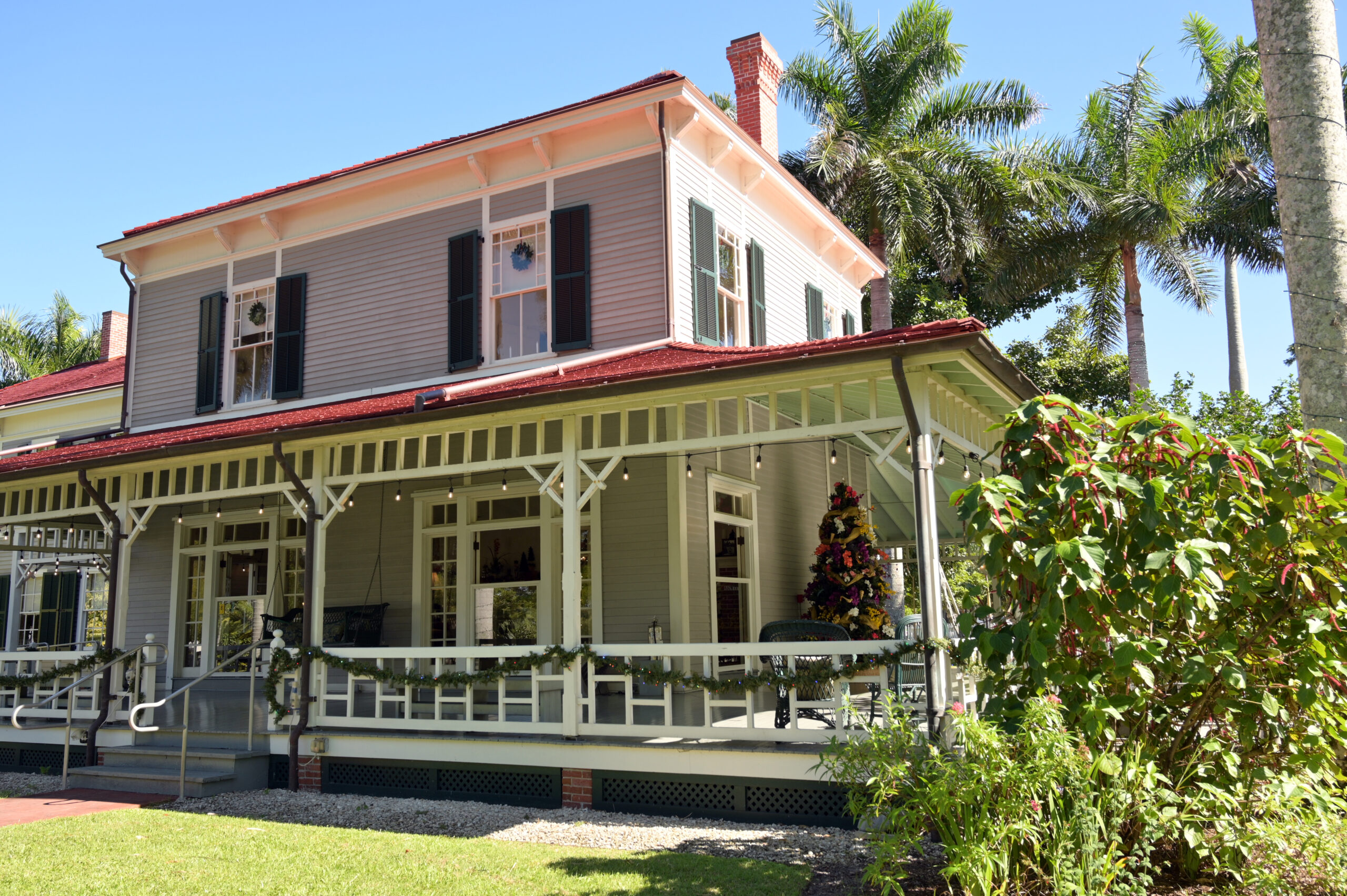
Pictured is the backside of the Edison and Ford Winter Estates. This view faces the roadway, while the front of the home overlooks the water. -CASEY BRADLEY GENT / FLORIDA WEEKLY
O’Mailia says she relishes the rich history of living within walking distance of the Edison Ford Winter Homes, which are adjacent to Edison Park and exist today as a non-profit where visitors may pay a fee to walk the grounds and view the historic structures. Prather’s Laundry and Dry Cleaning was one of the neighborhood’s original businesses, and O’Mailia proudly displays a Prather’s Laundry clothes hanger on a hook above her own washing machine.
She confided, “People give me relics from the neighborhood, because they know I’ll hold onto them. I love everything about living here. We are surrounded by schools; it is very safe, and you can just get lost in here, winding around the roads.” From the historic Prather’s hanger to an original road sign and old kitchen tile, O’Mailia’s collection of stuff is a time capsule of Edison Park in the same way her brain is a time capsule of the area’s stories.
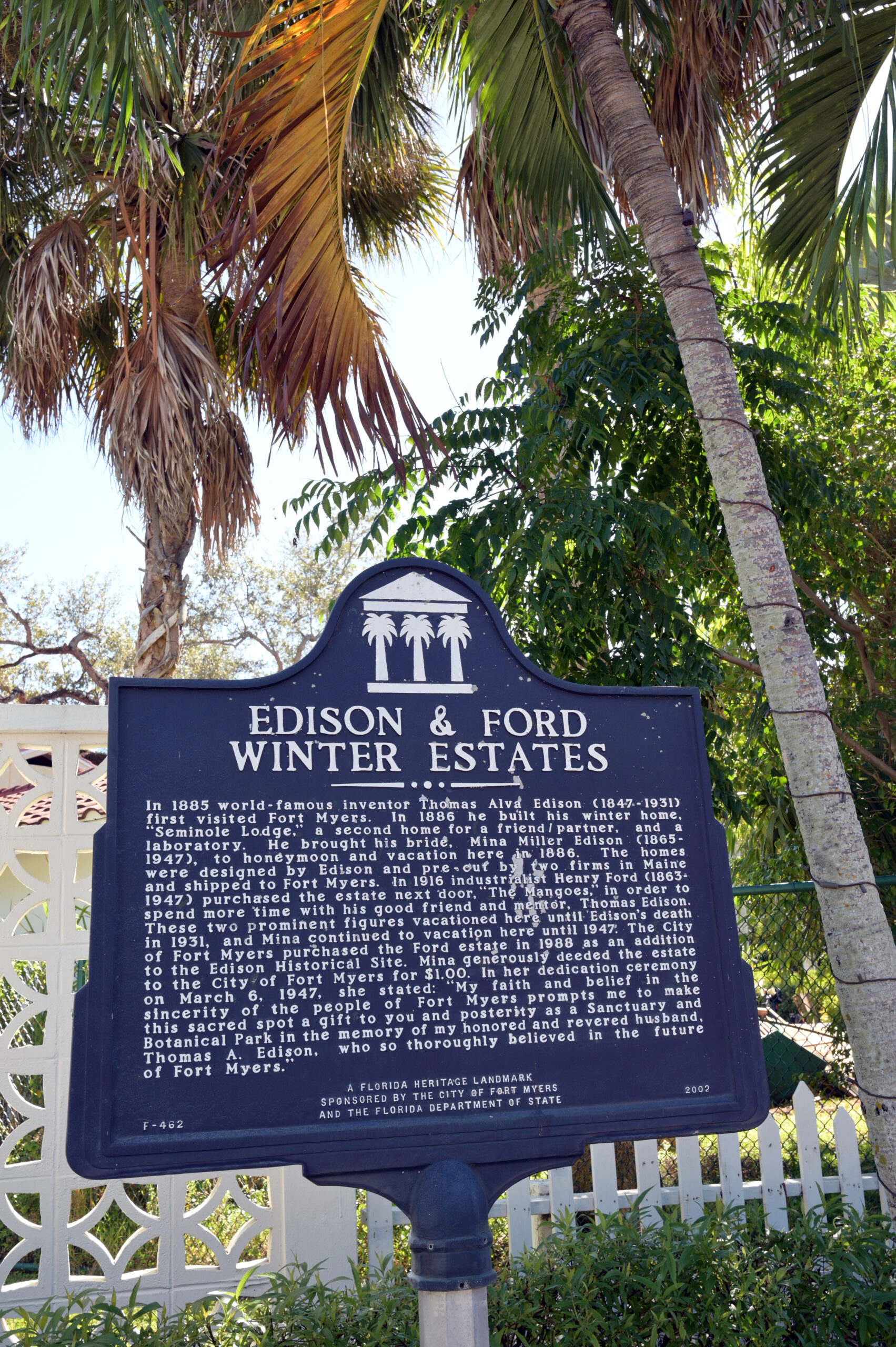
Signs, like the one pictured, give visitors to the Edison and Ford Winter Homes historical information about the treasured property and its former owners. -CASEY BRADLEY GENT / FLORIDA WEEKLY
Michael Flanders is President and CEO of Edison and Ford Winter Estates. He has an undergraduate degree in architecture from the University of Florida, and a master’s degree in architecture from Virginia Tech. For 37 years, Flanders has been a registered architect in the state of Florida. “I’ve always been interested in the historic preservation of buildings,” Flanders reminisced, “and in the preservation of history in general.” Flanders makes an important distinction between Thomas Edison and Henry Ford’s fingerprints on Southwest Florida’s most notable neighborhood. Flanders explained, “Edison came to Fort Myers in 1885, and he was involved here for 20 years before Ford came and bought the house next to Edison’s in 1910.”
Thomas Edison was Edison Park’s first father-of-influence, in an era that had not yet invented influencers. The neighborhood boasts massive trees, one gifted to him in 1925 by Harvey Firestone, which now provide respite from Southwest Florida’s dogged summer sun. Like most collections, the history of Edison Park’s collective green canopy began with a single tree. Firestone planted the original banyan, hoping it would provide a means to naturally source rubber for tires. Instead, that single tree is now the largest banyan in the United States, covering nearly one complete acre on the grounds of the Edison and Ford Winter Estates. Flanders said the historic properties consist of 18 acres. While the Edison and Ford Winter Estates and Edison Park neighborhood both border McGregor Boulevard and overlook the Caloosahatchee River, the two entities are separate.
While Thomas Edison’s home was completed in 1886, Developer James Newton laid out the streets of Edison Park in the 1920s. 2026 will officially mark the neighborhood’s one-hundredth year. “A hundred years ago, curved streets were much more popular than they are today,” Flanders explained. Hence, the whimsical roadways and passages where Cheri O’Mailia discussed the opportunity for one to become “safely lost.” O’Mailia also discussed her appreciation for a neighborhood full of schools, which was another intentional part of Newton’s design. Additionally, Newton laid out the plan for a local hospital, which exists today as Lee Memorial Hospital on Cleveland Avenue.
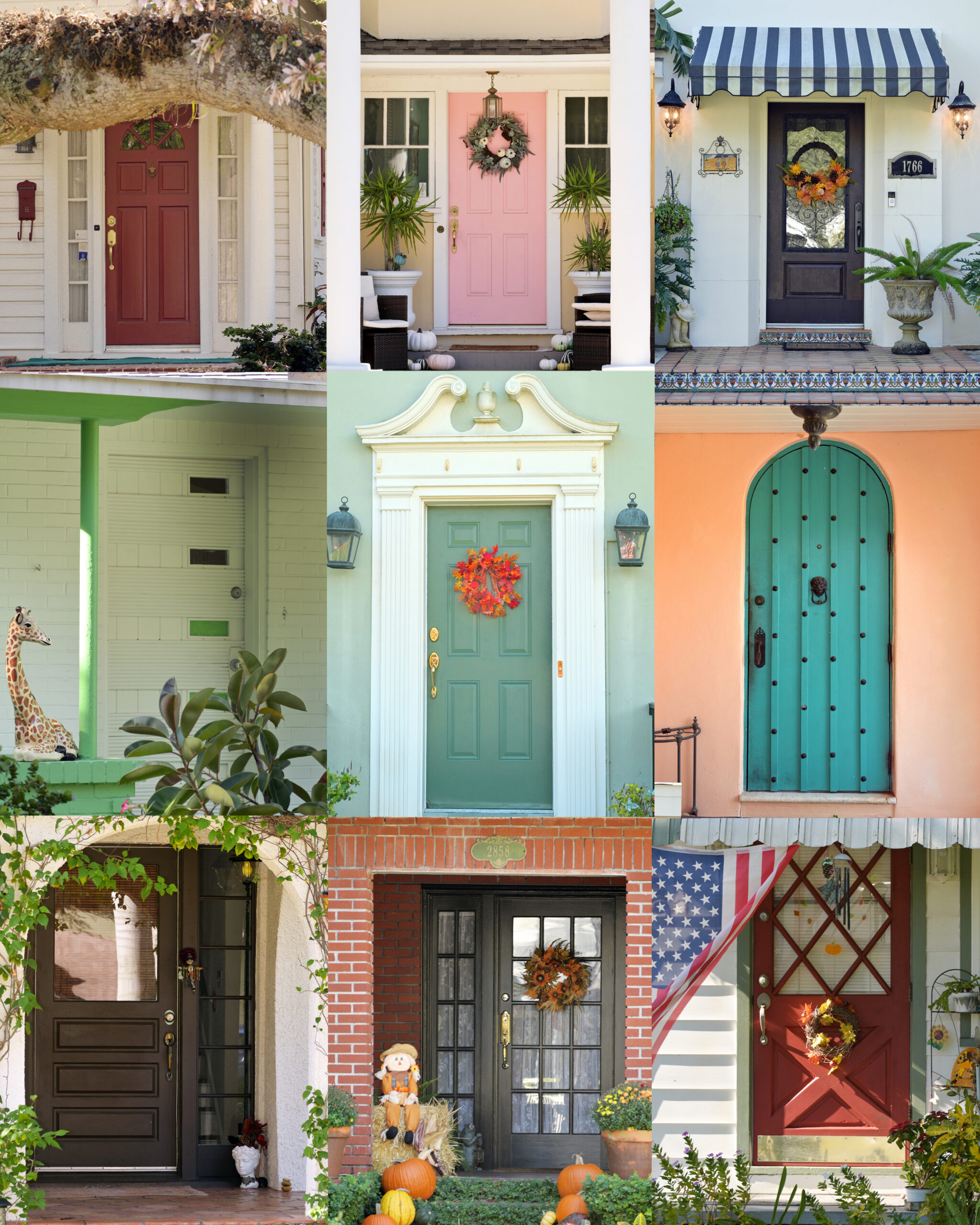
Within the winding roads and pathways of Edison Park, whimsical doorways and cheerful front doors line the sleepy streets. -CASEY BRADLEY GENT / FLORIDA WEEKLY
O’Mailia’s residence, and others like hers, are private homes. Inside one address on Marlyn Road, several walls are splashed in a decadent yellow – the color of lemon meringue. The heavy door leading into this home is turquoise today, but the door’s owner pointed out a fleck of dusty blue peeking through the newish paint. He said he covered the dusty blue years ago, but scratches here and there reveal the door’s original color. Edison Park boasts rows of homes with colorful and eclectic front doors. There is one soft pink door and several mahogany-colored entrances. Beyond the charismatic front doors are historic and often colorful rooms like the lemony music room from Myrtle Road’s Mediterranean Villa. These private neighborhood homes remain closed to tourists, but the Edison and Ford Winter Estates are certainly available to visitors.
The Edison and Ford Winter Estates are open daily, except Thanksgiving and Christmas. Outside of the homes is a nursery, gift shop and Edison’s remarkable banyan tree. A statue of Thomas Edison stands before the banyan, a tree that seems to exist in lifetimes and layers. Because Thomas Edison was from Greenfield, Michigan, his original laboratory from the estate was dismantled and taken to Greenfield after Edison’s death. O’Mailia said Edison’s wife, Mina, demanded that a load of dirt from Fort Myers be delivered to Greenfield, Michigan, so the reassembled laboratory would be built “on the same ground which it originally stood.”
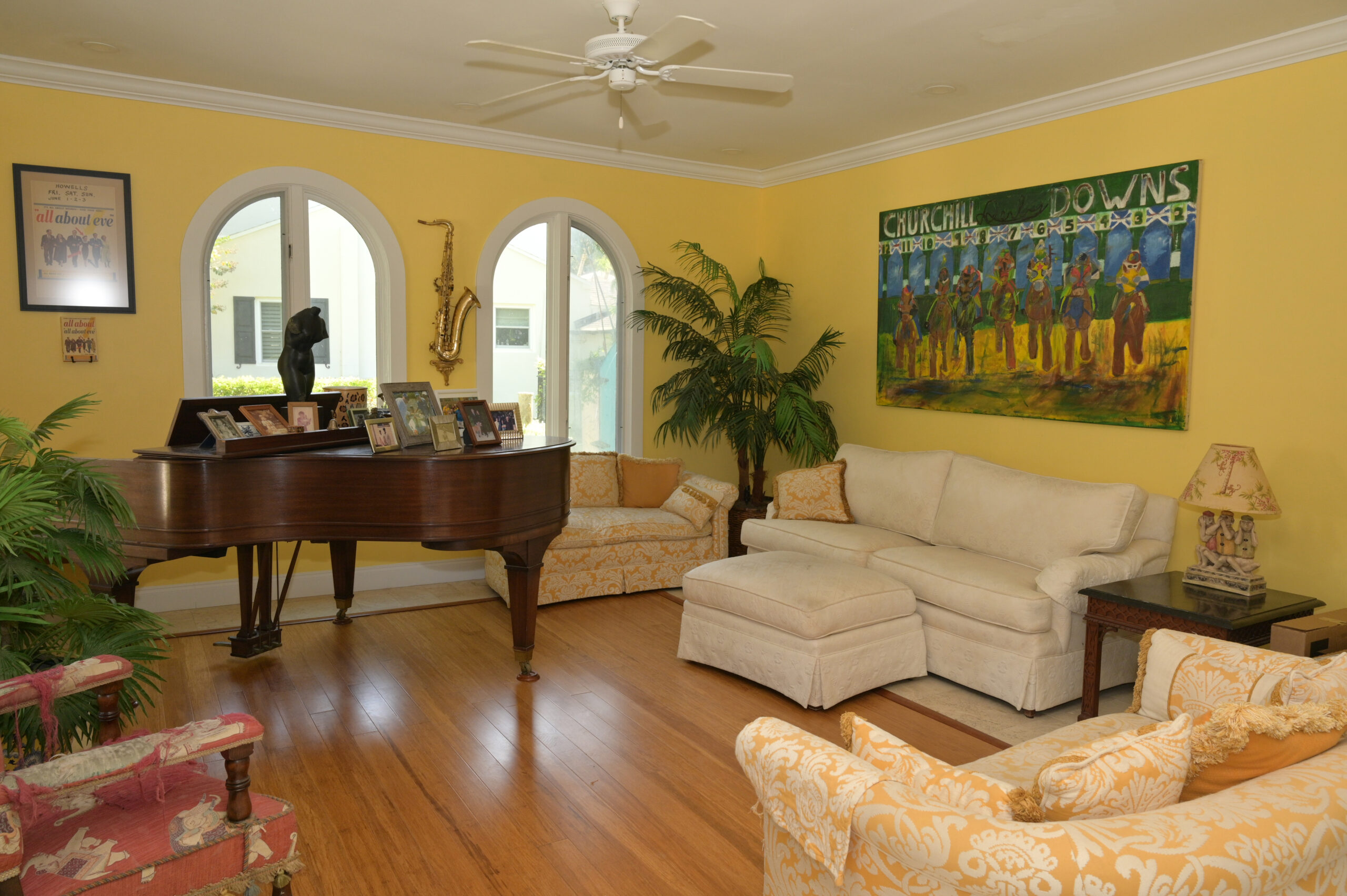
Inside one of Edison Park’s oldest Mediterranean style homes, this decadent yellow music room stands-out as the home’s formal sitting area. -CASEY BRADLEY GENT / FLORIDA WEEKLY
2025 is the 50th Annual Edison and Ford Holiday Nights. The twin-houses, as Flanders referred to them, are now elaborately decorated for Christmas. A bright red amaryllis adorns one dining table. Tall Christmas trees – and short, thin Christmas trees alike – are covered with so many delicate balls that the trees simply dance in light. Poinsettia blooms rest atop the fireplace mantles. Beginning Nov. 28 and running through Jan. 4, 2026, visitors may purchase tickets to stroll the holiday-themed grounds. This year’s theme is “Golden Jubilee.” For details, visit: www.fortmyersbeach.org or www.edisonfordwinterestates.org