
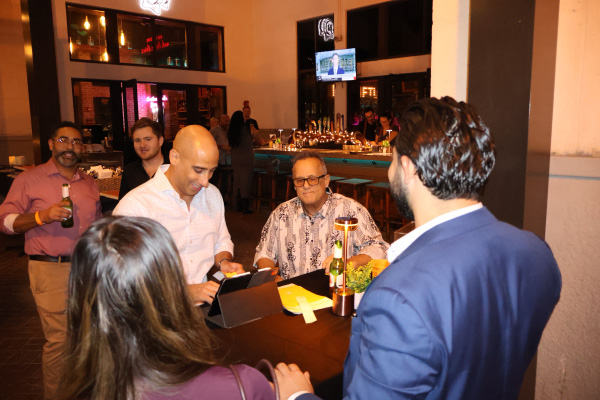
More than 100 people descended upon an outdoor bar restaurant in Fort Lauderdale on a recent November night, lounging by the fireplace, sipping wine and snacking on chicken wings, talking and laughing. Some kept an eye out for romantic interests; others reconnected with old friends, or made new ones.
But they weren’t just there to have fun. They came to network.
In a region known as “Wall Street South,” networking might take on a negative connotation, depending on who you ask. But for many millennials and Gen Z South Floridians, events like the one in Fort Lauderdale have become more than just a transactional exchange that ends with a swapping of business cards. Now, they have become a third space, offering people a sense of community — sometimes serving as the only reason a given attendee left the house that day or had a social interaction in a post-COVID-19, remote-heavy work world.
South Florida’s workers have a need, and a wave of networking clubs and digital apps has risen to meet it.
“When we started, I didn’t think there would be a need for a networking event, because there’s a million,” said Esther Deutsch, 32, who co-founded Sunset Connect, which put on the recent Fort Lauderdale event. Deutsch moved to South Florida from New York during the pandemic, and quickly discovered many like her lacked community.
“Clearly, there’s a need of some sort,” Deutsch said. “So, I think it’s not about whether we need it, it’s, is it fulfilling the need? And what could it do to fulfill more? Because there’s a need.”
But some of these experiences have a barrier to entry. One buzzy new app accepts only those with sufficiently impressive resumes and offers its members “micro-communities,” a more intimate form of networking that blends business with pleasure: pickleball clubs for healthcare innovators, book clubs for entrepreneurs, and cigar lounge meetups for people in finance. Other groups rely on word of mouth but also seem to self-select for white-collar professionals.
Regardless, “people are actually craving connection more than ever,” Deutsch said.
Economic anxiety
The growing need for networking events and apps isn’t just because South Floridians want community. Networking also presents an advantage in a job market that is both increasingly impersonal and difficult to navigate, especially for young people.
Numerous reports have documented the growing struggles young college graduates face in the white-collar job market as layoffs increase and AI threatens entry-level careers. Some companies are predicting that 2026 will be the worst job market for college graduates in five years. Meanwhile, many job seekers find that their applications receive no response, sometimes screened only by AI, not a real person.
For those trying to launch their careers, it feels as if doing everything right is no longer enough.
“Anybody can get a degree, anybody can get certification,” said Brenda Chamizo, a Fort Lauderdale networking attendee who currently is in college studying psychology and works as a server. “The value of the degree is going down. So, what’s going to make you different than everybody else?”
The current push for authentic friendships isn’t just because people are seeking fulfillment. It’s also strategic. Today, some say basic networking is no longer enough; career advice websites encourage people to form authentic relationships rather than transactional ones because they will have more success doing so.
“Networking has evolved dramatically in the digital age,” a “Networking Tips” page on one career advice website reads. “It’s no longer about aggressive self-promotion, rather about building genuine relationships, exchanging value, and creating authentic connections.”
The rise of apps and events is just the world catching up to that need, Deutsch said: “the world is finally realizing that everybody needs to network at every stage of their career and how important it is for jobs, for life, for growth.”
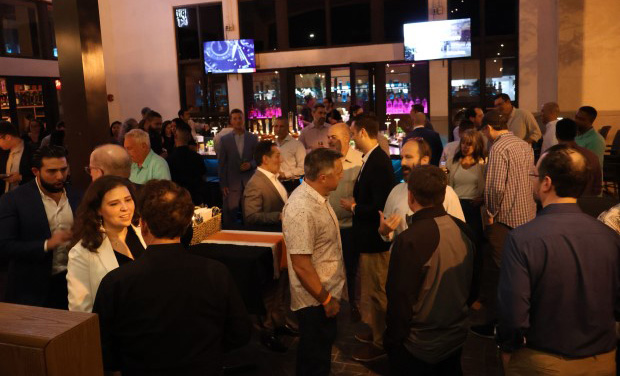 Networkers gather at a Sunset Connect event in Fort Lauderdale. (Jacob Horwitz/Courtesy)
Community — but only if you’re smart?
Among the new approaches to networking currently taking hold in South Florida is an app that markets itself as only for smart people.
The app is called Clockout, and it was founded by Krishna Dosapati in 2022. The beginnings of the app idea came to Dosapati after she graduated from New York University in 2016 and found herself increasingly frustrated with her social scene.
The now 31-year-old said it was easy to constantly meet new people in college — especially people with whom Dosapati felt aligned, whether through shared interests, career pursuits or personality traits.
“But then once I graduated, I kind of felt like that wasn’t really there in the real world,” she said.
Dosapati wanted a way to meet other young professionals digitally that wasn’t Facebook, Meetup or LinkedIn. Those platforms lack “quality control,” she explained.
So in 2022, she launched Clockout. On Instagram, the company has reached 70,000 followers, but remains private, emblematic of its ethos. Its description reads: “A private network for (people with) ridiculously high standards” and “Smart enough to get in?”
The concept is a bit of a marketing strategy, Dosapati admitted: Exclusivity sells. The company has paid some influencers to make videos about the app on TikTok and Instagram. Several videos focus on the app’s intelligence requirement and the controversy it’s generating.
But an element of exclusivity does exist. The app is, at this point, largely designed for white-collar professionals with college degrees. Those who don’t check the boxes may find themselves rejected, unless they can prove their success in other ways, Dosapati said.
Prospective users have to go through a short application process that asks where they work, in what industry they work, their job title, where they went to school and when they graduated. After inputting those details, the user receives an email a day or two later with their results.
Dosapati said the goal is to ensure everyone using the app is an “ambitious professional,” though what that looks like depends on the location. In New York, the typical user is someone in tech, finance or consulting. In South Florida, the app is full of small business owners and real estate agents.
You don’t have to be a “cookie-cutter person” to get in, Dosapati said — but “if somebody hasn’t gone to university, or maybe they’re a bartender or a barista or a DJ, that doesn’t mean those people aren’t ambitious, it’s just that they wouldn’t be the right fit for Clockout.”
Still, sometimes the AI makes mistakes, or people without the right boxes checked but who are worthy of joining the app might get rejected.
“We’ll definitely get DMs from people being like, ‘I am so qualified and I was rejected,’” Dosapati said. “And whenever we get those DMs, we actually really do go check that person and we’re like, ‘Hey, you know, we make mistakes.’ So, let us go look into that, and if that person, they were ambitious or maybe they didn’t fill out their application properly, then they do get approved and get access to the platform.”
As the app evolves, Dosapati’s goal is to move away from the approval process and instead replace it with an automatic system that will “filter out relevancy based on who you are and your data,” she said.
“We’re not excluding people to be mean, we just want to build a platform that works, and once we find that it works, and we have those algorithms in place, then it will no longer be, you know, exclusive,” she said.
‘I just like socializing’
On Clockout, South Florida users can create and join their own hyperspecific communities: the Law Runners Club, the Christian Environmental Professionals, the Entrepreneur Billiards Club, the Real Estate Tennis Club. Some have pointed to the rise of these micro-communities as the future of networking. These groups offer genuine social experiences in contrast with the isolation of a remote job.
Uri Yudewitz, 47, started a sub-group on Clockout that meets monthly in Boca Raton, simply called Networking at Night. He felt he’d “graduated” from the other networking events he was attending, and sites like Eventbrite and Meetup felt too broad and didn’t offer a real sense of community.
Yudewitz is happily established in his career as vice president of business development for a multi-national conglomerate based in Boca Raton. But as someone who works mostly from home, he simply doesn’t get to interact with many people.
“I just like socializing,” Yudewitz said on a recent weekday evening at a gathering he helped organize along with another networking group called Sunset Connect. “… I just want high-quality people who are interested in business, who I can connect, who I can trust and know that if somebody says I need a plumber, I need a mortgage broker, I need a whatever, that I have somebody in my network.”
At the gathering, he reunited with one of those people: Marlen Rosales, 43, a friend he had made through networking, who also works fully remotely. She does business development and marketing for a health care technology company. Through Clockout, she was able to join a health care technology group that hosts pickleball events every month.
“I feel like because I’m not in an office, I’m missing out on the social aspect,” she said. “So networking for me helps me to connect with professionals in the area.”
But the connections aren’t purely business. After one recent comedy open mic event she found on Clockout, Rosales said she and the group went out dancing.
“You can meet friends as well, you know,” she said. “It’s not just necessarily a business relationship.”
Rosales also sees the events as a possible opportunity to meet a romantic interest. A date has yet to come out of a networking event, but she isn’t discouraged.
Clockout isn’t alone in blending people’s personal lives with business. Exclusive dating apps continue to rise in popularity, from The League, a dating app only for professionals, to Raya, another exclusive dating app that now offers networking services. Outside of apps, smaller in-person communities built around activities have begun to form organically, according to a 2023 Business Insider article about how networking has changed.
“I think at the end of the day, we all are human,” Selva Param, a partner at executive search and leadership consultancy firm Stanton Chase, told Business Insider. “We like human touch; we like to meet people.”
Could exclusivity drive more isolation?
Still, while many look to networking events and apps like Clockout for social connection, the exclusivity and focus on success could ironically perpetuate the preexisting sense of isolation that pervades America’s workforce culture, said Anindya Kundu, a sociologist and professor of educational leadership at Florida International University.
“The American rat race is unique in that way where if you compare America to other cultures, there isn’t this competition to climb to the top. There’s more equal income distribution amongst professions,” Kundu said. “If you’re slowly seeing yourself climb, you don’t necessarily think about holding the door open for people behind you, case in point, this app.”
That push toward exclusivity could drive loneliness, so much so that Kundu believes Americans may be on the brink of a cultural reckoning.
“A lot of people are realizing that doesn’t work for us, especially people who don’t have the means, who could get derailed if their car breaks down, because we’re seeing that this individualism mindset is also not producing mental health and fulfillment,” Kundu said.
“There is rising depression, anxiety, addiction, and all of these negative ways of coping, and I think one of the leading causes of that is this individualistic mindset that we have been developing.”
In dense metropolitan areas like South Florida, Kundu said this phenomenon pervades more than ever.
“Cities, I think, which make up large parts of South Florida, are very much that industrialized eat-or-be-eaten structure,” he said.
Still, those who enjoy the local networking scene say that their groups are emblematic of inclusivity and openness, not exclusivity.
“We welcome people that have no networking experience,” Deutsch said, adding that her approach to Sunset Connect is “very open and accepting.” The group tends to self-select, Deutsch added, and membership often spreads by word-of-mouth.
Even Clockout’s projected exclusivity seems more like a “marketing gimmick,” Rosales said, though she added that she appreciates how the app tries to rope in people who “probably have good jobs, a good head on their shoulders.”
Yudewitz doesn’t fit perfectly into the networking demographic due to his age. But he doesn’t mind because there is value in the social experience.
“I’m in my 40s, but it doesn’t really matter, right?” Yudewitz said. “It doesn’t matter what the demographic is. It doesn’t matter what kind of company you work for. It doesn’t matter what your role is. It could be a dev, it could be sales, it could be accounting. People just kind of seem to want to have that space where they can get together and just let off a little bit of steam while networking, while meeting other good people.”