
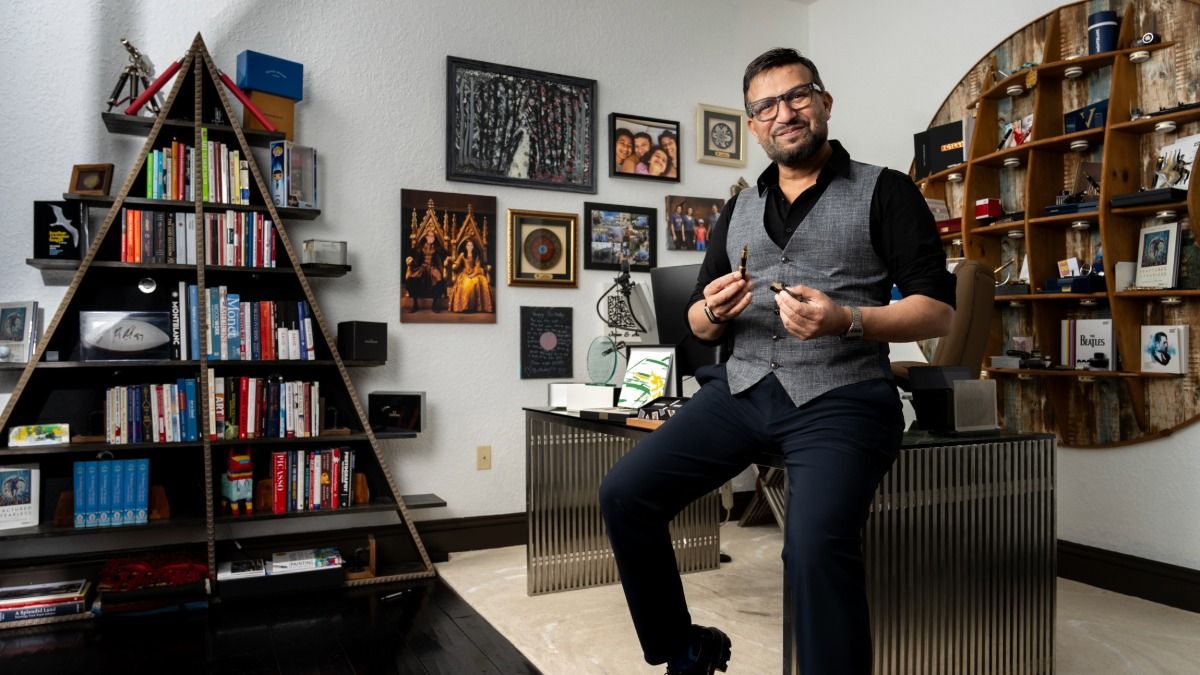
The man was dying when Ali sat beside him. The silence felt heavy, but what he needed was not medicine. Ali held his hand and listened as he spoke of fear, family and the relief of being understood.
When Ali stood to leave, the man whispered that what eased his pain was not the medicine. It was being seen, heard and no longer alone.
Ali never forgot those words. They shaped how he defines success, measured not by what is cured but by who feels seen.
Unspoken lessons
He grew up in Karachi. His father was a physician who sometimes treated patients from a mobile clinic in a car. His mother was what he calls a serial activist. They taught him that dignity has nothing to do with wealth and that purpose lives in service.
“Life is just not about us,” he says. “We are related to each other. We are relevant to each other.”
At school, colors signaled worth. White meant below average.
“I was white, subpar,” he says. “It is like showing a report card every time you walk outside.”
In ninth grade, a teacher told him to stop memorizing and start reasoning. Logic gave him calm. Order gave him control. For the first time, he could think without fear.
READ: UTampa moves ahead with new riverfront science building
That order became a refuge for a child living through something no child should face. Between the ages of seven and 11, he suffered abuse from a distant relative. The trauma left scars that words could not reach and shame that followed him for years.
He learned to read people in ways that became instinct. He could sense tension before words appeared. He could recognize fear without sound and see that empathy begins where language ends.
“80% of communication is nonverbal,” he says. “Your body language, pauses, reflective listening, tone and touch speak more than any words.”
His father showed him that long before Ali could name it. The elder Dr. Ali sat beside patients and told them, we will make this better. I am with you in this.
“The level of compassion I learned from him,” Ali says, “I would be a much better man only if I could be half the man my dad was.”
Medicine was never a career. It was an inheritance.
Ali buried his pain and built a life around discipline. “The distance between failures is where courage grows,” he once told a room of health leaders. “You do not have to say it never happened. You just have to learn to live beside it.”
That resilience shaped how he would lead. Empathy, he tells young physicians, is not a technique. It is an instinct. “If you can make one person feel safe again,” he says, “that is medicine.”
Fireproof
In the 1990s, Karachi faced political violence and fear. Universities became battlegrounds. Medical students were told to stay home. Ali led a student charity and refused extortion demands from political groups.
“They said if you come to medical school, you will be harmed or even murdered,” he says.
The unrest targeted NGOs and community programs, including a blood bank he co-founded. Helping others had become dangerous.
When he was allowed to return days later, he went back. One afternoon he was dragged into a back room and forced to watch men beat a classmate. Weeks later, the family clinic burned. Medicine and equipment turned to ash.
“Our office was on fire,” he says. “Something just died that day.”
Soon after, a young boy arrived holding his mother’s body.
READ: Tampa hotels launch Plates with Purpose to fight food insecurity
“He was holding her feet,” Ali says softly. “She had passed away. It just broke my heart.”
Later, he was kidnapped and beaten.
“I was tortured by them,” he says. “But I kept going. I felt I had a destiny to make a positive change in people’s lives.”
The violence could have hardened him. Instead, it refined him. Each loss deepened his belief that strength is not the absence of fear but the mastery of it.
After medical school, he left Karachi for Chicago with $1,700 and a quiet belief in empathy. By day, he ran lab tests at Rush University Medical Center. By night, he cleaned floors at Home Depot and Blockbuster.
“When I wore a suit, people smiled,” he says. “When I changed into my janitor clothes, those same people looked past me.”
The lesson stayed with him. No one who worked for him would ever feel unseen.
His next chapter took him to Boston, where he trained in radiology at Beth Israel Deaconess Medical Center and completed a residency in internal medicine in Worcester.
Later, he moved to Tampa. The group that sponsored his visa stopped paying him, but warned that leaving would mean deportation. He stayed.
For 14 months, he worked without a paycheck, driving to Punta Gorda every other weekend to take overnight hospital calls.
“I would leave Friday at two, take calls all weekend and be back by seven Monday morning,” he says. “Then I would start another two weeks of unpaid work.”
Between shifts, he studied accounting, project management and process improvement.
“Medicine does not teach you business,” he says. “You do not learn contracts or margins. I had to teach myself.” Those months became his real education. “That was my MBA.”
He later traveled to Japan to study the Toyota Production System.
When AdventHealth offered him a position, he accepted. But he remained restless. He saw people trapped in systems that rewarded compliance instead of creativity.
“If I do not learn business, I will be back here again,” he told himself.
He studied leadership with the same discipline he gave to medicine. He learned that empathy and efficiency can coexist and that structure can free rather than confine.
Eventually, he called three hospital CEOs and told them he wanted to be fired. They laughed in surprise. That leap of faith sparked a partnership built on trust and innovation. It set the stage for what Pioneer would become.
“I wanted to do the same work but on my own terms,” he says. “We could be more efficient, more flexible and more focused on people.”
Invisible work
From that conviction, Pioneer Medical Group was born.
It began in Zephyrhills with a few clinicians and a simple goal: treat people better. What started as a small practice grew across Tampa Bay into Ocala, Orlando and Sebring. Pioneer became a connected system of care that spans hospitals, specialty programs and post-acute facilities.
The growth expanded into national consulting and real estate ventures. Pioneer became a diversified, purpose-driven enterprise.
Pioneer Nation employs about 350 people across all service lines. About 320 are clinical providers. The rest support administrative and executive operations.
“Be brave enough to keep the fear behind you, not in front of you,” Ali says. “If you align purpose with responsibility, you do not need bureaucracy.”
Building a company was not about control. It was about proving that integrity and efficiency can live together and that people do their best work when trusted to lead.
When the pandemic arrived, fear returned in a new form. Data changed by the hour.
“Logic works when you have more than half the data,” he says. “During Covid, you often had 10%. That is when trust has to do the rest.”
READ: 6 story luxury student housing project breaks ground near USF
Where others cut staff, Pioneer did not.
“It is never funny when someone gets fired,” he says. “Nobody checks the log or remembers who could not pay you. So we stopped paying ourselves first. 45 days without pay. We never cut anyone during Covid. That is a testament to our commitment to our people.”
It remains one of his proudest moments.
“We survived. We did okay. That was the moment I knew our culture worked.”
He believes leadership is about clarity. You cannot hide behind hierarchy when lives are at stake.
Mondays begin with a 90 minute leadership meeting. From 10:30 to 2, he works from a cubicle so anyone can walk up. Every project runs through digital dashboards that track revenue, recruitment and quality in real time.
“If you can decide in the room, you save a week of emails.”
He checks email once a day, returns only known numbers and declines unprepared meetings.
Every decision must pass three filters: relevance, integrity and impact.
“If it is relevant to our mission, if it keeps integrity intact and if it improves one life, it is worth doing. Everything else is noise.”
His schedule protects what he values most: time, trust and focus.
“Nobody cares about my time as much as I do,” he says. “I close the book when my daughter walks in after school.”
Efficiency matters, but never more than empathy.
Art became another form of clarity. He has been a photographer all his life, but during the pandemic, he turned to painting, sculpting and metal art.
“I could work on a piece for two hours without thinking of anything else,” he says.
His first figure, a tall, upward-looking shape, still stands in his home. He calls it his meditation.
“In medicine, you learn to save life,” he says. “In art, you learn to live it.”
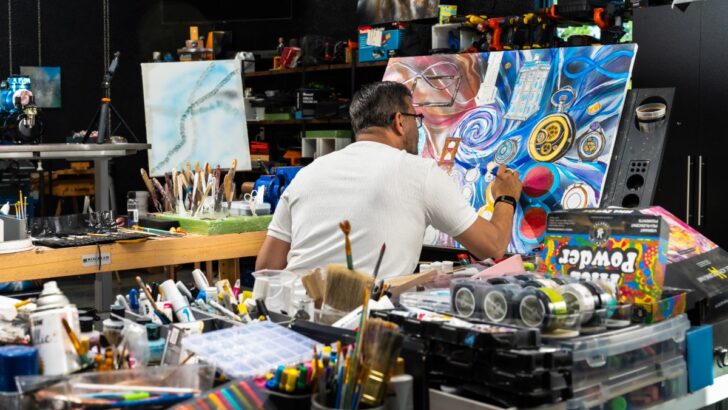
Dr. Ali in his studio creating one of his abstract works, a practice he says brings him calm and clarity.
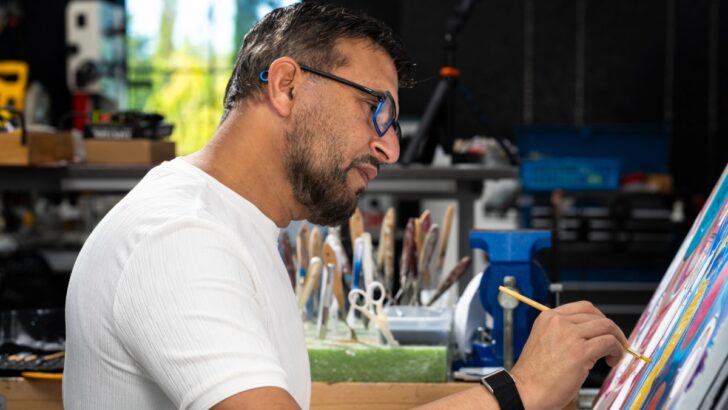
A close look at Dr. Ali as he paints, a routine he uses to quiet his mind and reset between demanding days.
Shared light
The Pioneer Medical Foundation began with a simple mission: give back to the community that gave his family so much.
Its focus remains on helping the homeless and underinsured. Barriers like transportation and access to basic resources guide its work.
Its reach has grown globally, but its heart is still local.
“Anybody can throw money,” he says. “Training people, building systems. That lasts.”
He teaches physicians abroad leadership through programs on transparency and process improvement. Locally, his team volunteers at health fairs and mentorship programs for young doctors.
“I have seen the best and worst of humanity,” he says. “The lesson is the same. The world is small, people are good and the only currency that holds value is kindness.”
READ: USF eyes 2027 launch for new real estate master’s program
He calls Tampa a city that lets you build. “Tampa has innovation, but it still has soul. People remember your name here. They still value honesty.”
Pioneer strengthens the local medical economy while keeping ownership close to home.
“This region raised my children, gave me opportunity and taught me to give back,” he says. “I owe Tampa Bay.”
Ali’s philosophy rests on empathy, logic and humility.
“We are all invisible at some point,” he says. “I have cleaned floors. I have seen people step over me without looking. You never forget that.”
He believes leadership begins with listening and ends with accountability.
For him, success is not measured by revenue but by relevance.
“If one person feels seen because of what we do,” he says, “then we did our job.”
His story is not about what broke him but what he chose to repair.
Photos courtesy of Evan Smith.
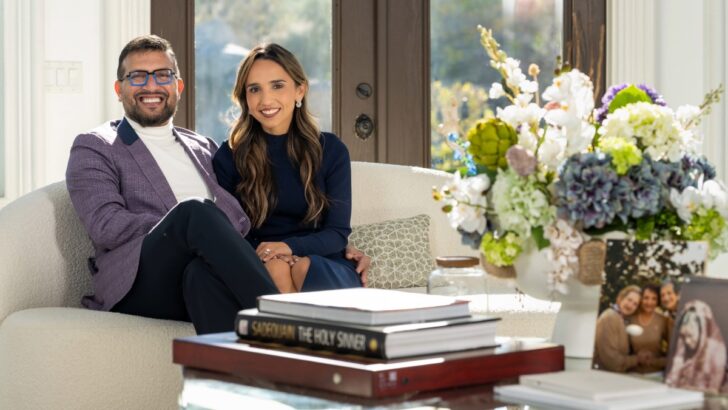
Dr. Ali and his wife at home in Tampa, a place he says keeps him grounded.
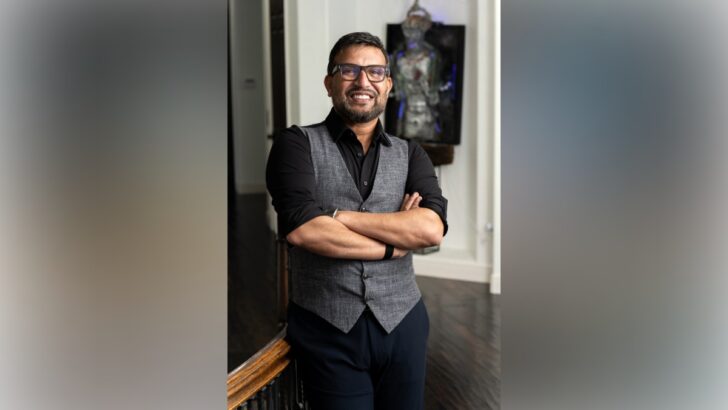
Dr. Ali at home in Tampa, where he says empathy and discipline guide every part of his work.
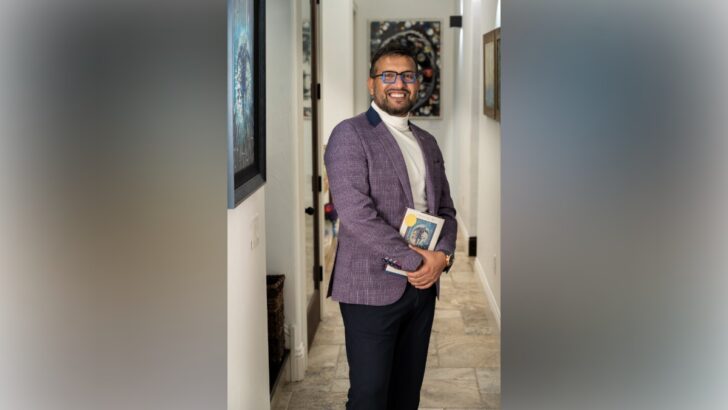
Dr. Ali stands in a hallway lined with his artwork and books, a space that reflects his love of learning.
Stay Connected