
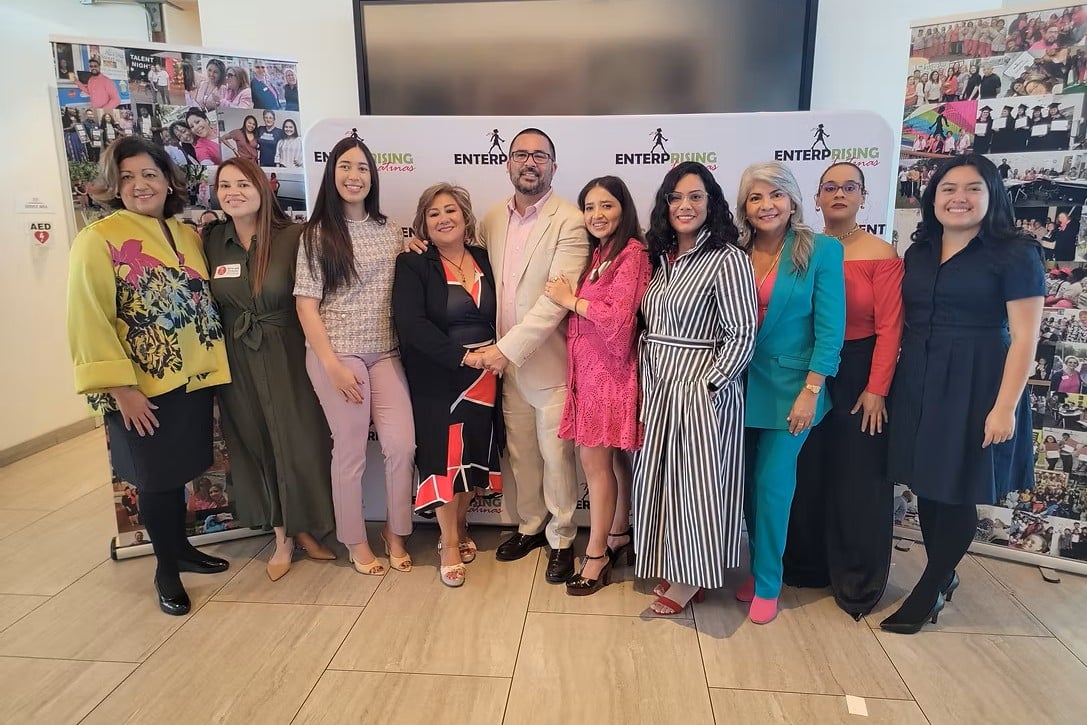
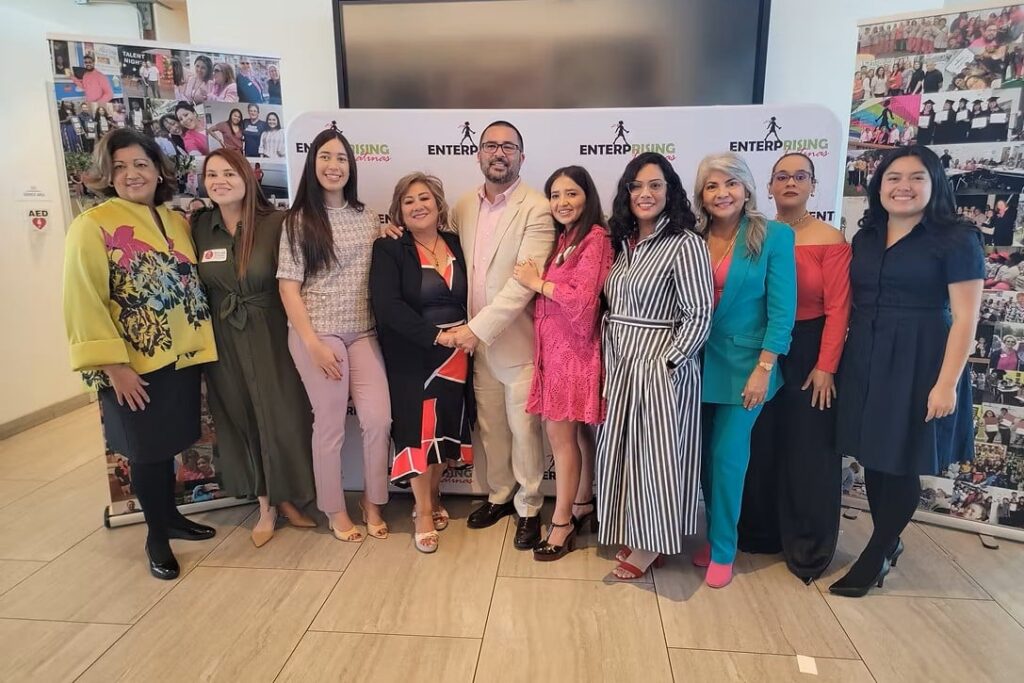
 The Enterprising Latinas team at their 11th anniversary celebration (Enterprising Latinas).
Liz Gutierrez is not only the founder of Enterprising Latinas, an organization dedicated to creating pathways of opportunity for Hispanic women in Tampa Bay. She is also the embodiment of the name.
Gutierrez arrived in the U.S. from the Dominican Republic at age six. Her family settled in Massachusetts, where they purchased what she describes as a three-tenement building that was soon occupied by extended family.
“When I was in my home, I was in a Latina environment,” Gutierrez recalls. “When I was outside, I was in an American environment. I developed a strong sense of survival and a motivation to learn the language.”
These experiences would shape her resilience.
“My aunts, who were in their 20s, all worked in textile mills where they eventually found themselves enrolled in English classes,” Gutierrez says. “I was fortunate they took me with them. I was like a sponge. The teacher told them the mills were going to close, and they needed to learn English to find another job.”
She learned a lesson she never forgot – how quickly life can change.
“Those women were so talented,” Gutierrez says. “They were expert seamstresses who could have started their own business, yet they lacked the confidence to do more than work in a factory. They thought, ‘This is my place.’ They were conformists.”
Gutierrez, on the other hand, had aspirations.
“I thought about going to the Fashion Institute of Technology (FIT) in New York to study the business side, traveling the world doing merchandising,” she says. “But as I grew through adolescence and young adulthood, I had another dream – to become a lawyer, to defend people’s rights. By this time, I had developed a deep sense of justice through my family’s experiences.”
Moving to Tampa
During Gutierrez’s last year of high school, her family sold the apartment building, moving to Tampa and a warmer climate. Gutierrez enrolled in Leto High School in the Town & Country area.
“I walked in and was shocked,” she says. “There were so many Latinas. At my other school, it was clear I was an immigrant, but not here.”
(According to niche.com, an aggregator of in-depth profiles of high schools and colleges, Leto High School is approximately 81% Hispanic.)
Gutierrez says it was a difficult experience joining a senior class that had been together through high school. On top of that, she was older than everyone else in her class because, after arriving in America, she was held back in first grade for not being able to speak English.
“I didn’t really fit in,” Gutierrez says. “I wanted to be an adult, to do adult things.”
After graduation, she attended Hillsborough Community College for two years and got a job with an airline. Then she did an adult thing; she got married. It turned out her husband only married her to get a green card, she says.
“The marriage was so bad, but it taught me what I was made of,” she says. “I dusted myself off, went back to Massachusetts, and got my master’s degree in community economic development. What could have sunk me woke me up. From then on, I was fearless. I knew if I could survive that marriage, I could survive anything.”
With a degree in hand, Gutierrez stayed in Massachusetts and worked for nonprofit organizations focused on affordable housing and youth development. She says the experience showed her the power of having a unified vision.
Gutierrez returned to Tampa in 2003 to help care for her aging parents. She found only a few organizations doing the type of community development work she envisioned.
“I wanted to start an organization where women like my mother would not have to clean bathrooms as their only option,” Gutierrez says. “I had the credentials; I had the experience.”
She knocked on a lot of doors, asking people if they wanted to work together.
“Some saw the vision; they said yes,” Gutierrez says. “No one does this alone. We started by doing small things with a handful of people. Lucy Stewart, a Cuban entrepreneur and Owner of Aguilas International Medical Institute, was our first president.”
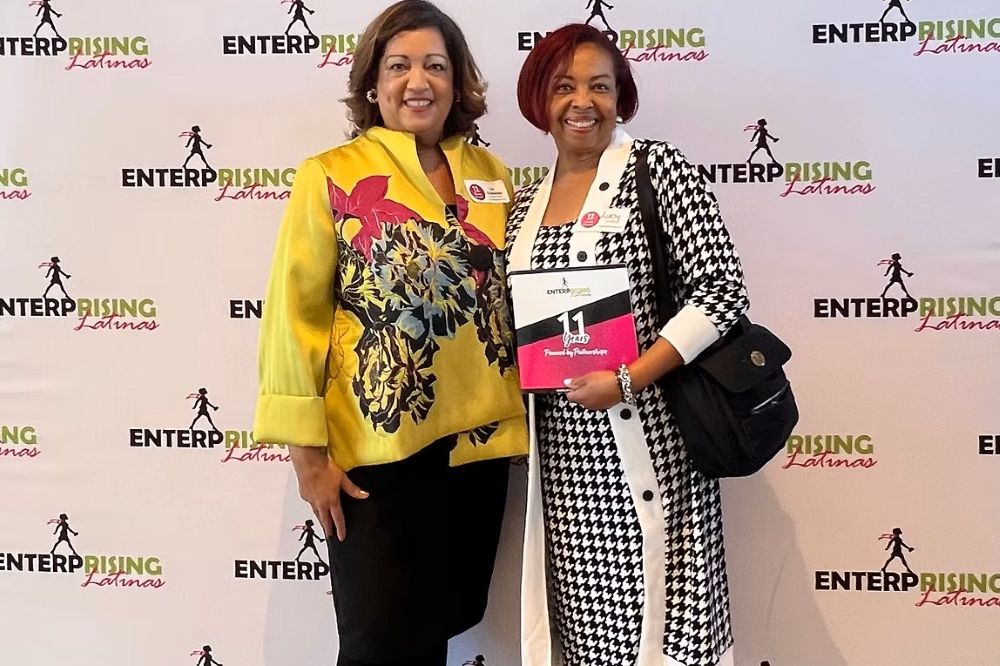 Liz Gutierrez and Lucy Stewart (Enterprising Latinas).
“We created an organization that could create opportunities,” Gutierrez says. “Charity is good, but it doesn’t change trajectories…We’re so proud we’ve been able to do that. Our little grain of salt has helped women see themselves in a very different way.”
Moving ahead
Always looking for ways to grow their community impact, Enterprising Latinas has established a small business loan program, the Rising Community Fund, to provide microloans and low-cost funding to entrepreneurs and local businesses.
When fully funded, the Rising Community Fund will be certified by the U.S. Treasury’s Community Development Financial Institutions Fund (CDFI Fund), which injects new sources of capital into neighborhoods that lack access to financing.
Enterprising Latinas has raised $250,000 in “private sector capital” for the fund through community organizations and private gifts. Gutierrez says they plan to submit their application to the CDFI in early 2026 and hope to receive certification in the summer. Her goal is for the fund to reach $1 million.
In the nonprofit world, reputation is everything. Enterprising Latinas has earned a coveted four-star rating from Charity Navigator, a national firm whose comprehensive ratings focus on the cost-effectiveness and overall health of a charity’s programs, including their stability, efficiency, and sustainability.
That stellar reputation is reflected in the community support Enterprising Latinas receives, like the woman who came to Gutierrez’s office during the COVID pandemic with a check for $7,000. The woman had saved up the money for a vacation she now couldn’t take. She wanted to temper her disappointment by contributing it to a worthwhile cause.
Enterprising Latinas’ Wimauma Opportunity Center opened in 2019 as a hub where the community can access the organization’s services, get information on insurance coverage, find help with a job search, receive career counseling, and take English as a second language (ESL) classes.
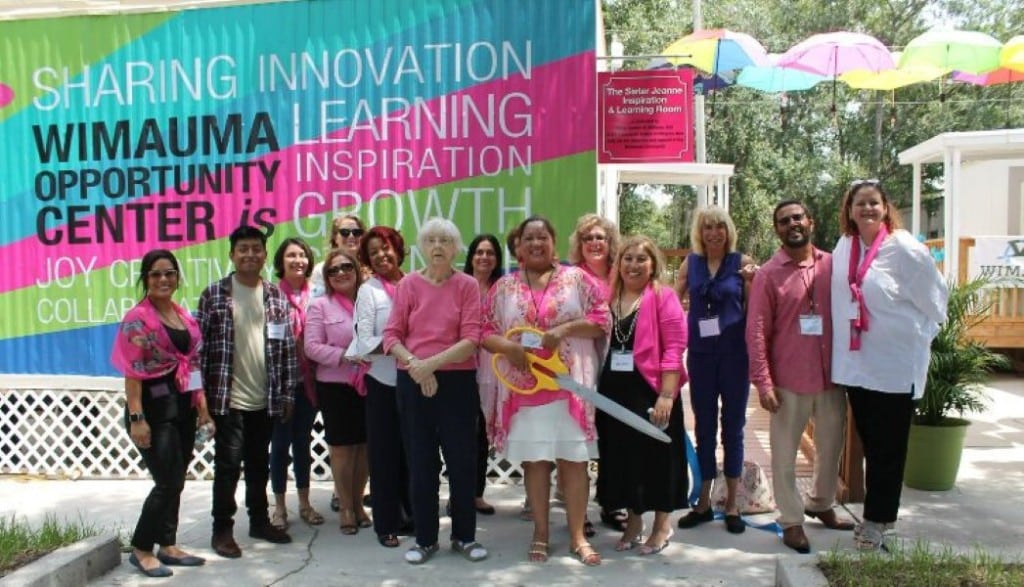 Celebrating the 2022 expansion of the Wimauma Opportunity Center
Already bustling, the center is adding a child care center that will serve up to 50 children. An existing building is being converted to a food service incubator with a kitchen that local culinary entrepreneurs can use for their businesses. The goal is to equip entrepreneurs looking to start a catering business or food truck with the cooking and business management skills that lead to success.
Asked to reflect on her extraordinary journey, Gutierrez says in our current social climate, organizations like Enterprising Latinas are more vital than ever.
“With all the anti-immigrant sentiment out there now, it’s important to continue to champion that idea that everyone deserves an opportunity,” she says. “It is incumbent upon us to create that opportunity. We are, after all, our brothers’ keepers.”
Success stories
Before small business owner Carmen Galarza, of Custom Cakes By Carmen, shares her experience with Enterprising Latinas, she offers an unqualified endorsement.
“I am blessed to have found them,” she says.
Galarza was two when her migrant farm worker parents brought the family to the U.S. and settled in the predominantly Hispanic community of Wimauma in southern Hillsborough County. It was a difficult life.
“We would spend six months here and then move north to pick crops in Michigan, so I was constantly changing schools,” Galarza says. “The language barrier was hard, and back then, there was not much help available.”
She says she knows “God puts angels here” because she found one in Mrs. Rose, a teacher’s assistant at her school who took the time to teach her English.
“I knew how hard it was to work the fields in the cold, in the rain, and in the blazing heat,” Galarza says. “I didn’t want that to be my life or the life of my children. I tried waitressing; I tried childcare. Then I decided to do for others what had been done for me, and for four years I was a teacher’s assistant teaching English as a second language. I worked in the migrant education program, helping kids to graduate.”
Then, in 2004, a drunk driver hit Galarza and her husband head-on. She broke both knees. Her husband spent eight months in the hospital and endured nine years of surgeries.
“The medical bills ruined us,” Galarza says. “I didn’t know what to do. I decided to go back to my job at the school. I would finish classes at 2:30 in the afternoon, then go do a shift at Walmart, where I became the bakery manager.”
She loved to bake, so the job was a good fit.
“We were staying with my mom, so in my free time, I would experiment in her kitchen, especially with cake decorating,” Galarza says. “I thought maybe I could sell my cakes, but I didn’t know where to start.”
She saw an Enterprising Latinas’ flyer at church and went to their office in Wimauma with one of her cakes.
“Liz was there,” Galarza recalls. “She looked at me, she looked at my cake, and she said, “You’re the one. You’re the picture I see for this organization. You have talent and drive.’”
Galarza says she started to cry. Finally, there was a light at the end of the tunnel.
“Enterprising Latinas have taken me under their wing,” she says. “I now have a clear picture of where I’m going. I have a coach, I have a business plan, and I am licensed and insured. The business is doing well. My cakes are at celebrations all over Tampa Bay for birthdays, sweet sixteens, weddings, and quinceañeras. Next year, I’m planning to open a brick-and-mortar location.”
Her children are also poised for success as well.
Her oldest son went to college and recently got back from Australia, where he was working with the Monster Jam monster truck tour. Her daughter is a banker. Her youngest son graduates from high school next year.
“I give many thanks to Enterprising Latinas and to Liz Gutierrez,” Galarza says. “She was my second angel.”
\Ale Pacheco, owner of Ale’s Charcuterie Boards, says Enterprising Latinas changed her life. Pacheco arrived in the US in 2017, after fleeing Venezuela’s political violence. Before the violence erupted, she had a good life and owned a small hotel. In the U.S., she had to start over.
“All of a sudden, you’re nobody,” Pacheco says. “I was working two and three jobs at a time. I forgot who I was. As a way to maintain my memories, I started making food again. The food I would make for my hotel guests.”
Enterprising Latinas helped her grow her skills into a business. Pacheco says she took courses in food management and business management with teachers who “gave me so much positive energy, I knew I could make it.”
Today, she says Ale’s Charcuterie Boards has even caught the attention of a consortium of master cheesemakers in Wisconsin, who saw the business on Instagram and contacted her about using and promoting their products. Pacheco says Gutierrez and her team provided a strong foundation on which to build success.
“This organization is Liz’s life,” she says. “She is dedicated to empowering other women. Thanks to Enterprising Latinas, I’m living the dream. I feel alive again.”
Community partners
For all the praise and glowing reviews, launching and growing a successful nonprofit organization takes sweat, tears, and 24/7 dedication. It also takes money.
Allegany Franciscan Ministries President and CEO Eileen Coogan says her first contact with Enterprising Latinas was during a June 2015 community town hall introducing Allegany’s Common Good Initiative. The outcome was $5,000 in funding awarded to Enterprising Latinas. Since then, Allegany Franciscan Ministries has provided Enterprising Latinas with more than $4 million in funding.
“Enterprising Latinas is an anchor in the Wimauma community,” Coogan explains. “AFM is primarily a health organization. One of the goals of Enterprising Latinas is the stabilization of the family. We consider that a health issue.”
Coogan says that Allegany’s grants process includes rigorous review of a nonprofit’s application and reporting.
“Enterprising Latinas does a good job of reporting and accomplishing their outcomes,” she says. “They are such problem solvers. They get the job done. From our perspective, Enterprising Latinas has been very transparent.”
Coogan says that begins with Gutierrez.
“Liz is unique in that she’s very visionary,” she says. “She can figure out how to get ‘there.’ She has ‘big hairy goals! And she’s been smart about who she hires, about who is going to walk along beside her. She’s added leaders with similar vision…She’s built a team. She made Enterprising Latinas into a sustainable organization that can eventually survive without her.”
Since 2020, grantmaking public charity Community Foundation Tampa Bay has awarded Enterprising Latinas $192,000 through its competitive grant program for Project 2025, a workforce and entrepreneurship training program for 100 low- to moderate-income women from the south Hillsborough communities of Wimauma, Riverview, Gibsonton, and Ruskin.
Community Foundation Senior Vice President, Community Impact Jesse Coraggio says the two nonprofits’ relationship is built on “collaboration.“ Enterprising Latinas has connected with community partners like CareerSource Tampa Bay, Hillsborough Community College, and Ruskin nonprofit the Mary & Martha House to build a coalition, Coraggio says.
That collaboration is valuable when working to improve the quality of life in a community like Wimauma that faces challenges like concentrated poverty, a lack of affordable housing and healthcare access, and road and school infrastructure that hasn’t kept pace with growth.
“It takes a village to solve issues, along with a qualified workforce,” Coraggio says.
Coraggio says with a “visionary leader” like Gutierrez at the helm, Enterprising Latinas moves at the “speed of trust.”
“When you build trust with each other, things move faster,” he says. “Liz brings an energy that gets buy-in.”