
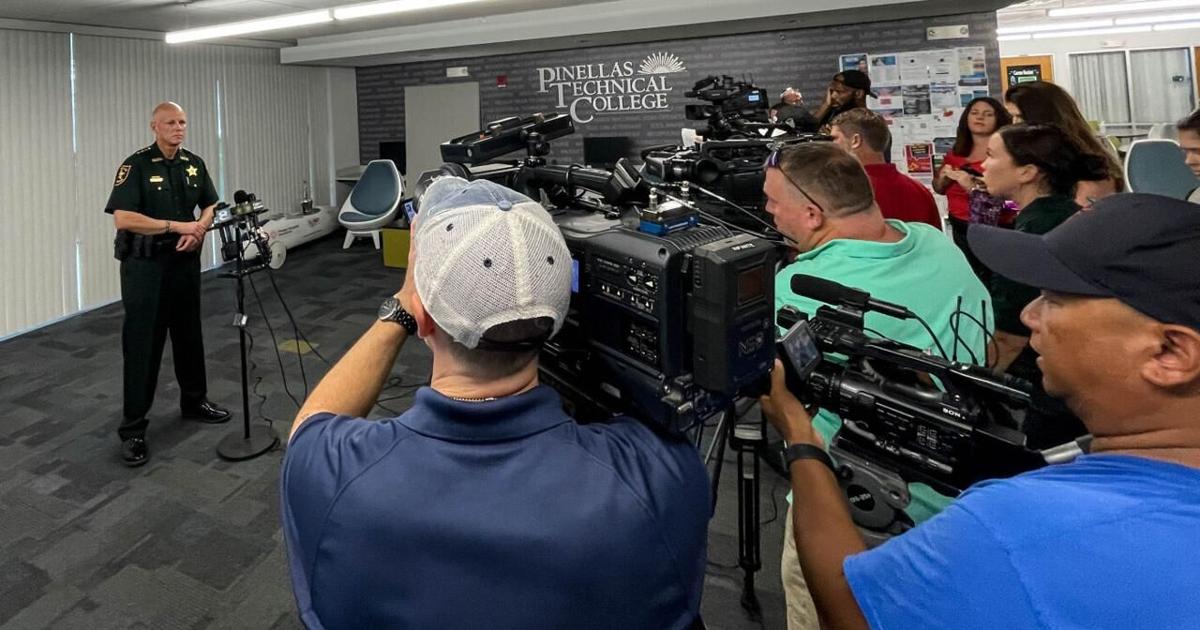

I first met Pinellas County Sheriff Bob Gualtieri when he was running for office in 2011. One of my gigs after getting laid off from The Tampa Tribune was coaching political candidates, Republicans mostly, on how to distill their message, make an elevator pitch and handle questions sure to come their way.
From the moment he walked in, I knew Gualtieri was a winner. He knew what he wanted to say, but drilled and took notes anyway. He knew his stuff from having climbed the ladder — first at the jail, then on patrol, then in narcotics, then in law school and private practice, then PCSO general counsel and interim sheriff. He won the election the next year and has been reelected three times since.
I next experienced Sheriff Gualtieri in 2018, when I was the editorial page editor of the South Florida Sun Sentinel. It happened after the school shooting at Marjory Stoneman Douglas High School in Parkland. An expelled student, known on campus as “Crazy Boy,” bought a military-style weapon and returned with a vengeance on Valentine’s Day. He shot 34 people, killing 17. Most were ninth-graders.
Then-Gov. Rick Scott appointed Gualtieri to lead a commission to investigate the shooting. It was a tough job with competing personalities, pressures and emotions. For the group included family members, other sheriffs, politicians and school officials.
Like our editorial page, Gualtieri was a detailed critic of the Broward County School District and the Broward County Sheriff’s Office for their leadership failures before, during and after the shooting. For speaking truth to power, we both took a lot of incoming.
I saw Gualtieri — and still see him — as a sensible, middle-of-the-road leader who calls it like he sees it. He stood head and shoulders above Broward’s succession of disappointing Democratic sheriffs.
I liked, for example, how quickly he laid to rest the unfounded criticism that a diversion program for low-level, first-time offenders had enabled the shooter. “It’s completely irrelevant,” he said at the time. “It’s a rabbit hole. It’s a red herring. It’s immaterial. And that’s why we’re taking it off the table and the community needs to know that that has nothing to do with what happened at Marjory Stoneman Douglas High School on February 14.”
Our editorial board disagreed with Gualtieri, though, about arming teachers and staff. He believes that teachers, if properly screened and trained, can make a difference, given how fast school shootings occur. We didn’t believe more guns on campus would prevent more shootings.
But we agreed the next school shooting is a matter of when, not if.
The Stoneman Douglas shooting ripped families, friendships and our community apart. It left a lasting scar on many people, me included. So it was good to see the sheriff again the other day.
I had emailed him, asking if he’d come speak to the Dunedin Newcomers Club, of which I’m now president. He immediately said yes. He remembered our coaching session. We also shared some Parkland memories.
He stands 6-foot-5, but I didn’t immediately notice him when he entered the banquet room. Unlike other sheriffs I’ve met during my journalism career, he wasn’t wearing his uniform. It made him appear more approachable.
Gualtieri wowed the crowd, me included. I didn’t agree with him on everything, but who agrees with everybody on everything?
When he talked about immigration enforcement, for instance, he emphasized deporting those who have committed violent crimes, especially those previously deported. Who doesn’t agree with that? But he offered only a passing glance for the many long-time, hard-working immigrants who have been swept up in ICE raids.
He also focused on the school system’s failures in the Parkland shooting. Even a year later, he noted, it still hadn’t created an active-shooter policy. But he failed to mention the sheriff office’s failure to appropriately respond to an active shooter, the FBI’s failure to respond to an emailed warning, the mental health system’s failure to address multiple signs of violence and how Florida let a kid known as Crazy Boy buy a military-style assault rifle. Then again, our time was limited. But in the moment, with so many competing memories flooding back, my eyes welled up.
Still, I give it to Gualtieri. After Parkland, he supported raising the age at which someone can purchase a firearm, from 18 to 21. He continues to oppose efforts to lower it, a fight that will take place in Tallahassee again this year. Both are courageous stands for a Republican sheriff. But in preparing that nearly 500-page commission report about the shooting, he obviously took good notes about when the minds of young men fully develop.
Gualtieri also crusades for more mental health funding, a cry that largely falls silent as mass shootings fade into yesterday’s news. He’s also practical about school safety. He underscores the need for vigilance on threat assessments but recognizes the impracticality of metal detectors and hand-held wands in getting 4,000 students to class on time.
Neither is he a fan of open carry. Since Florida’s long-standing open-carry ban was struck down in September, he says it’s legal to walk down Main Street with a gun in your hand. He plans to lobby lawmakers to require that guns be holstered, at a minimum.
Gualtieri was named Sheriff of the Year by National Sheriffs’ Association after his work on Parkland. The Major County Sheriffs of America gave him a similar award in 2022.
At 64, he has three years left on his term. I have no inside knowledge, but I expect he’ll run again.
I’m a moderate Democrat. He’s a moderate Republican. But my first impression was right. Gualtieri’s a winner. And from my vantage point, he’s a keeper.
Rosemary Goudreau O’Hara is the former opinion page editor of the South Florida Sun Sentinel and before that, The Tampa Tribune. She now lives in Dunedin.