
Four proposed constitutional amendments to overhaul Florida’s property tax framework are now one stop from the House floor after clearing another committee hearing, where Democrats, local officials and policy advocates again warned of adverse impacts.
After three hours of discussion, Republican lawmakers in the State Affairs Committee pushed through the quartet of proposals, which varied in scope. One measure (HJR 201) would eliminate all non-school property taxes for residents with homestead exemptions. Another (HJR 211) would allow homeowners to transfer their accumulated Save Our Homes benefits to a new primary residence, without portability caps or restrictions on home values.
The former, if cleared by both chambers of the Legislature and approved by voters, would result in savings for homeowners — and shortfalls for local governments — of more than $14 billion in 2027 and more than $18 billion per year after.
The latter, far more focused resolution, would lead to a negative yearly impact on local coffers statewide of close to $337 million, according to state economists.
Another proposal (HJR 205) would exempt Florida residents 65 and older from paying non-school homestead property taxes. In its current form, the measure has no long-term residency requirements for beneficiaries and no income threshold.

There’s also HJR 209, which would grant an additional $200,000 non-school homestead exemption to those who maintain multiperil property insurance, a provision that proponents say will link relief to insured, more resilient homes.
All the proposals would prohibit local governments from reducing property taxes that fund law enforcement below their current funding levels and also exempt school-related property taxes. Those carve-outs would not extend to fire rescue, and the funding for other first responder-related services — such as 911 dispatchers and emergency medical technicians — may not be protected, depending on how the Legislature implements the changes.
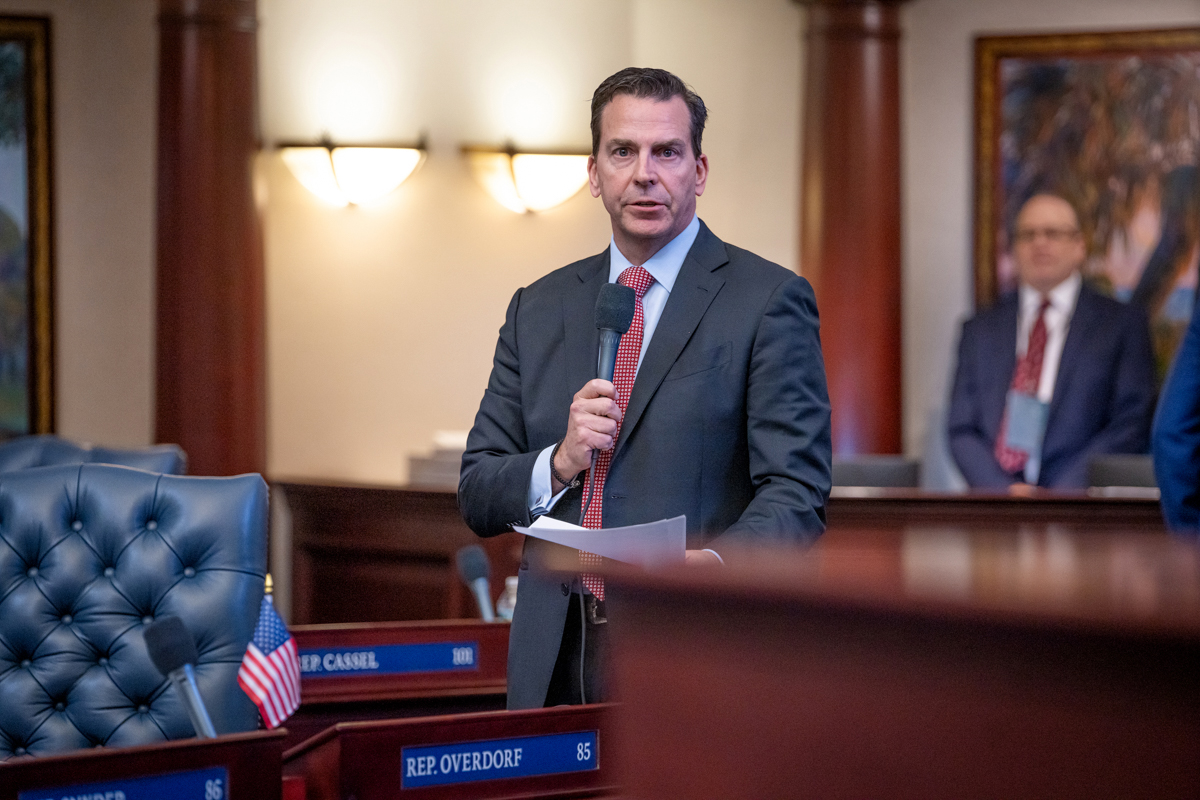
Palm City Republican Rep. Toby Overdorf, who is sponsoring HJR 211 and chairs the Select Committee on Property Taxes that helped to craft eight property tax proposals now advancing in the House, reiterated his central thesis in backing restrictions on local levies: Counties and cities have gone spending-crazy in recent years, and they’re playing too liberally with money that isn’t theirs.
“Local government property tax revenue (is) increasing at an unsustainable rate and causing an unsustainable burden on the Florida citizens, homeowners and businesses,” he said. “It’s time to put money back in the pockets of Floridians.”
Rep. Monique Miller of Palm Bay, who is carrying HJR 201 with fellow Republican Rep. Kevin Steele of Dade City, noted that the budget of nearby Orange County has ballooned by 90% since 2020 at a rate that “far exceeds any population growth or inflation.”

“We have to get back to the right size of government and the services government is meant to provide,” she said.
Miami Republican Rep. Juan Porras called HJR 205, which he filed, “the most commonsense solution to property tax relief” being considered, since it would safeguard seniors on fixed incomes from the risk of losing their homes.
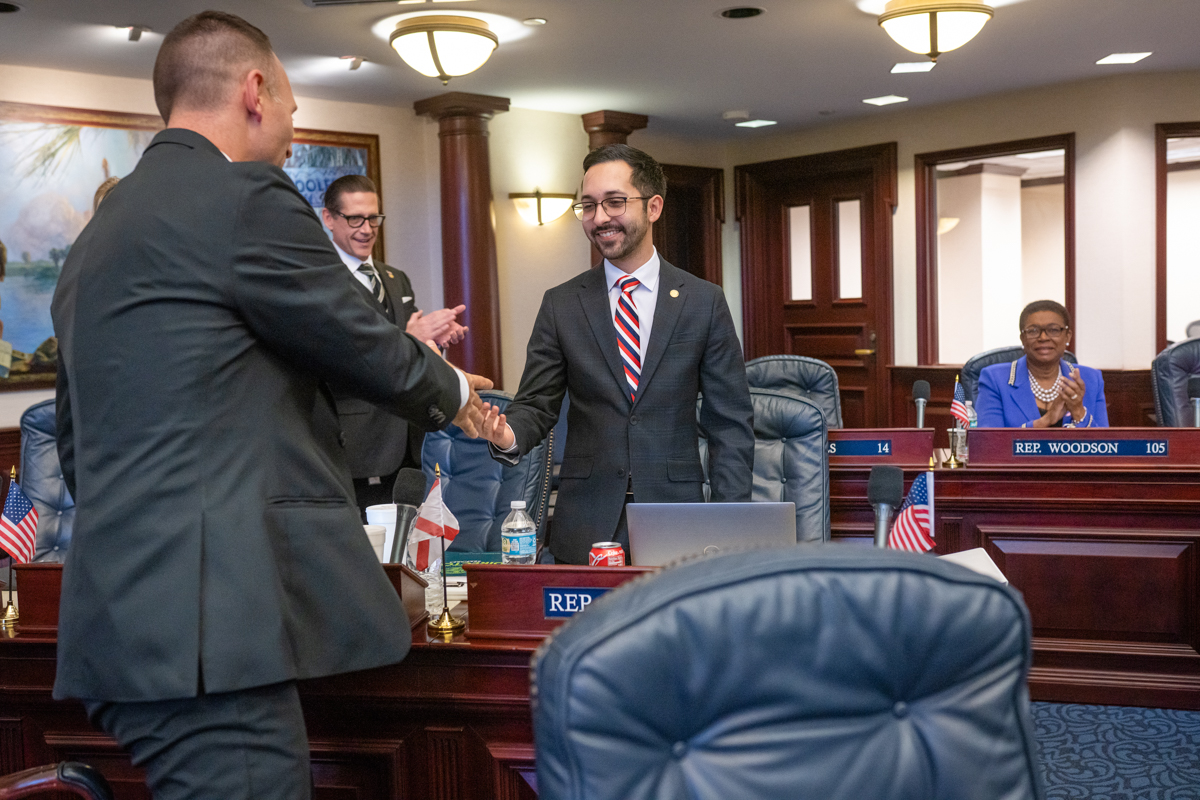 Miami Rep. Juan Porras says his proposal to eliminate property taxes for homesteaders 65 and older is ‘the most commonsense solution to property tax relief’ being considered. Image via Florida House.
The first-year impact of his measure, if approved, would be a $5.1 billion reduction in local government revenues that would grow to about $6.7 billion statewide by the fifth year. That includes a $2 billion shortfall in his home county of Miami-Dade.
Democrats on panel, all of whom voted “no” on the measures Tuesday, pointed out what they saw as flaws in the proposals, from the lack of consideration for other first responder services to lost funding for food assistance, paratransit and senior centers, among other vital services.
St. Petersburg Rep. Lindsay Cross, an environmental scientist by trade, warned of severe water impacts as Water Management Districts across the state could face calamitous underfunding.
She cited recent research by Florida TaxWatch and the state Office of Economic and Demographic Research that found that the state’s current freshwater shortage of about 79 million gallons is projected to grow exponentially over the next 20 years, requiring an extra $2.4 billion in investments to address supply needs.
“These are really scary numbers,” she said, adding that HJR 201 has the potential of eliminating about a third of the budget for Water Management Districts tasked with overseeing water supply, quality, flood protection and related issues, which don’t have another revenue-generating option.
“It is incredibly shortsighted to jeopardize the quality and quantity of our freshwater systems that are literally the lifeblood of our state. And honestly, I can’t think of something that is a bigger priority than water. This bill puts that at risk.”
Orlando Rep. RaShon Young, who won his seat in a September Special Election, argued that HJR 209 could hurt homeowners doubly if a hurricane hits their area and their insurer later drops them. Rep. Wyman Duggan, a Jacksonville Republican who spoke for the bill in place of its sponsor, fellow Republican Rep. Demi Busatta of Coral Gables, said it could “potentially” happen, but that lawmakers may address that potentiality in the implementation language, post-voter approval.
Of more than a dozen people and organizations that registered to speak to the committee Tuesday, all admonished lawmakers to kill the bills or proceed more cautiously.
Casey Cook, Chief of Legislative Affairs for the Florida League of Cities, said people choose to live in cities because they expect more services than are provided at the county level. And the types of taxes they levy vary in share from city to city, he continued, noting that while Parkland in Broward County generates 75% of its property tax revenues from homesteads, Sanibel in Lee County gets just 32% of its property tax pie from homestead taxes.
Cook said that while most states have a “three-legged stool” to support their budgets, Florida has just two, since it has no state income taxes, leaving only local property and state sales taxes.
“The highest credit rating you can get in Florida if you’re a local government is double-A. If you’re removing a major component of that credit rating or a major revenue source, our credit ratings will be decreased,” he said, pointing to a similar scenario Indiana now faces. “What that means is your borrowing costs will go up. That means the taxpayers pay more and get less.”
Amina Spahic, Political Director for Florida For All, said the absence of implementation bills suggests Republicans are advancing half-baked ideas whose effects haven’t been thought out enough so Gov. Ron DeSantis and CFO Blaise Ingoglia — whose audits of local government have produced reports of more than $1.5 billion in overspending — gain political points.
“I don’t know how you can, for example, include a retired billionaire who will not be paying taxes in the same crowd as somebody on Meals on Wheels,” she said. “At the end of the day, the rich are just going to get richer, as has been historically the case in the state. So, if we’re going to go down that track, I would like to know accountability measures.”
Miami Beach Republican Rep. Fabián Basabe likened concerns over implementation drafts are misplaced, considering that they almost always come after the approval of a referendum, not before.
“That’s just the way it is,” he said. “To confuse that, to create this narrative, to act (like) somehow we’re doing something wrong this time, this one time — it’s just false.”
HJR 201, HJR 205, HJR 209 and HJR 211 all passed 18-7 on a party-line vote. They will next go to the Ways and Means Committee, after which they would head to the House floor. None of the bills has a Senate companion.