
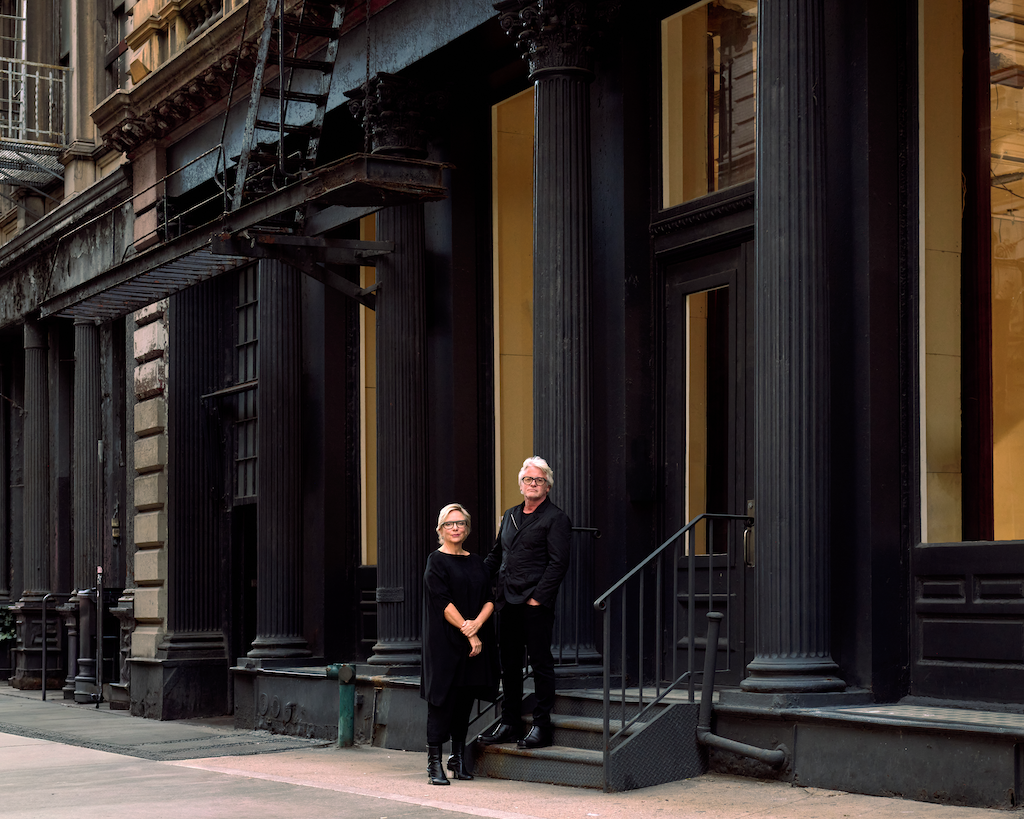
Trevyn McGowan is in love with the ceiling: sixteen feet of air and light and exposed brick walls supported by thick cast-iron over a century old. The co-founder of Southern Guild, the well-regarded Cape Town gallery, was showing me their newest outpost, a lovingly restored 19th century Tribeca townhouse on Leonard Street. She moved through the raw, empty space slowly. Spools of electrical cable and construction lights hung from white Corinthian columns and the exposed air ducts and piping.
“This has happened with all of our moves around the world,” she said, lowering her voice to a whisper. “I saw two other places, just two. And I walked in here I was like ‘no, no, no, this.’ I just lost my heart.” She paused. “Are we really doing this?”
Related Articles

Later, in a conference room at a nearby coworking space, she framed the expansion to New York as not so much strategic as instinctive. “It feels right and we feel ready,” she said, before conceding that there was a ‘leap of faith’ involved. “My daughter said that if I wasn’t nervous about the move, I’d be psychotic. And we are, but there’s a calm rightness about this as well.”
The reason for nervousness is obvious: 2025 has been a bewildering year, rife with gallery closures and doomsday proclamations. Among the more savvy players, there has been a growing recognition that the art world is shifting into a less overheated—and perhaps healthier—version of itself. But to understand why Trevyn and her husband and fellow co-founder Julian McGowan felt they had to make the leap to New York—and consequently close their Los Angeles space—you have to understand how Southern Guild was built.
By the time the McGowans opened their first space in Cape Town, they had already decided on their program’s criteria: deeply personal, technically ambitious, and utterly singular. The last part is the most important.
“We’re not attracted to artists that overlap. If you see something by Zizipho Poswa or by Manyaku Mashilo or by Zanele Muholi, there’s no other artist who could have made it,” Trevyn said with the matter-of-fact conviction of someone explaining gravity.
Their program isn’t built around trends or the usual rhythms of the global gallery network. It moves according to its own internal logic, one shaped by Trevyn’s childhood under apartheid and her experience as a mother of five, and by Julian’s technical and theatrical sensibility. Over time, the contours of the program have emerged: work that requires labor, that builds its own world, and that wrestles with the relationship among material, form, and memory. In their hands, identity isn’t a prompt—it’s a set of lineages.
Zizipho Poswa, Isacholo (2024) Courtesy, Southern Guild.
Elizabeth Carababas
If Southern Guild has an anchor artist, it’s Poswa, whose sculptures—often ceramic silos topped with bronze amulets or fierce, sharp horns—feel as if they emerged from a future archaeological site. Poswa has been with the McGowans since the beginning, having started her career with handcrafted bowls made for export. The Met, the Art Institute of Chicago, the Los Angeles County Museum of Art, among others, now all have major works by Poswa in their collections.
Her practice is physically grueling and materially complex: clay bodies built in Cape Town paired with bronze elements cast in the gallery’s partner foundry, sometimes assembled across continents. Poswa described Julian’s involvement in near-engineering terms: he helped her figure out how to blend the two materials.
“They are very invested in the dream of the artist,” Poswa told me. “It’s not easy for artists here to find representation. When the representation is there—and they really understand you—it matters.”
If Poswa represents the gallery’s roots, Mashilo embodies its expansion. A younger painter, picked as a 2026 Artsy Vanguard artist just last month, she works with materials rooted in the land—ochre, plants indigenous to South Africa, clay, and earth. Born in Limpopo in the north of the country, Mashilo witnessed the rites of Sepedi women but moved to Pretoria before experiencing them herself. Those rituals, and others, appear often in her work.
“I didn’t even know how to imagine what I was imagining until they came along,” she told me.
Manyaku Mashilo, In the radiance of stars (2025) Courtesy, Southern Guild.
The Tribeca gallery is Southern Guild’s second foray into the U.S. Their first, in Los Angeles’s Melrose Hill, opened in February 2024. With that location closing, Trevyn framed their Los Angeles period as a kind of two-year apprenticeship in the American art world.
“There’s no way we could have come from Cape Town straight to New York,” Trevyn said. L.A., she added, gave them room to grow, to build community, to find their footing. And once they had, the horizon shifted.
Their entrée into New York, then, is about answering a new level of ambition for both the gallery’s artists and the gallery itself. A string of strong fair outings at Frieze Los Angeles in February and the Armory Show in New York convinced the McGowans that their program was ready for the scale, scrutiny, and gravity of a city that still shapes the global conversation.
Southern Guild’s debut at Art Basel Miami Beach this week is a stress test — a chance to see how their most ambitious material language holds up inside the fair that still dictates, for better or worse, the mood of the global market at the end of the year. The presentation centers on Zanele Muholi, one of the most acclaimed photographers working today and arguably the gallery’s greatest success. Fresh off a mid-career survey at London’s Tate Modern, which closed in January, the artist will present two new material explorations based on their well-regarded self-portraiture series “Somnyama Ngonyama,” one rendered as a photographic lightbox, the other a large aluminum print.
Poswa’s nearly ten-foot Isacholo — an upscaled Xhosa healing bracelet cast in bronze and ceramic — will form the booth’s vertical anchor, while works by Dominique Zinkpè, Bonolo Kavula, Chloe Chiasson, and Ambrose Rhapsody Murray broaden its terrain.
Collectors have already begun circling. Ty Ahmad-Taylor, a collector and SFMOMA board member who encountered the gallery at both fine art and design fairs this year, told me, “What [Southern Guild is] doing isn’t about category or trend. It’s conviction. You can feel when a gallery isn’t faking it.” For him, the gallery’s presence at certain fairs signals its level of ambition. While he hasn’t seen the Miami presentation, the gallery’s steadfast approach has long since made a convert of him.
Southern Guild arrives in New York with a worldview sharpened by proximity to its artists: that ambition should be technical as much as conceptual; that an artist’s strange, private language is something to be protected, not tidied; that borders between design and fine art exist mostly because people are afraid of what happens when you ignore them. The McGowans hope the Leonard Street gallery becomes the physical expression of that worldview.
Standing in the unfinished Tribeca gallery, Trevyn gestured toward the far wall where there was once a fireplace, long since bricked up. As she moved through the space, she pointed to where Julian wants a movable wall, to the natural light falling in a sheet across the hardwood floors, to the Corinthian column, the uppermost sections of which will remain exposed because “you can’t take away the soul of this room.”
It’s not confidence, exactly, that animates the McGowans, but conviction. They believe so deeply in their approach that they aren’t afraid to adapt, improvise, and sometimes leap before the ground has finished shifting. And with 2026 fast approaching, it might be those first movers who define what comes next for the art world.