
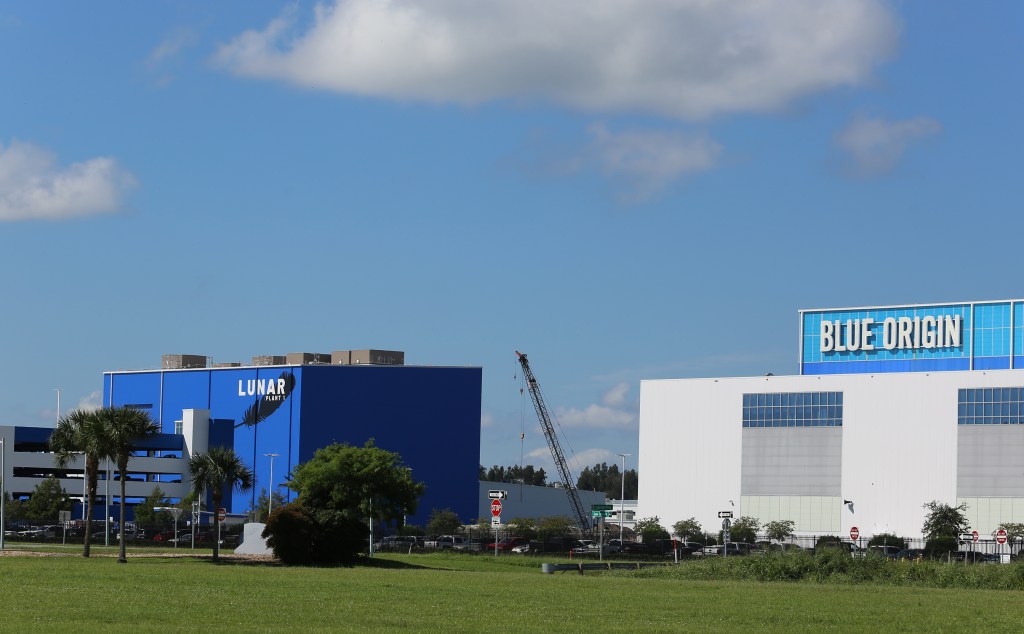
The Florida Department of Environmental Protection has issued a draft proposal that would allow nearly 500,000 gallons of wastewater daily at Blue Origin’s Merritt Island facilities that would affect the Indian River Lagoon.
The permit would allow Jeff Bezos’ rocket company to operate an industrial wastewater treatment facility that could dispense up to 0.49 million gallons per day. Of that total, up to 15,000 gallons per day could be for nonprocessed wastewater.
All of it would be discharged into a large stormwater pond with more than 400,000 square feet of surface area, but then flow into the Indian River Lagoon in north Brevard County.
“This is a renewal of an existing agreement that has been in place for more than five years,” the company said in an emailed statement. “We are committed to maintaining responsible and compliant operations.”
The issue, though, raised the alarms for environmental groups that are already waving red flags for the potential impact on the regional waters on the Space Coast amid the surging aerospace infrastructure needs.
A Change.org petition launched in response to the proposal titled “Stop Industrial Wastewater Discharge Into the Indian River Lagoon” has drawn nearly 5,000 signatures. It calls on the DEP to either deny the permit as proposed or require zero discharge into the lagoon married with strict, enforceable limits, mandated third-party monitoring, full public data transparency and public meetings.
“The Indian River Lagoon belongs to ALL of us — not corporations, not private interests, not polluters,” it states.
The DEP said public comment should be made within 30 days of the notice’s Nov. 18 publication. If sufficient call is made, a public hearing on the draft proposal could occur. Details on how to comment can be found online at floridapublicnotices.com/notices/11397829
Of note, the Florida DEP has a Basin Management Action Plan that requires any wastewater treatment facility with a flow of more than 500,000 gallons per day to meet more rigorous wastewater treatment standards if they flow directly into the Indian River Lagoon or rapid infiltration basins within the lagoon watershed.
This Blue Origin draft permit falls just under the threshold.
SpaceX and Blue Origin have led the way with billion-dollar manufacturing operation expansions, while the region has also seen other players behind major projects. That includes the addition of a major satellite processing facility for Amazon, the expansion of operations for United Launch Alliance and the arrival of new rocket company facilities in Cape Canaveral including Relativity Space, Stoke Space and others.
“I think our basic problem with the whole thing is that, of course, the space industry is expanding at a historical pace at the Cape, and the problem we have with it is that it’s being done piecemeal, contractor by contractor,” said Dave Botto, chair of the intergovernmental committee for the Marine Resources Council, a nonprofit group based in Brevard County dedicated to the restoration and preservation of the Indian River Lagoon.
He said his organization’s view is the entire Cape is an ecosystem and that site planning and design should be approached with that in mind.
That means taking in the region’s total hydrology and topography, which allows developers “to use things like wetlands and other natural areas to help you with your site planning, and to use those tools to take care of the problems of runoff pollution, wastewater pollution and so forth,” he said.
The group was among several that have weighed in on the massive expansion plans of SpaceX for its proposed Starship and Super Heavy operations at both Kennedy Space Center and Cape Canaveral Space Force Station.
In the draft Environmental Impact Statement public responses for the KSC site, the Marine Resources Council posted its concerns noting the waterway is a 156-mile estuary that includes the Indian River, Banana River and Mosquito Lagoon that supports more than 4,300 species of plants and animals. That includes threatened and endangered species like the Florida manatee.
“Despite its ecological value, the IRL faces significant stress from nutrient pollution, algal blooms, habitat loss, and rising sea levels,” the letter stated. “Water quality declines have led to widespread seagrass die-offs and cascading effects on wildlife populations.”
It notes the activities from the aerospace operations on the Space Coast can contribute to these pressures through increased stormwater runoff as well as noise, light, vibrations and potential chemical contamination.
“Because of its proximity to launch facilities, careful assessment of cumulative impacts (such as launch emissions, acoustic shockwaves, and accidental spills) is essential to ensure the protection and restoration of this fragile ecosystem,” the letter stated. “Strong mitigation measures and ongoing monitoring are critical to safeguard the Lagoon’s ecological health and the economies and communities that depend on it.”