
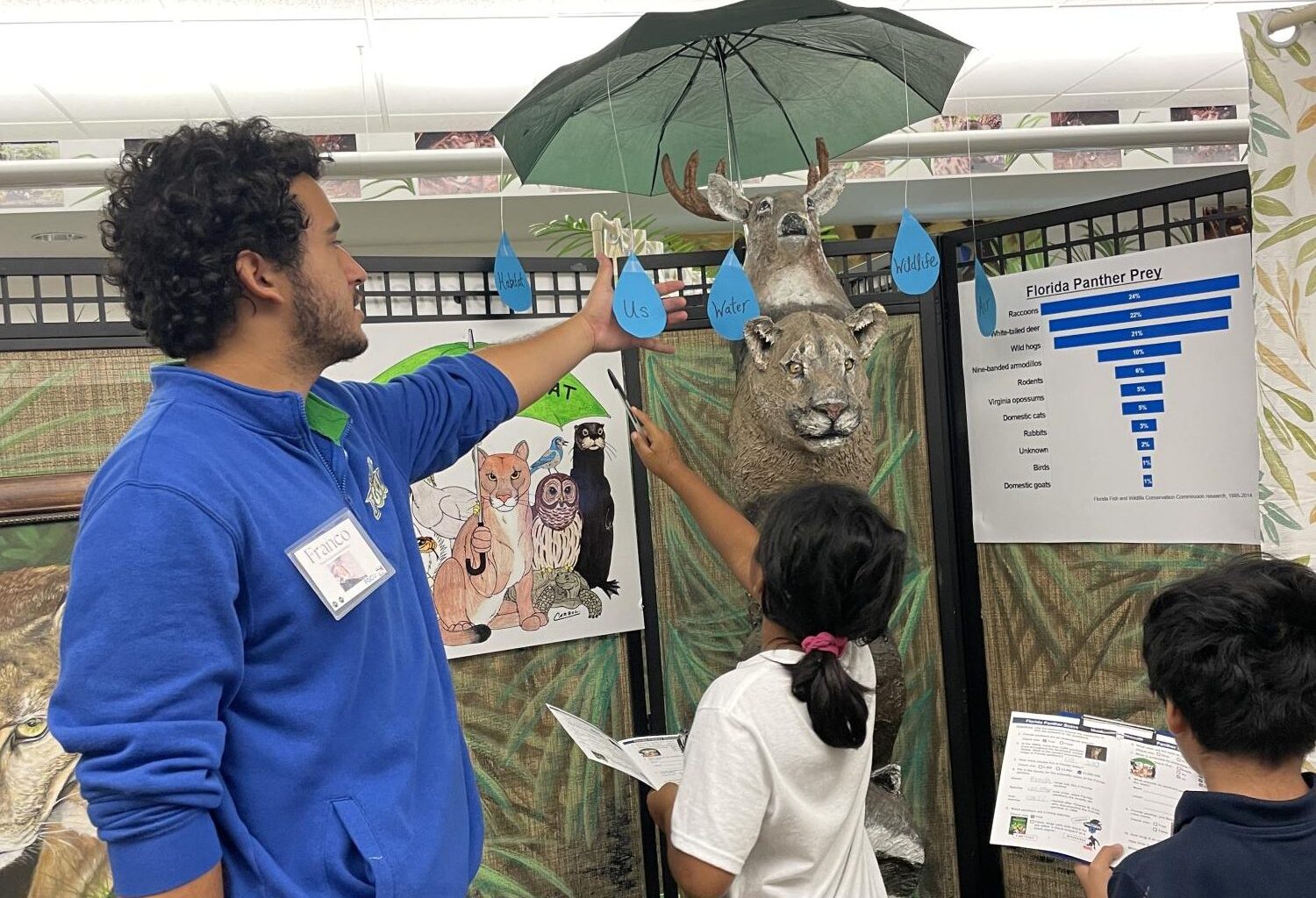
FGCU offers many on-campus opportunities for students to work. One that some might not be as familiar with is the Wings of Hope program, where FGCU students help educate elementary school students across Lee, Collier and Sarasota counties about the importance of the Florida panther to our ecosystem.
Wings of Hope is a longstanding program at FGCU started by Ricky Pires in 2000. Pires was the former director of the Wings of Hope program until her retirement on Aug. 2, 2024.
This fall semester, it is now overseen by Anna Godsea. She is currently the Outreach Coordinator for Wings of Hope and has been part of the program since 2017, when she was hired at FGCU to be the Education Coordinator for the curriculum. During her time with the program, she has brought new additions and a vision for its future.
Eric Camacho is a student working for Wings of Hope, and he and his peers are adding new activities to the Panther Posse program.
Story continues below advertisement
“We have this new project that I’ve been working on. I’m really excited for the kids to see, we have a big table where they can identify paw prints,” said Camacho.
The Florida panther is an important species to the Florida ecosystem because it is classified as an umbrella species. Their protection is a priority because they have an estimated population of around 200, and their habitat is crucial for protecting animals and species within the ecosystem.
“Something that people should always know is to drive slowly when you see a Panther sign. Drive slow, because they cross and they get hit by a car and then most of the time they don’t recover,” Camacho said. “There is a big push to build underpasses and overpasses here in Florida. For the wildlife, you get from one side of the territory to the other. And I support that.”
While the program has remained focused on its mission of educating young children about the Florida panther, Godsea is introducing a new way for middle school children to get involved with Wings of Hope. The goal is to get them to use a wildlife camera to conduct their own research projects.
“We provide the equipment, training and the students,” Godsea said. “The school would have it on their campus for about nine weeks of the grading period, and then we collect that, and then we do it again on another grading period.”
The Panther Posse program runs through October and November. In spring, they switch over to a Hiking Adventure program.
Wings of Hope brings students to the CREW Land and Water Trust’s trails and explores the panther habitats with them.
It is becoming more common for students to receive texts from FGCU informing them to exercise caution when bears are spotted on campus. Godsea is interested in helping students adapt to living with the wildlife encountered on campus.
“We’re also trying to turn our attention and focus back to our FGCU community, and make sure that we’re doing things and hosting events that help our FGCU students as well,” said Godsea. “Soon we’ll be having some table events to talk to FGCU students about coexisting with black bears since we’ve had a few visit the campus. Just to keep everyone safe, there’s some really simple things that you can do so that we can coexist peacefully with these animals.”
Although urban development has become a more prevalent reality in society, the program helps inform the next generation that healthy ecosystems are still essential for survival.
In a world that is increasingly dominated by technology and urban development, it is easy to forget that we still rely on a healthy ecosystem for our survival, from clean air to drinkable water. Wings of Hope has remained committed to its goal of raising awareness about the Florida panther. Godsea hopes to expand the program into new areas of environmental protection.
Students interested in volunteering for Wings of Hope can take advantage of on-campus opportunities located in Reed Hall 247. Through the program, FGCU students can continue to educate children about the local environment and the animals that inhabit its ecosystem.