
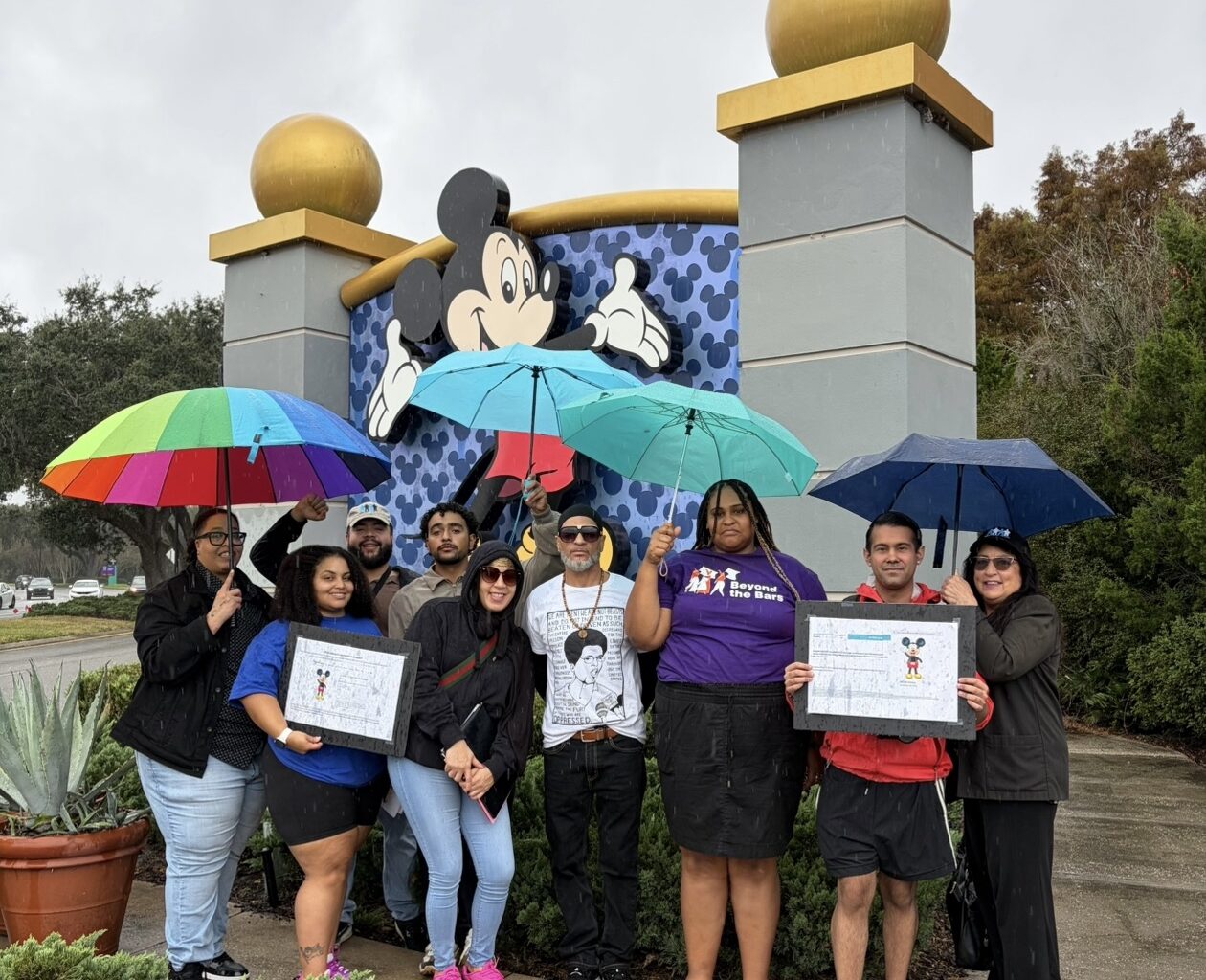
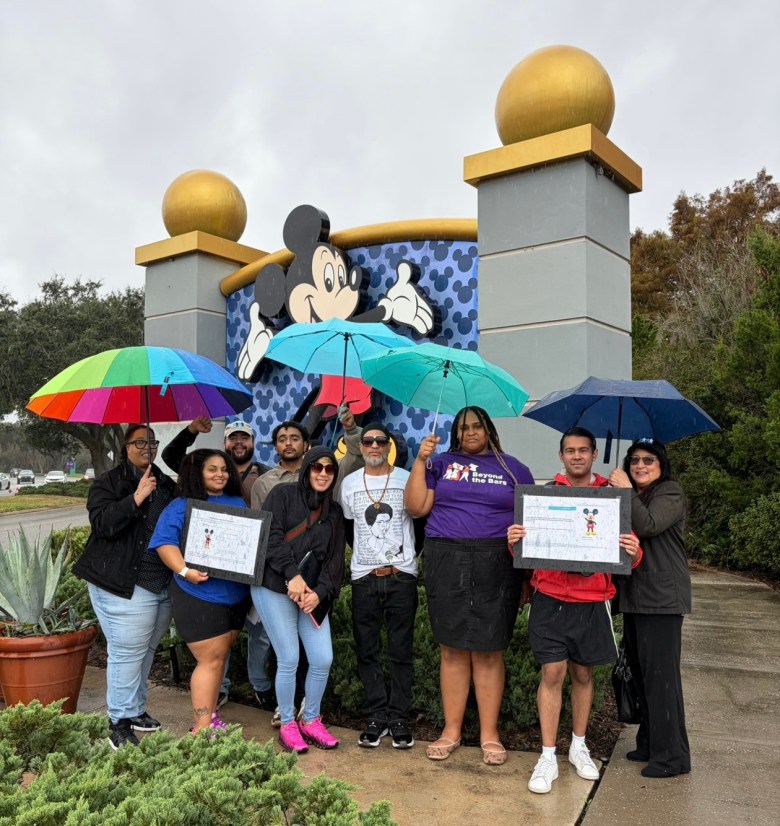
 Advocates with Central Florida Jobs with Justice and the Minnesota Incarcerated Workers Organizing Committee urge Disney to hold balloon manufacturer accountable for fair treatment and pay for incarcerated workers who fold Disney character balloons. Dec. 2, 2025. Credit: Courtesy of Central Florida Jobs with Justice
Disney World has long been known for putting effort into making every family’s visit to its Orlando parks magical. The multinational entertainment giant sells its fill of merchandise at its world-renowned parks to appease eager children and adults alike, and offers various guest services to accommodate the needs of guests with all abilities, plus their service animals.
Disney even recommends specialty character balloons through an online vendor that guests can buy and have personally delivered to their hotel room at a local Disney World Resort hotel.
A jumbo Mickey Mouse-shaped balloon, for instance, will cost you $45 plus a delivery fee. But what isn’t disclosed, by neither Disney nor its third-party vendor, is the manufacturer who produces those balloons — and how much workers are paid to fold and package them.
Anagram International, a licensed manufacturer of decorative Disney balloons, is based out of Minnesota and is one of the Minnesota Department of Corrections’ largest contractors for prison labor. Its contract with the state’s corrections system — a recent subject of scrutiny by state auditors — allows Anagram to use prison labor at certain correctional facilities to fold, add ribbons to, and package their products. Allegedly, this includes Disney character balloons.
That’s why advocates with the Minnesota Incarcerated Workers Organizing Committee and Central Florida Jobs with Justice joined forces outside Disney World Tuesday to voice their concerns.
Dontania “Nina” Petrie, 35, who served three years’ time in Minnesota’s Shakopee Women’s Prison from 2017 to 2020, is all too familiar with the balloon production process. She told Orlando Weekly that, while incarcerated herself, she was directed to fold 300 to 500 hundred Anagram-branded balloons per hour for an hourly wage of just 50 cents.
“One of the tasks that I did was folding balloons with Disney characters on them,” she recalled at a press conference Tuesday. “I remember that some of them had characters from Frozen and the fork from Toy Story 4 – I remember because my other daughter really loved Frozen, so it stuck with me.”
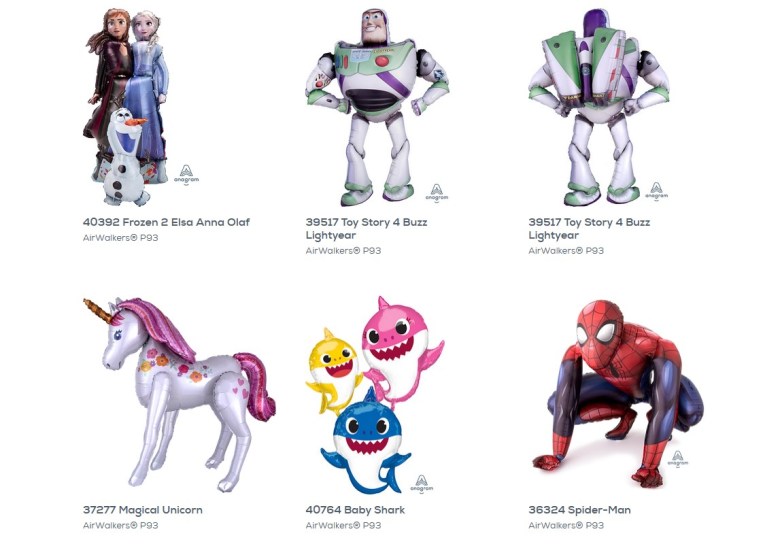 A screenshot of Disney character balloons manufactured by Anagram International. Credit: via Anagram Balloons
In 2024, the average wage for workers folding balloons in Minnesota prisons was just 90 cents an hour, according to a recent state audit. That’s more than Petrie herself earned, but still far less than Minnesota’s 2024 minimum wage of $10.85 for large employers — those that report at least $500,000 in annual gross revenue — and $8.85 for smaller employers.
“There’s 50 of us to a room, we’re all folding balloons, and we’re each getting paid 50 cents,” Petrie recalled. “That’s $25 an hour to fold up 300 balloons a piece. And then they’re selling these same balloons, one balloon, for $50.”
A call to action
Incarcerated workers, unlike most other employees, aren’t entitled to minimum wage under the Fair Labor Standards Act. Courts have ruled they do not in fact count as “employees.”
And although slavery and involuntary servitude is barred under the U.S. Constitution, the 13th Amendment contains one exception: “except as a punishment for crime whereof the party shall have been duly convicted.”
Petrie, an advocate with the Minnesota Incarcerated Workers Organizing Committee, can’t say for sure whether the Disney balloons that prisoners fold behind bars for Anagram are the same balloons that are delivered to guests at Disney World Resort hotels in Orlando. Balloons produced by Anagram International, a Minnesota-based company, are also sold at Amazon, Party City, and other party supplies sites.
Still, she and other advocates with Central Florida Jobs with Justice, a local coalition of labor and social advocacy groups, are calling on Disney to disclose whether prison labor was used to make the balloons sold at Disney World Resorts. And, if so, for Disney to disclose the pay rates for the workers who helped make those balloons and to advocate for state legislation in Minnesota that would raise wages for incarcerated workers.
“When I left Shakopee, I left with about $108 that I used to get a little flip phone and a tank of gas,” said Petrie, who’s now studying to become a civil rights attorney. “I believe that when people leave prison, they should be able to get their life back on track.”
“I believe that when people leave prison, they should be able to get their life back on track”
Having too little money upon release, she added, “can make it easier to fall back into criminal activity.”
The Walt Disney Co. did not respond to multiple requests for comment on this story via email. Nor did Anagram International, a leading foil balloon manufacturer that has a contract with the Minnesota Department of Corrections that is set to last through 2026.
The Walt Disney Company has a set of international labor standard for its supplier chain that explicitly prohibits forced labor, including paid prison labor.
“In the event forced labor is identified at a facility, Disney may require that Disney-branded production at the facility be suspended until remediation is completed,” a Disney impact report reads.
“People who are serving their time deserve to be treated like human beings,” said Sam Delgado, a community activist and program manager for Central Florida Jobs with Justice.
Advocates with Beyond the Bars, a Miami-based worker center that similarly advocates for workers with criminal records, joined Delgado and the Minnesota IWOC on a public sidewalk just outside of Disney World on Tuesday, in solidarity with their call to action for Disney.
“What our members are fighting for is what every person deserves: a living wage, strong protections, and a clear path to stable, long-term, union employment when they reenter their communities,” said Jandrick Castro, an organizer with Beyond the Bars. “We reject it when their labor is exploited.”
‘It’s exploitation, really’
In 2024, Minnesota prisoners who folded Anagram-branded balloons behind bars did so for less than a dollar an hour, even as incarcerated workers tasked with packaging or adding ribbons to balloons, for instance, earned more.
Under rules of a federal program that Minnesota’s correctional system participates in, the Department of Corrections determined that only certain types of work, including tying ribbons onto balloons, were eligible for a higher, prevailing wage that is mandated by program requirements.
Other types of work, such as folding balloons, were exempted from this higher wage, a state audit found, as long as the balloons folded by inmates weren’t actually produced by other incarcerated workers.
“It’s exploitation, really, at the end of the day,” said Petrie.
Members of her organization have advocated in recent years for stronger protections for incarcerated people in Minnesota prisons, including an end to solitary confinement and an end to strip searching in the wake of sexual assault allegations against prison guards.
In Florida, prisoners similarly work through multi-billion dollar companies like Aramark — producing billions of dollars’ worth in goods and services — for little to no pay. For Petrie, her cause is driven by a commitment to racial justice in addition to labor rights, arguing that low pay for incarcerated workers (a disproportionate percentage of whom are people of color) inside creates a “pipeline” for recidivism.
“I do believe that this is just the prison industrial complex, so that we are there to actually subsidize these billion dollar corporations,” Petrie said.
Taking it seriously
Advocates highlighted the fact that the Walt Disney Company has delved into allegations of labor violations before. It has sent auditors to factories overseas and has even looked into labor practices at a factory that didn’t have a direct relationship with Disney, but was producing Disney-branded products as the result of “unauthorized subcontracting” by a licensee’s supplier.
As stated in a 2022 impact report, Disney has made efforts to respond to “public concerns” and “allegations” of unsavory labor practices. This includes allegations of the “underpayment of wages” at a factory in Thailand that produced Disney-branded products without explicit authorization from the entertainment giant.
“We take seriously claims of labor standards violations against independent facilities that manufacture Disney-branded products, and when stakeholders and those we do business with bring such allegations to us, we work to investigate and address these allegations promptly and responsibly,” the impact report states.
Disney World itself employs more than 40,000 parks and hotel workers who are represented by a labor union, and who have certain protections and a path for recourse if they believe their rights have been violated. Third-party service workers at Disney Springs, employed by Disney subcontractor The Patina Group, have been organizing for similar protections on the job and a fair process for forming a union themselves.
Delgado, with Central Florida Jobs with Justice, confirmed that advocates delivered a report to Disney on Tuesday, documenting the Disney balloon-folding situation occurring in Minnesota prisons. They also requested a meeting with corporate Disney representatives in Orlando to discuss.
“Anagram Balloons saves money by having their balloons folded in prisons,” Delgado said. “We are proud that Disney has the tools to stand against that.”
Subscribe to Orlando Weekly newsletters.
Follow us: Apple News | Google News | NewsBreak | Reddit | Instagram | Facebook | Bluesky | Or sign up for our RSS Feed
Related Stories
From Orlando to Tokyo in one flight? Pinch me (Actually, don’t)
Disney argued a strike by employees of one of its contractors would violate a separate union contract Disney has that covers its own employees
The beloved gorilla and original Animal Kingdom inhabitant leaves behind a legacy of family and conservation
Related