
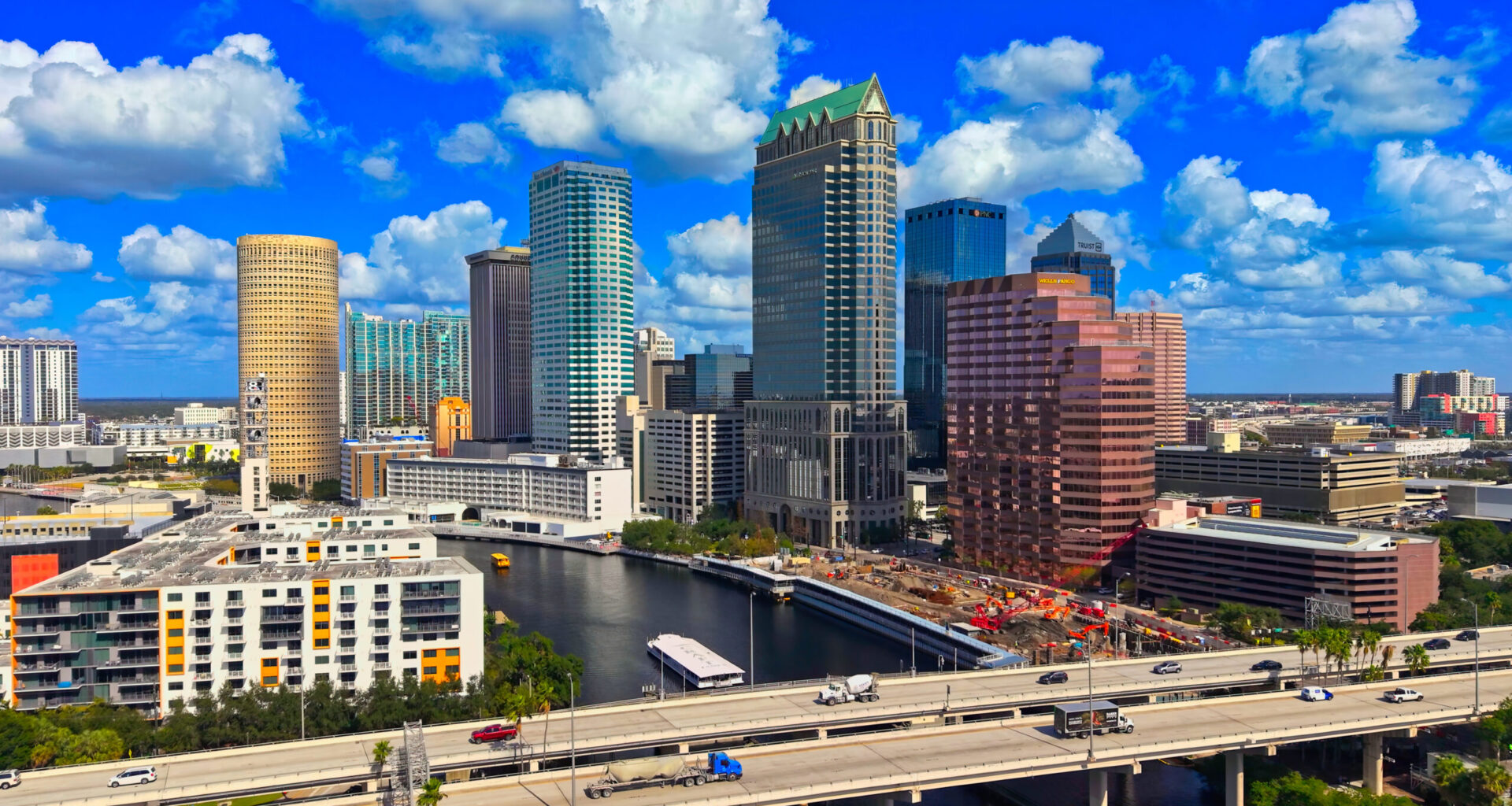
Tampa is closing 2025 with one of the strongest regional economies in the country. Job growth stayed ahead of the national average, commercial investment picked up across key sectors and new migration pushed demand that few metro areas could match.
Even with inflation pressures and a cautious lending climate, the region’s fundamentals in talent, infrastructure and momentum stayed solid.
This report brings together insights from Cushman & Wakefield, Visit Tampa Bay, the Tampa Bay Economic Development Council, FloridaCommerce and the Tampa Bay Partnership to show what drove growth in 2025 and what to watch in 2026.
How growth was measured
This analysis uses data collected through Q3 2025, including labor statistics from the U.S. Bureau of Labor Statistics, property market data from Cushman & Wakefield and benchmarking from the Tampa Bay Partnership’s 2025 Regional Competitiveness Report.
Together, these sources give a clear view of Tampa’s progress across commercial, residential and workforce areas.
Tampa’s economy outpaced the nation
A national CoworkingCafe study ranked Tampa #2 among mid-sized U.S. cities for economic growth from 2019 to 2023. The city’s economy expanded by 43%, average paychecks rose by 38% and exports nearly doubled.
Mayor Jane Castor put it simply: “Tampa is on the rise.”
Jobs kept fueling the momentum
FloridaCommerce reported that the Tampa metro area added 15,500 private-sector jobs in May 2025, the third-highest gain in the state. Education and health services led with 5,200 new positions. The unemployment rate dropped to 3.5%, below the national average.
READ: Dallas firm buys Westshore’s 1 North Dale Mabry, plans $4M upgrade
Real estate stayed strong
Multifamily
Stabilized occupancy held at 92.7% and effective rents rose to $1,887 per unit. Developers slowed new construction by 80% year-over-year, helping rebalance demand.
Retail
Vacancy stayed tight at 3.5%. Average asking rent reached $26.81 per square foot, up 4.8% year-over-year. Total sales hit $555 million, second only to Miami.
Office
Vacancy fell to 19.4%, the lowest since 2022. Class A rents rose to $35.38 per square foot. Major moves by GEICO and Immunologix showed renewed confidence in in-person work.
Industrial
Vacancy rose slightly to 6.8% as 1.4 million square feet of speculative space came online. Asking rents grew to $10.32 per square foot, a sign of strong demand for logistics and manufacturing.
Workforce and affordability took center stage
The Tampa Bay Partnership’s Regional Competitiveness Report showed poverty dropping from 12.45% to 11.96% and early education metrics improving.
Kindergarten readiness increased to 52.1% and third-grade reading proficiency rose 6%. Still, 46% of households fall under ALICE, meaning employed but financially constrained. Workforce development remains urgent.
Talent and innovation led the EDC’s 2025 agenda
The Tampa Bay Economic Development Council closed 29 projects in FY2025. These included 13 newly recruited companies and 16 local expansions from Amazon, AquaFence, GEICO, Joffrey’s Coffee, OrderlyMeds and XTEND.
The EDC relaunched its Make it Tampa Bay website and talent campaign with Visit Tampa Bay and Hillsborough County. Created in 2017 by Ronald Barton, the platform promotes regional career opportunities and lifestyle advantages.
READ: New platform links Tampa Bay donors to nonprofits losing funding
“Make it Tampa Bay has raised international awareness of exciting career options in Tampa and Hillsborough County,” said Craig J. Richard, President and CEO of the Tampa Bay EDC. “Talent is the number one reason companies choose to relocate or expand here.”
Tampa ranked #8 on Lightcast’s 2025 Talent Scorecard.
The EDC also supported a $9.7 million grant for Ashley East Tampa, a 100% affordable housing and job training project with 118 units for households earning at or below 80% of AMI. An East Tampa Innovation Center will add job training and small-business space. Construction begins in 2026.
Tourism reached record highs
Tampa’s visitor economy hit new records. Hillsborough County finished FY2025 with more than $1.2 billion in taxable hotel revenue, the third straight year above the billion-dollar mark.
Tourism Development Tax collections topped $70 million for the first time. September closed with $71.8 million in hotel revenue, the second-highest ever for that month.
“Surpassing the billion-dollar mark for a third fiscal year is proof the Tampa Bay hospitality industry sustained its momentum,” said Santiago C. Corrada, President and CEO of Visit Tampa Bay.
READ: 400 Central clears inspections, begins move-ins in downtown St. Pete
More than 540 conventions and meetings brought an estimated $366 million in economic impact and more than 580,000 room nights.
Major events included the Association of Zoos and Aquariums Annual Meeting, the U.S. Conference of Mayors and SOF Week.
Visit Tampa Bay credited its “Ready to Play,” “Time to Play” and “Doggone Summer” campaigns for expanding national and international reach. The group also earned the 2025 Flagler Henry Award for its Meeting the Moment program.
What drove Tampa’s growth?
Tampa’s momentum comes from three forces:
People
Tampa ranks #1 in net migration among comparable regions, especially for young professionals and entrepreneurs.
Place
Public and private investment in infrastructure, from Midtown and Water Street to Port Tampa Bay, is reshaping the regional economy.
Purpose
More companies are tying expansion to community outcomes, like Amgen’s philanthropy or the EDC’s affordable housing partnerships.
What it all means
The data shows more than recovery. It shows maturity. Tampa is no longer a hidden gem. It is a proven investment market where talent, innovation and quality of life meet.
READ: Port Tampa Bay adds 2 new cranes from Ireland as Vision 2030 expands
The challenge is balance. Growth must continue without reducing affordability or pushing supply too far. Long-term success depends on inclusion and resilience.
Looking ahead to 2026
Analysts expect steady rent growth, more job gains and continued migration. With over 1.4 million square feet of new industrial space and several mixed-use projects on the way, Tampa’s next phase will test how well the region manages growth.
“Our transformation from a regional center to a globally recognized hub of innovation has accelerated,” said EDC Chair Archie Collins.
Tampa enters 2026 with focus, confidence and room to grow.
Stay Connected
Follow TBBW on Social Media