
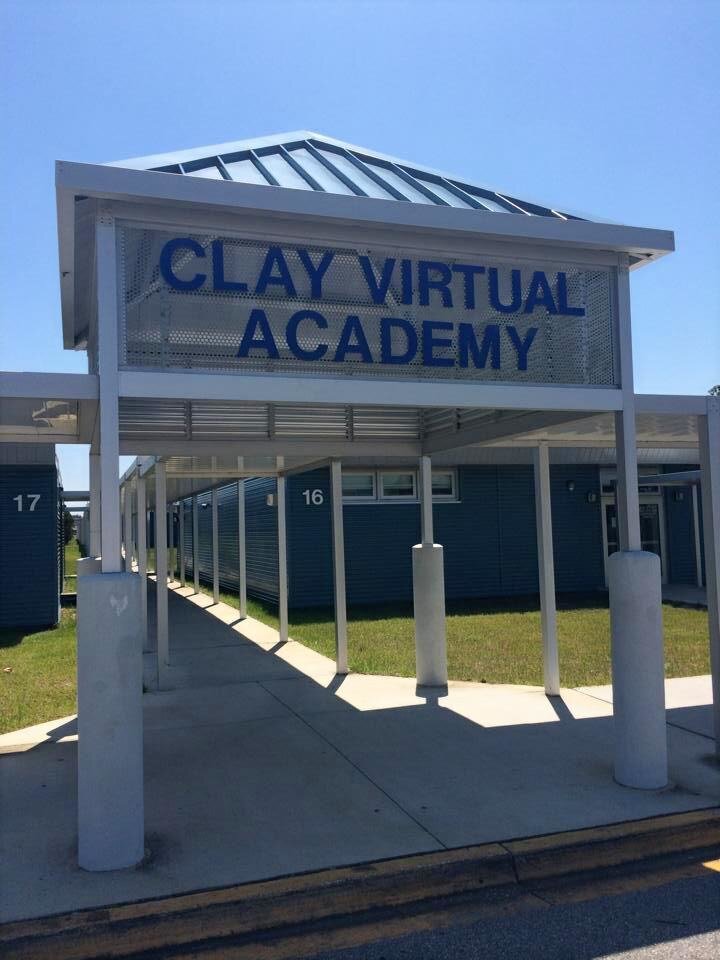
ORANGE PARK – The Clay Virtual Academy doesn’t just have its lesson plans stuck in the clouds. There’s so much more happening in the cluster of buildings that are seemingly hidden on the western corner of Orange Park High.
Sure, students are taking online classes. But there are courses to support early learning environments that promote social, emotional and cognitive development; programs that create partnerships between families, educators and the community; classes where students learn English, earn their General Educational Development degrees and receive driver’s education certificates; and scholarships for students and grants for teachers.
“We come in every day, working on the normal school day for the most part, and then a lot of after-hours stuff,” said Virtual Academy Principal Amanda Stilianou. “The teachers themselves are the ones who are normally virtual and helping students from home, doing live lessons and Google Meets or Zoom.”
Stilianou said Virtual students can focus on ESOL (English for Speakers of Other Languages), Career and Technical Education (CTE), 911 dispatching certifications and a variety of adult education and special needs classes.
On Mondays, kindergarten-aged children work on science, technology, engineering and mathematics projects. This current undertaking was for students to create something to highlight their habitat.
Teachers and Stilianou watched intently as students planned detailed shadowboxes and three-dimensional displays.
“There are several programs that run through here,” Stilianou said. “A lot is going on here. We have a lot of programs. We are now a designated ACE Cambridge School. We had to do a whole application on how we’re going to support our kids online in the Cambridge ACE program. All of our high schools, our brick and mortars, are all ACE Cambridge schools now.”
There are checks and balances to make sure students stay on pace and do their own work, Stilianou said. Teachers are required to speak with students at least once a month to discuss work and assignments. Those answers will provide instructors with enough information to know if the student is doing their own work.
“They can work at 3 a.m. if they want, but they have to keep up,” Stilianou said. “Just because it’s virtual doesn’t mean it’s easier.”
Enrollment fluctuates. There are about 140 full-time students, but between 4,000 and 6,000 part-time students, Stilianou said. Part-time students may be taking an extra class or two to make up for a missed class or to get ahead.
Some athletes take a virtual class to maintain their eligibility, while others try to boost their grade point average before applying to college.
Even better, students can jump into a virtual class at any time.
“We’re not tied to the traditional school calendar,” she said. “Once they get into a course, it just starts. They’re not behind. Of course, if they need it for that semester, we put them on track to be done by the end of that semester. We have courses because maybe they have to work. Maybe we’ve got some athletics. We have a professional pickleball player who plays internationally. We have families that might travel, like a parent who might be a truck driver. They can take the student with them and do their work wherever they are. Really.”
Parents who homeschool their children can also use Clay Virtual Academy to supplement their children’s studies. Stilianou said that it keeps education money within the school district.
A homeschooled student’s portfolio must be checked yearly to make sure the parent, or a hired instructor, meets all the state’s requirements so “the student isn’t falling through the cracks,” Stilianou said.
And if they are, help is just one keystroke away.