
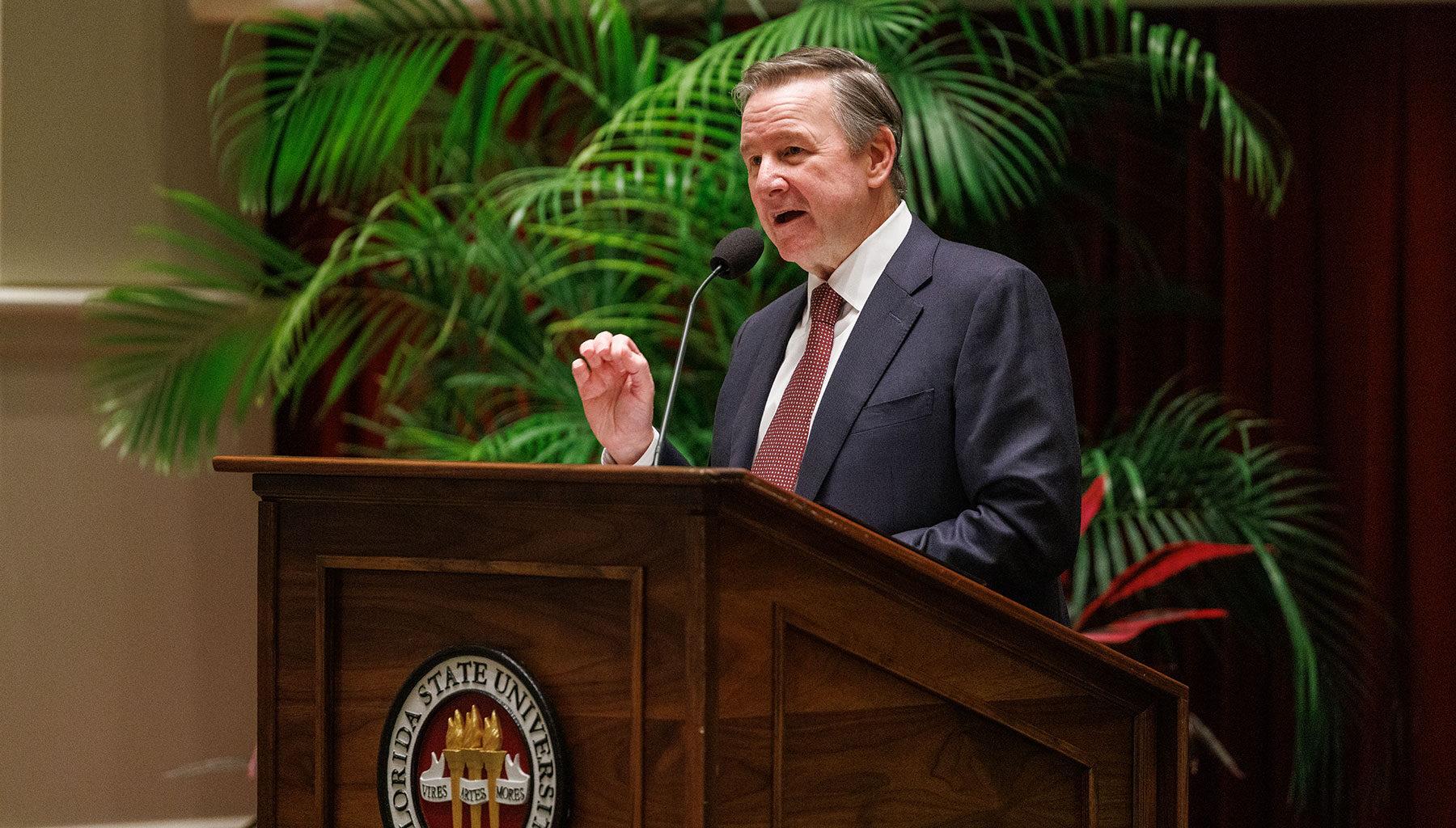
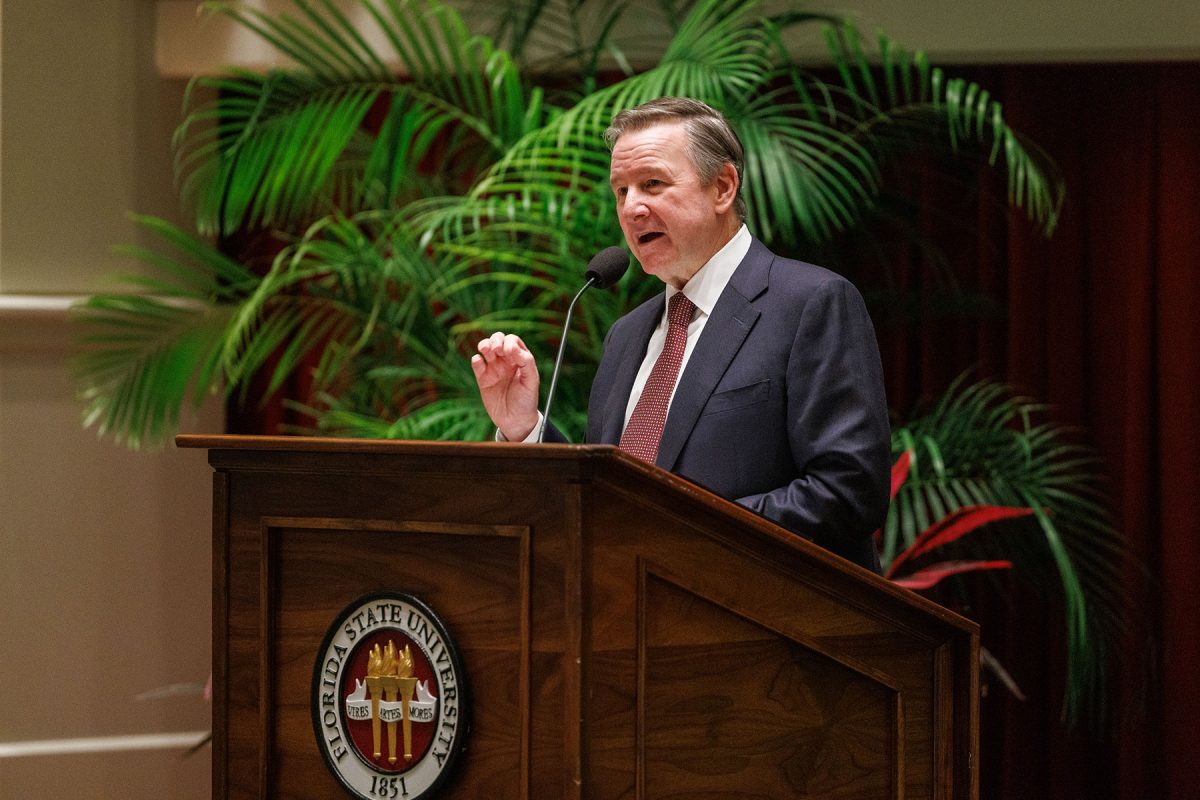
 FSU President Richard McCullough delivers his fifth State of the University address during a meeting of the Faculty Senate on Dec. 3, 2025. (Bill Lax/FSU Photography)
Florida State University President Richard McCullough said the university has “powerful momentum” as he delivered his fifth State of the University address Wednesday during a Faculty Senate meeting at the College of Medicine.
“The state of the university is strong,” McCullough said. “And we are a university that continues to get better every day. … We are Florida State University, and we are Unconquered.”
McCullough highlighted record student success, rising national rankings, expanding research activity and major institutional growth. He also thanked faculty, staff, students, trustees, alumni, parents and community partners for guiding the university through a year marked by both achievements and difficult moments.
“Because of all of you, we are experiencing unprecedented momentum,” he said. “We’ve hired great faculty and we’ve set records in research expenditures. We’ve built out new spaces for faculty and students that are the envy of other universities.”
He pointed to the opening of the Interdisciplinary Research and Commercialization Building and the completion of Legacy Hall, the new home of the College of Business, and construction of the new FSU Health Research Building as spaces that are attracting top faculty from around the country.
McCullough applauded FSU faculty for achieving a record $487 million in research expenditures and submitting more than $1.22 billion in proposals this year.
“Our research programs continue to impress,” he said. “We have grown research expenditures at an impressive rate — from $325 million in 2021 to a record $487 million — up nearly 50 percent.”
He said that FSU has built research focus areas that align with state and national priorities. The university is advancing quantum science and engineering, making breakthroughs in superconductivity, pioneering environmentally responsible methods for extracting rare earth minerals and making strides in aerospace and advanced manufacturing.
In health and biomedical innovation, FSU launched ICON-Health, an institute that explores the benefits of food as medicine, and expanded the Institute for Pediatric Rare Diseases, which is translating discovery into care for some of the most devastating childhood diseases. Both institutes are part of the university’s expanding FSU Health initiative.
As a part of FSU Health, the university is growing research and health care opportunities in Northwest Florida, including building an academic health center in Panama City Beach and advancing its partnership with Tallahassee Memorial HealthCare. The university’s first Vice President and Chief Clinical Operations Officer, FSU alumnus Jeremy Slaga, will start in the new role in January.
“For faculty, FSU Health means research opportunity and expansion, new clinical partnerships and a pathway to move discoveries from the lab to the bedside,” McCullough said.
McCullough highlighted significant momentum in the arts and humanities, including the acquisition of a movie theater for the College of Motion Picture Arts and funding a new Humanities Center.
While other universities are in the midst of hiring freezes, FSU hired more than 200 new faculty members for the third year in a row. The university now counts 13 members of the National Academies on its faculty, double the number from 2024.
“We’re trying to take advantage of when others are slowing down,” McCullough said. “We’re in a position to accelerate, and that’s what we’re trying to do.”
He highlighted the launch of IGNITE Tallahassee, a new incubator supporting high-tech startups, and said the university has doubled the number of start-ups so far this year.
FSU achieved its highest-ever U.S. News & World Report national ranking at No. 51, climbing three spots from last year, and moved up to No. 21 among public universities.
Student success metrics continued to set records. The university’s freshman retention rose to 97 percent, an increase of three percentage points over the past four years.
McCullough called the increase “absolutely monumental, and we could not be more proud.”
The four-year graduation rate increased to 78 percent, and the transfer student graduation rate reached 80 percent, the highest in State University System history. Applications also hit a new record, with 86,000 students seeking about 6,200 freshman spots.
“The quality of the students continues to rise, and we continue to hear over and over that we are now the most desirable undergraduate institution in Florida, especially given our excellent academics, our top-ranked student experience and a wonderful family environment,” McCullough said.
McCullough reflected on the strength the FSU community showed after the April 17 campus tragedy.
“We still mourn our losses from the shooting tragedy on April 17, and our hearts go out to the families and students that were impacted,” he said.
He praised police and first responders for their bravery, courage and professionalism on that day, and recognized the mental health professionals who helped the campus community in their recovery.
McCullough noted the significant improvements made to campus safety in the months since the tragedy, which include new classroom locks, panic buttons, lockdown buttons and expanded training.
Philanthropic gifts are also expanding the university’s reach. FSU is in the Leadership Gift Phase of its most ambitious comprehensive campaign to date.
“Our amazing donors help to transform FSU every day in unbelievable ways,” he said, noting Legacy Hall as a prime example.
In addition, the College of Nursing received the largest gift in its history — $10 million from Bruce and Tracey Berkowitz and the Fairholme Foundation — to expand the nursing program to the Panama City campus and help address Florida’s nursing shortage.
Through the support of Ben and Christina Macfarland, FSU has established a presence in West Palm Beach, an area now being called “Wall Street South.” This new executive education space connects students, alumni, and industry partners.
McCullough praised both the academic and athletic progress of FSU’s teams. He expressed excitement for the launch of women’s lacrosse, which will play its first season this spring under Coach Sara Tisdale, and congratulated the women’s soccer team for returning to the NCAA College Cup for the 15th time in program history.
He said the university is equally proud of its student-athletes’ work in the classroom. The NCAA reported record academic performance this year, including a 91 percent graduation success rate, the highest in university history.
“These are students who have to work hard, to do well in class, and they’re also athletes who are at the top of their game, trying to get a little better every single day,” he said.
The impact FSU has on the local community is powerful, McCullough added, as it injects an estimated $15 billion a year to local and state economies and employs about 18,000 people.
McCullough thanked Gov. Ron DeSantis, the Florida Legislature, the Florida Board of Governors and the university’s community partners for playing a key role in supporting FSU, and he said the university has continued to strengthen its relationships at the federal level to advocate for FSU priorities.
McCullough said FSU will celebrate its 175th anniversary in 2026 with events led by First Lady Jai Vartikar.
“As we honor our past, we look ahead with confidence and purpose for an even brighter future,” he said.
McCullough closed on an optimistic note.
“Our goals are bold and ambitious, and as you can see, we are not done yet.”