
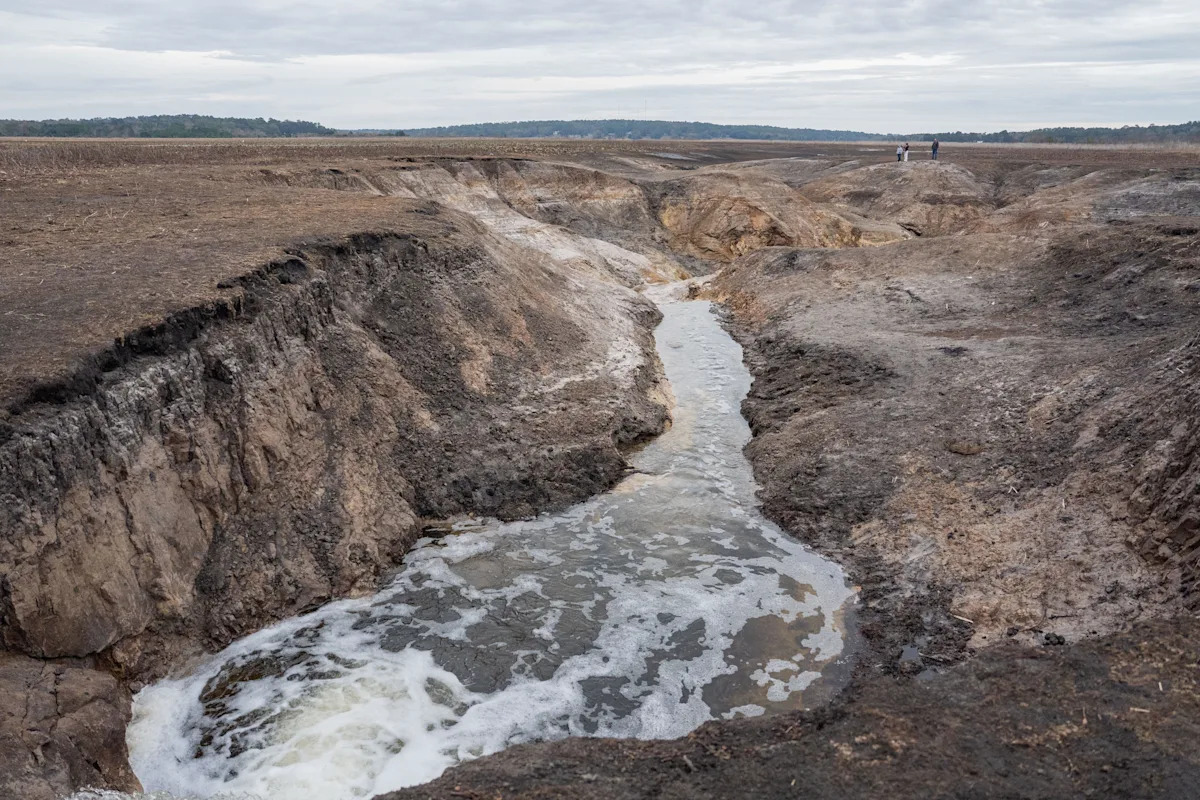
Lake Jackson in northern Leon County has drained down, or dried up, this time amid an ongoing drought in the state capital, though it is unknown if the two are connected.
The lake has been a recent topic of conversation for the Leon County Commission as they reversed themselves on a controversial Comprehensive Plan change which would have allowed for more development in the area.
Before the previous dry down in 2021, the last one was in 1999, which resulted in a massive muck removal, in which dump trucks hauled away 100,000 loads full of sediment.
It’s a rain-fed lake, its beds dotted with sinkholes that drain into the aquifer. Porter Sink, the sinkhole responsible for the dramatic dry downs, serves as a sort of bathtub plug. Until the sink plugs itself back up there is no lake, and with the ongoing drought, there’s no telling when enough rain will fall to refill what is now a prairie.
Where is Lake Jackson?
Lake Jackson is in north-central Leon County, Florida, just northwest of Tallahassee, stretching along U.S. Route 27.
How often has the lake dried up?
Lake Jackson has drained down, or dried up, at least a dozen times since 1837. Native Americans called it Okeeheepkee, or “disappearing waters.”
Hernando DeSoto’s scribes made no mention of it when the conquistadors wintered in present-day Tallahassee in 1539. They did describe a savannah and big plain where Lake Jackson sits today. And a British trader who worked north Florida in the 1740s, also made no mention of the lake.
But early settlers made note of the lake. Especially when it disappeared in 1836. And it repeated the feat in 1886, 1909, 1932, 1956, 1982,1999 and 2006 and most recently in 2012.
Lake Jackson is a rain-fed lake. Its beds are dotted with sinkholes which drain into the aquifer.
Why does the dry-down happen? Is it only caused by drought?
Lake Jackson is a “closed basin” with no major creeks or streams to supply water. Drought is the primary factor for the lake bottom to be revealed. The last time the limestone outcroppings were revealed was 2012, but only briefly.
A common misperception is that it dries every 20 or so years, but the simple answer is that the lake bottom is exposed during extensive local droughts; there’s no particular time table.
The lake waters leaves the lake through evaporation from the surface, transpiration of water vapor from the emergent aquatic plants and water seeping into the sinkholes (of which there are hundreds).
What do visitors say?
The Lake Jackson dry downs have been reported extensively over the years by the Tallahassee Democrat. Here’s a selection of reactions from previous stories:
“This is magnificent,” Cora Fabian said as she stood above Porter Sink, staring at an alien landscape of canyons, crevices and soaring cliffs carved into the limestone lakebed. “Some of the rocks are masterpieces. I see all these little pictures in the rocks. Right there, is Groot from the Avengers. It’s amazing how the sun and water can create art.”
“It was just an opportunity to see it after the sinkhole opened up,” said Mike Hamilton, from Tallahassee originally but now lives in St. Augustine.
“This is so pretty,” said Kathy Ryan. She and spouse Joe moved to Tallahassee from Orlando. They had never heard of a lake that disappeared.
Are there caves underneath Lake Jackson?
One Monday morning in 1999, after Lake Jackson had been reduced to a trickle of a stream, Tom Scott, Guy “Harley” Means and Mike Hill looked at the 20-inch wide slit the water was emptying into and realized it was big enough for them to fit into.
Scott retrieved a second ladder and “tied a rope around my waist, attached it to Mike’s truck and went down another ten feet and examined the limestone all around the bottom.”
He found himself in a chamber that opened to caves running north, east, and west. They had been carved by eons of flowing water dissolving the limestone lakebed. Since this adventure, there have been no further efforts to explore the caves.
Has anything been discovered when the waters drain?
Lake Jackson’s dry-down in 2021 revealed two human skulls in the muck of the 4,000-acre aquatic preserve along U.S. Highway 27.
After an assessment by state archaeologists, the two human skulls found in Lake Jackson were determined to be of Native American ancestry, potentially dating back five centuries.
In an email, Ryan Ash, a deputy director of the Florida Department of State, said the skull originated in the midwestern United States sometime between the 1400s and 1600s.
He did not explain how the skulls wound up in the dry lake bed. Some county officials privately surmised it may have been a collector of artifacts who realized they were illegal to possess, then tossed them in the lake.
This story contains previously published material that appeared in the Tallahassee Democrat.
This article originally appeared on Tallahassee Democrat: Disappearing waters showcase hidden beauty of Lake Jackson