
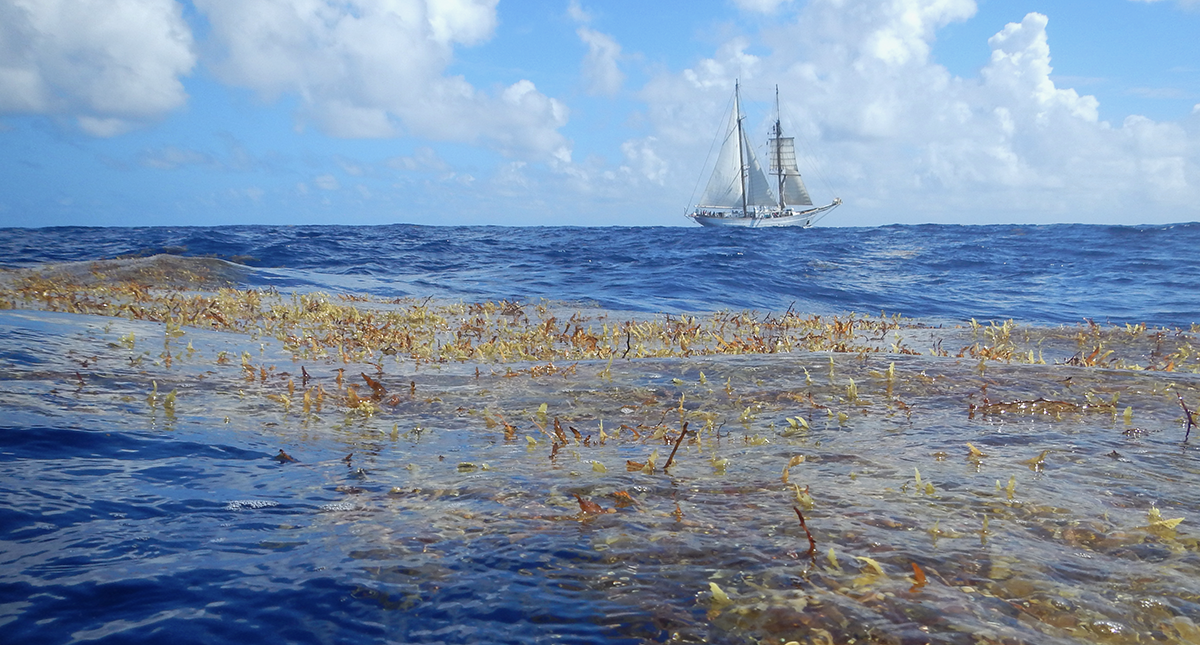
Dyllan Furness, College of Marine Science
A new study led by researchers at the University of South Florida’s College of Marine
Science has found that certain populations of the seaweed sargassum have experienced
a significant decline over the past decade. This was true even as an increased abundance
of sargassum in the tropical Atlantic caused large mats of the seaweed to inundate
beaches across the Caribbean and Gulf regions.
The abundance of sargassum in the Atlantic’s north Sargasso Sea has plummeted since
2015, according to the paper published this week in Nature Geoscience. Sargassum from the Gulf, which annually supplies the Sargasso Sea, has also decreased
substantially.
The findings point to ocean warming as a possible cause of the decline and suggest
a dramatic shift in sargassum’s distribution, which could affect the health of marine
ecosystems.
“What is fascinating is that two opposite patterns occurred in the Atlantic Ocean,”
said Chuanmin Hu, professor of oceanography at the USF College of Marine Science and senior author
of the study. “The tropical Atlantic has seen a significant increase in sargassum
in the past decade, but at the same time the Sargasso Sea has a lot less sargassum
than it used to.”
Much like rainforests, large floating mats of sargassum support high levels of biodiversity.
They serve as an important habitat for turtles, crabs, shrimp, fish, and seabirds,
some of which are specially adapted to inhabit the mats of seaweed.
However, once sargassum mats wash ashore and decay, they can emit a foul odor, harm
marine life, and disrupt coastal communities. Cleanup efforts in the United States
alone have cost businesses and governments millions of dollars annually.
Hu has used satellites to study sargassum since 2006 and spearheaded the discovery of the Great Atlantic Sargassum Belt in 2019. His Optical Oceanography Lab is a global leader in sargassum research, providing
satellite imagery and monthly bulletins that inform stakeholders about sargassum biomass
seen from space.
Read more: USF experts lead on sargassum research, monitoring, and prediction
For the recent study, Yingjun Zhang, then a postdoctoral researcher, and Brian Barnes, assistant research professor at the USF College of Marine Science, analyzed satellite
data gathered by NASA to assess changes in sargassum biomass. The lab partnered with
researchers at Sea Education Association and Eckerd College, who observed similar declines using field collected data, and provided historical
records, temperature tolerance information, and variety-level sargassum distribution
insights that were unavailable by remote sensing. Researchers from Woods Hole Oceanographic Institution and Florida Atlantic University also contributed to the study.
The Gulf typically experiences a spring bloom of sargassum, which is carried north
by currents to the Sargasso Sea, where peak season occurs during late fall or early
winter. Lower levels of healthy sargassum in the Gulf result in a decreased abundance
of healthy sargassum in the Sargasso Sea.
“These findings suggest we may be witnessing the early stages of a basin-scale regime
shift in sargassum distribution,” said Zhang, now a postdoctoral scholar at the Scripps
Institution of Oceanography. “Since a wide range of marine life relies on pelagic
sargassum ecosystems, this could really make a difference.”
Barnes said, “The regime shift also includes changes in sargassum seasonality, as
the once fall and winter peaks are now replaced by summer peaks in the north Sargasso
Sea.”
By analyzing three ingredients all plants depend on — light, nutrients, and temperature
— the researchers posit that record high temperatures in the Gulf, including more
frequent marine heat waves and possible nutrient competition by sargassum transported
from the Caribbean Sea, may have stunted the region’s population of sargassum. The
result is weakened sargassum that struggles to survive once it arrives in the Sargasso
Sea.
Studies have shown that waters in the Gulf warmed approximately 0.19°C (0.34°F) per decade between 1970 and 2020, about twice the rate of the global ocean. While sargassum
in the Gulf prefer temperatures between 20 and 28°C (68 to 82°F), summer water temperatures
in the Gulf have recently exceeded 30°C (86°F).
Even the Great Atlantic Sargassum Belt, which stretches 5,000 miles across the Atlantic,
hasn’t helped compensate for the decline in the Gulf. Sargassum from the belt may
be acclimated to warmer conditions or in poor health upon arrival and thus does not
tolerate the colder waters of the Sargasso Sea.
“It’s a complex story and challenging to unravel due both to the spatial scale and
the fact that each variety of sargassum responds to ocean environmental conditions
in different ways,” said Deb Goodwin, chief scientist at Sea Education Association
and a co-author of the study. “Long-term data identifying and quantifying sargassum
varieties provided critical context to the satellite observations.”
Looking ahead, the research team aims to better understand how sargassum’s shifting
population dynamics could impact marine ecosystems, including whether competition
from the Great Atlantic Sargassum Belt could drive further declines of sargassum in
the Gulf.