
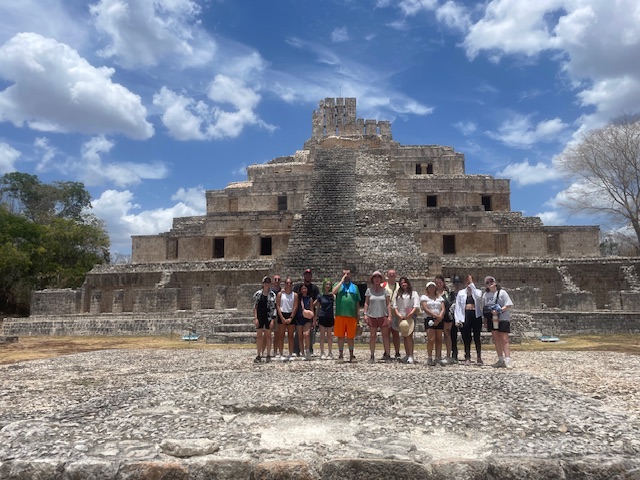
This past summer, students in Professor Barbara Wright’s English as a Second Language (ESL) course went to Campeche, Mexico, to practice teaching their own students in a foreign country. In the three-week course, students learned how to teach language, reviewed parts of speech and created teaching plans, then travelled to Campeche.
“Before we go, it’s basic English, kind of a review, and then going into pragmatics and things like that, and how to read body cues as well,” said Wright. “They have to be able to read a room, for lack of a better term. We did two weeks of pedagogy, and in those two weeks, we created the lesson plans. And then [in the] third week, we left for six days, Sunday to Saturday. When we came back, it was a week of reflection.”
The students from FGCU were assigned families to stay with for the week and paired up before the class started. The families gave the students in Campeche the opportunity to learn from the Eagles outside the classroom.
“It was easy to converse with them, at least [with] my sibling,” said Moses Suchomski, a senior English major who took the class. “It was very straightforward, we conversed for several weeks leading up to it and gauged what we’re going to do, and [asked] things like what she likes, what her family likes, what I should bring, things like that.”
Story continues below advertisement
When the FGCU group arrived in Campeche, there was a sudden change of plan, with more students added to the class than anticipated. Wright and her team weren’t prepared for the challenges of teaching students with many different skill levels, so they had to create an entirely new study plan.
During the course of the week, members of the class had a schedule where they would teach in the morning, from 7 a.m. to 5 p.m., then would have time in the evening to continue interacting with their host families.
“We had to make our own curriculum instead. I wouldn’t say it was difficult, but it was different because I feel like whenever you’re given a curriculum, like here in the States, or as a teacher in general, you have objectives to follow and certain things that you’re looking for,” Suchomoski said. “Over there, it’s different because each student is not only different, but also because we didn’t fully know what their level was.”
In addition to teaching, students on the trip had the chance to explore Campeche. Wright would take her students to places in the area where they would learn about the local culture and see highlights of the community.
“The first day we went to a bread-making shop, which was like an hour or two away, and we got to see exactly how they made regional bread,” said Suchomski. “The ovens that they were using on that particular day were very old ovens that were made a long time ago out of the mud and the clay and the specific elements that were found in the region. The funny thing was, we were not asked, but told, we could put our hands inside one of the furnaces. What’s funny is, when I did that, it was cooler inside the furnace than outside.”
After the trip, students had a week of reflection on their teaching, working on a project that tied everything they had learned over the duration of the course to everything they had applied in Mexico. The class is offered again in the spring and summer 2026 semesters. Wright is working on some changes she wants to implement to the course to offer a different reflection experience for the students than last summer.
I want to, only if it’s approved, do a transcription project in Campeche where I would audio record students teaching and students learning, and then bring them back home, and that’ll be a project for the students that they have to transcribe them and do a conversation analysis to figure out what was really happening in this learning session, [and ask] ‘When did learning take place?’”
The class, Selected Topics in Lit Studies, is taught by both Wright and Christopher Jeannot, another ESL instructor. Students that are interested can apply for the program by going to the Study Abroad office or emailing them at [email protected].
“It was challenging, but it worked out so well,” said Wright. “It was a growing session for them. They just took off as teachers, [and was] super impressive.”