
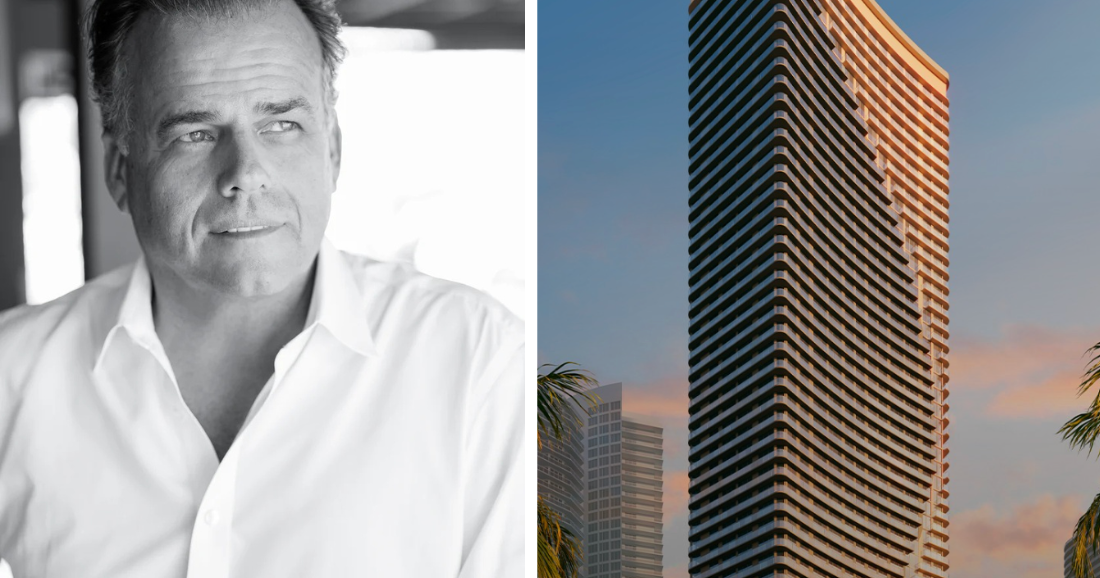
Kobi Karp is one of the most renowned architects and designers in Miami today.
With 30 years in the industry, his company, Kobi Karp Architecture & Interior Design, has designed homes, condominiums and buildings worth billions of dollars for famous figures in the country, making him a true authority on the future of Miami in terms of development and construction.
Currently involved in the development of Edge House, Karp has worked on multiple luxury projects in South Florida. From state-of-the-art buildings to hotels, including the Astor & Edison hotels, as well as the Palazzo Del Sol and Palazzo Della Luna on Fisher Island. In a conversation with Islander News and Key Biscayne Portal, he shared his views on the city’s evolution and what’s to come.
Islander News (IN): Miami has become a global center for design. How do you see the city’s evolution as a leader in architecture and design?

Kobi Karp Group’s Sunset Island Canal Residence in Miami Beach.
Photo courtesy of Kobi Karp Group / Alexander Group
Kobi Karp (KK): Over the past few decades, Miami has evolved from a tourist destination to a cultural and economic capital. What inspires me most about this evolution is how the city has learned to honor its past and embrace its future. Miami’s architectural identity has always been rooted in the climate, light, and landscape, but as the city has evolved, we have placed greater value on restoration and preservation, especially in Miami Beach, where I have been fortunate enough to help revive many historic structures. These historic buildings carry the story of Miami’s origins. Restoring them has protected our heritage and shaped the way we design today. Miami now combines preservation with innovation, creating resilient, climate-sensitive works with cultural roots.
As global talent continues to elevate our skyline, it has been rewarding to contribute to projects that honor the city’s past while embracing its future.
IN: What sets Miami apart from other cities around the world in terms of its design language and creative spirit?
KK: Miami’s mix of global cultures and its bold creative approach. It’s a place where American, European, and Latin American influences come together to shape an architectural language that feels both international and local. Miami has become a destination where world-renowned architects and developers seek to leave their mark, creating a design culture that prioritizes beauty and innovation. At the same time, our tropical environment, surrounded by water and lush landscapes, allows designers to seamlessly integrate nature into their work. This balance between global influence and natural harmony gives Miami’s design identity its unmistakable character.
IN: We are seeing an increase in new home construction in Miami. Do you think the pace of development is sustainable, or is there a risk of oversupply in the market?
A render of Pine Tree Bay, one of the Karp Group’s projects.
Courtesy of Kobi Karp Group
KK: The pace of development in Miami reflects the city’s ongoing transformation and growing global appeal. As more businesses and residents move here, demand has expanded beyond tourism into sectors such as finance, technology, and design. Developers are approaching this cycle with greater discipline, initiating projects only when they are well-advanced and building based on real lifestyle needs, such as flexibility, wellness, and community. In one of my most recent projects, Edge House in Miami, we collaborated with Adriana Hoyos Design Studio to design with that mindset: furnished interiors, wellness as a priority, and layouts that adapt to multiple ways of living and traveling. When architecture anticipates how people live, demand remains strong regardless of market cycles.
IN: You mentioned Edge House as an example of design that adapts to how people live today. Could you share more about the vision behind that project and what makes it different in the Miami market?
KK: Edge House gave us the opportunity to rethink what a modern urban tower can offer, both functionally and architecturally. With 57 stories and over 600 ready-to-move-in residences, we designed the building to integrate directly with its surroundings, from the shape of the bay to the floor-to-ceiling windows that maximize natural light and views in all directions. Inside, the goal was to create a move-in ready environment: from fully furnished studios to three-bedroom layouts, including flexible residences with restricted access.
The collection of amenities is also noteworthy, with wellness spaces, multiple pools, coworking studios, a podcast room, and social areas that promote community as much as comfort. Its location across from Margaret Pace Park offered an incredible setting, and we wanted the architecture to connect with the neighborhood while enhancing the flexibility of hotel living in Miami.
IN: You have been involved in the transformation of Miami. How does it feel to see the city evolve around the projects you have designed?
A render of the Overtown Youth Center, one of the Karp group’s designs.
Courtesy of Kobi Karp Group
KK: Seeing how neighborhoods are transformed and how residents and families live, work, and socialize in the spaces we have created is truly rewarding. When I arrived in Miami in the late 1980s, during the “Miami Vice” era, the city was vibrant but still finding its identity. Over the years, I have witnessed Miami’s evolution from a sun-and-sand destination to a global cultural and economic center. Seeing the city evolve around the projects I have been fortunate enough to design, and knowing that those buildings contribute to its character and resilience, is both a humbling and deeply rewarding experience.
IN: How would you define your personal approach to architecture and interior design?
KK: I design from the environment outwards. Each project is inspired by and draws inspiration from the natural environment of the site, the light, and human movement. These elements determine the form and materiality. The rest is about connecting and creating spaces that feel authentic, resilient, and emotionally resonant.
For example, at Edge House, the curve of the building was not conceived as a visual gesture, but as a response to its surroundings, to frame both the sunrise over Biscayne Bay and the city skyline at sunset, capturing the energy of Miami from all directions.
IN: Would you say Miami has its own design style today? If so, how would you describe it?
KK: Miami has evolved beyond tropical modernism toward a mature, cosmopolitan design identity that is deeply connected to the place. The city’s architecture celebrates nature, light, and texture, while embracing sustainability and craftsmanship. This is evident in how buildings open up to the sky and blur the line between interior and exterior. It is refined, yet retains the openness and creative spirit that define Miami.