
SANCAP CHAMBER
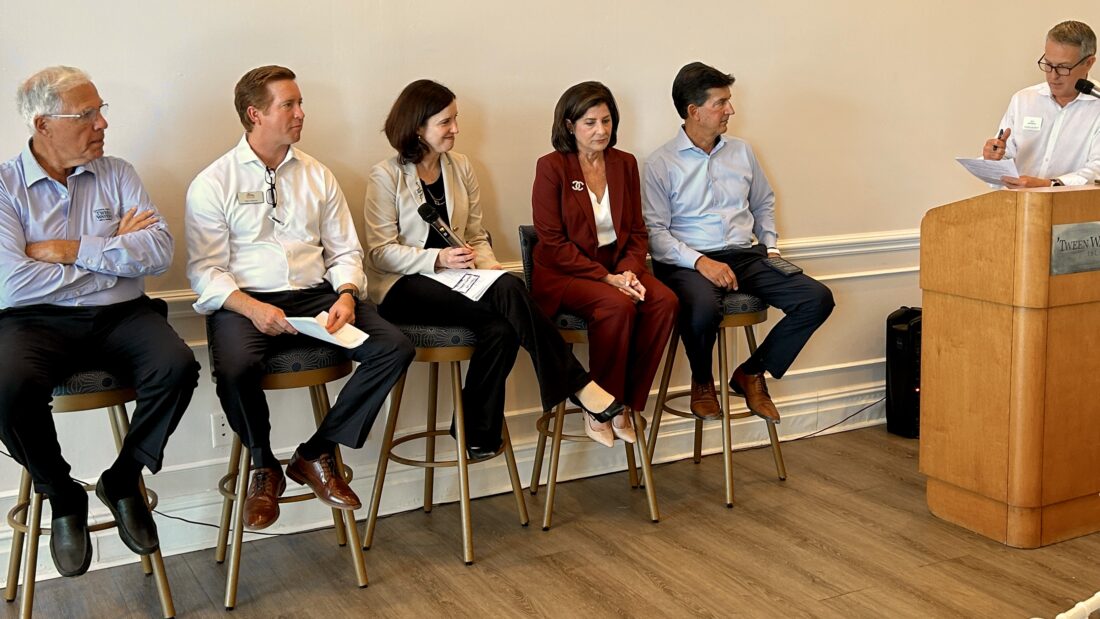
Far right, Florida Trust Wealth Management’s Jeff Muddell moderates the panel at the SanCap Chamber’s business luncheon meeting on Nov. 19 at the ‘Tween Waters Inn & Marina on Captiva.
Under the heading “Resilient Rebuilding,” the SanCap Chamber luncheon meeting on Nov. 19 at the ‘Tween Waters Inn & Marina on Captiva explored what was learned from recent post-hurricane recovery efforts from five viewpoints: hospitality, construction, city of Sanibel, hurricane protection and banking.
How the islands are changing and how they will maintain their charm were two hot topics about which the panelists delivered honest, experience-driven responses. Jeff Muddell, with Florida Trust Wealth Management, moderated the discussion.
“Nonprofits are the heart of Sanibel,” Sanibel Captiva Beach Resorts President and Board Chairman Tony Lapi, who represented the hospitality voice, said. “Now as these structures change, will that bring a different clientele, people in? I can tell you from Captiva, people ask me how has Captiva changed? The small house has gotten bigger, but the character of Captiva has stayed the same … (The nonprofits) are kind of like the skeleton that keeps us together. And these buildings that we build are just the skin.”
The panelists agreed historic, ground-level wooden cottages are a thing of the past.
“It’s just reality,” Lapi said.
Dan Adams, with Stevens Construction, said the biggest challenge from a building standpoint is adapting to tighter sites that have lost real estate due to surge. His company is handling rebuilds and were contractors for Shalimar — the first new island rebuild since Hurricane Ian and since 1984.
Planning Department Director Paula McMichael said the city’s biggest change since Ian was to add another 5 feet of elevation to the codes, to counter that loss and the need for more building height.
Sanibel is lightyears ahead of Fort Myers Beach in terms of dealing with construction, the panelists reported. The city is much easier to work with as far as getting units pushed through, getting jobs started sooner.
The most important lesson learned by banking institutions?
“You have to be able to evolve,” Rudi Hamer, with Sanibel Captiva Community Bank, said. “You have to be changing to what is required by the environment and by the community.”
For the “lightning round” question, Muddell asked the panel: If Sanibel and Captiva were going to do one thing better in the next 12 months to build back resiliently, what would it be?
“Keep the buzz going,” Hamer replied. “Strike while the iron is hot.”
“I wish the city had some way … a magic wand going, yeah, we can get this through without getting in trouble, without leaving the Sanibel Plan,” Lapi added. “But I understand rules are rules.”
McMichael reported the city has already scheduled its next thing for mid-December, with a vulnerability assessment to specifically pinpoint improving Sanibel infrastructure — roadways, electric, sewer, water — to make it more resilient.
“Keep doing what you’re doing,” Storm Smart Chief Executive Officer Scot Burris said. “In so many ways, you are a leader in how communities are reacting to disaster, and how you’re recovering, how you’re changing your process … Thank you for that.”
“How refreshing to hear what we did today, compared to three years ago when we couldn’t see this far ahead,” chamber President and Chief Executive Officer John Lai said. “These five perspectives painted a picture of achievement, community, and preparedness for the future. A picture of safety, hope, pride and, yes, resiliency.”
The luncheon was sponsored by Simple Social.