
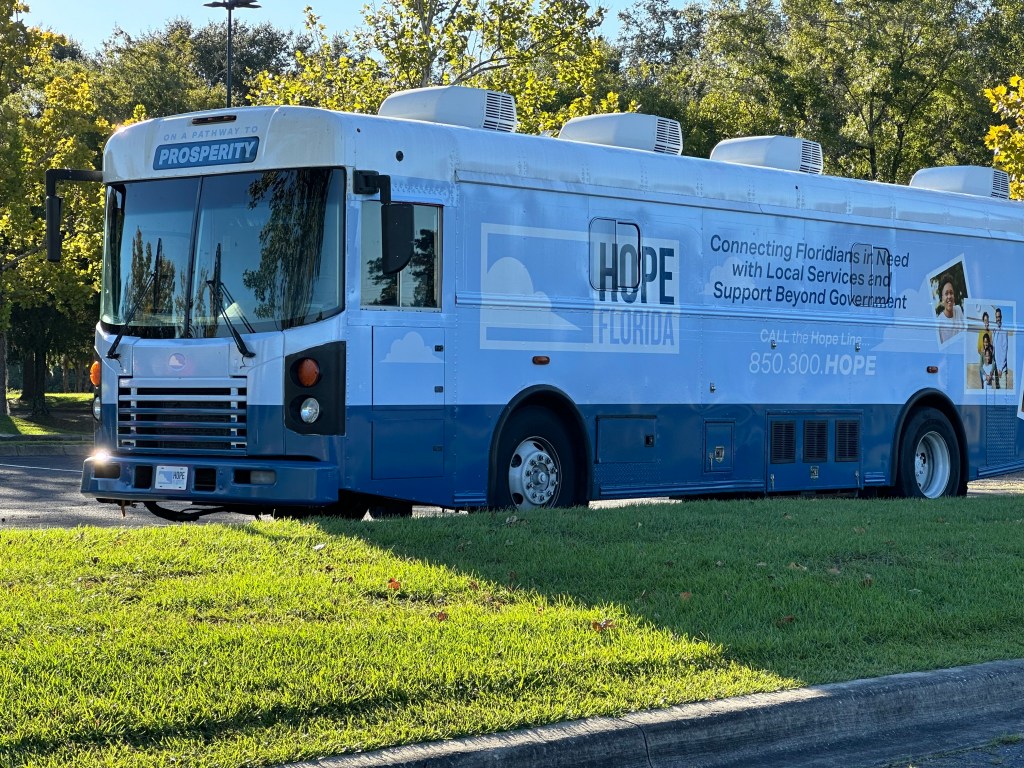
TALLAHASSEE — As controversy erupted last spring about Florida diverting $10 million from a Medicaid fraud settlement to the governor’s favored Hope Florida charity, the DeSantis administration insisted those dollars were not Medicaid funds.
Instead, the $10 million was described by Gov. Ron DeSantis as a “cherry-on-the-top” charitable donation the state was free to spend as it saw fit.
But a recent Medicaid payment from Florida to the federal government indicates otherwise: The state is including the $10 million in calculating its required federal pass-through of the settlement proceeds, just as it would do with any funds that truly belonged to Medicaid.
“Not only did we lose $10 million, we are still paying the feds back for it,” said Rep. Alex Andrade, R-Pensacola, who led the Legislature’s Hope Florida investigation.
The nature of the federal repayment is a new twist in a long-running scandal which has tarnished the governor and seems to have helped undermine plans for First Lady Casey DeSantis, the leading champion of Hope Florida, to mount a campaign to succeed him as Florida’s leader.
It began in September 2024, when Florida struck a $67 million agreement with Medicaid provider Centene for claims it had overcharged for prescription drugs.
Lawyers and agency chiefs for the DeSantis administration then peeled off $10 million from that settlement and gave it to the Hope Florida Foundation, the nonprofit offshoot of a state anti-welfare program spearheaded by Casey DeSantis. The foundation quickly turned the money over to two nonprofits fighting against the legalization of marijuana, a key DeSantis cause. Those committees in turn donated $8.5 million to a political action committee created by Attorney General James Uthmeier, then chief of staff for DeSantis, to finance a campaign against the marijuana initiative.
When the donations became public, a political firestorm erupted — igniting a legislative probe, sparking questions about whether highly regulated Medicaid dollars were illegally used for political purposes and later prompting a grand jury investigation.
Because Medicaid is a federal program jointly run with states, Florida had to give the federal government 57% of what it received from the settlement. Payment records for the Agency For Health Care Administration, which runs the state’s Medicaid program for some 4 million Floridians, show it made reimbursements based on the full $67 million settlement.
The agency made two payments, for a combined total of $38 million, in November 2024 and last month. That means it paid 57% of the $67 million. If only $57 million was Medicaid funds, the state owed its federal counterparts only $32 million.
The full refund to the federal program bolsters the argument made by Andrade for months: that the entire “settlement amount was Medicaid money.”
Officials for AHCA did not respond to requests for comment.
As negotiated by the DeSantis administration, the Centene settlement agreement required that Hope Florida get paid first — within seven days of the signing of the settlement agreement — and noted that the state intended for Hope Florida to have a greater role in the Medicaid program.
That donation made Florida’s agreement unique from settlement agreements between Centene and other states over similar fraud allegations. All the other states’ agreements required the money to go straight to state and federal medical assistance accounts.
That $10 million in Florida instead went to Hope Florida, which gave two nonprofits $5 million each. They then gave Uthmeier’s political committee most of the money to campaign against the Amendment 3 marijuana ballot initiative.
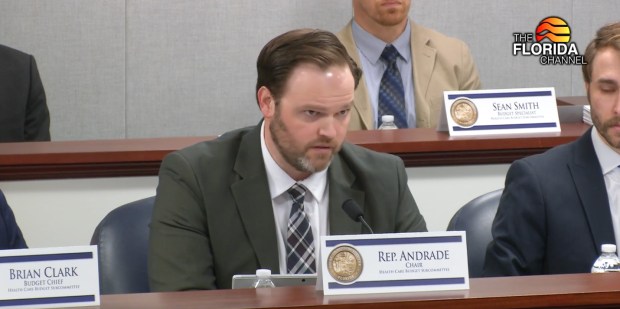 Rep. Alex Andrade led the legislature’s critical focus on Hope Florida. He is shown at the House Health Care Budget subcommittee in Tallahassee on Thursday, April 24, 2025. (The Florida Channel)
Andrade, chair of a House health care panel, came to the conclusion in the spring that Uthmeier and Jeff Aaron, Hope Florida Foundation’s outside legal counsel, committed fraud by diverting for political purposes funds that should have gone back to the state Medicaid program. Both men have denied wrongdoing.
At the time, AHCA General Counsel Andrew Sheeran sent Andrade a letter claiming that the donation was not Medicaid money because it came from a portion of the Centene settlement agreement designated for “any other potentially alleged damages (contractual or otherwise)” and not identified claims.
Centene identified $56.25 million of potential Medicaid-related damages, Sheeran said, so the remaining $10.8 million was not to compensate the state for loss of Medicaid funds. Therefore, he argued, the “donation was neither illegal nor illicit,” and the $10 million donation didn’t come from Medicaid funds.
Andrade responded to Sheeran’s letter by asking how AHCA calculated the share of settlement funds that had to be returned to the federal government. He never received a response.
He sent a letter to AHCA Secretary Shevaun Harris this week asking her to confirm the payments to Medicaid but she has not responded, either.
But the payments, available on the state’s Department of Financial Services accounting website, are an admission by AHCA that “the entire settlement amount was Medicaid,” so it all should have been used for health services, not political activities, Andrade said.