
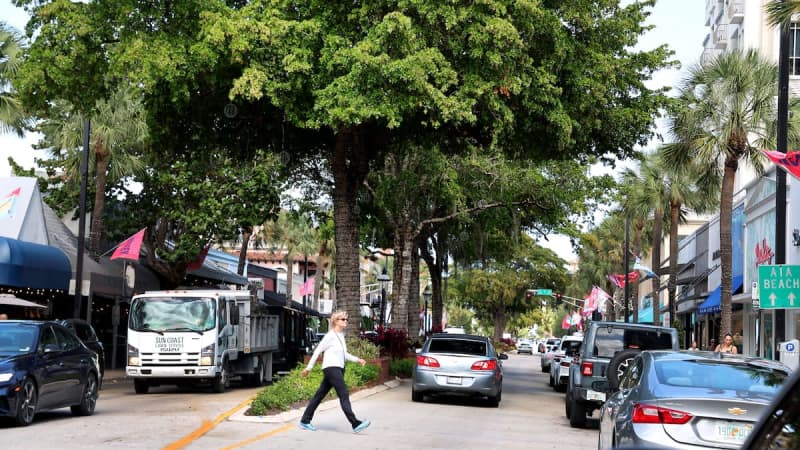
Fort Lauderdale sure could use some more trees — up to 276,000 more, to be exact.
The city’s proposed urban forestry master plan, which has yet to be adopted by the commission, sets a goal of achieving a 33% tree canopy cover by 2040. To get there, anywhere from 160,000 to 276,000 trees would need to be planted on both public and private property between now and the next 15 years, a city consultant says.
Tampa’s tree canopy is shrinking. Can anyone save it for the shade?
Mayor Dean Trantalis questioned whether such a lofty goal is even within reach.
“Where do we plant 160,000 trees?” he said. “How are we ever going to achieve that goal? It just seems like a herculean task to get 160,000 trees planted in the next 15 years, especially since most of the area (available to plant them) is not in the public realm.”
Justin Freedman, an arborist and project manager with RES Florida Consulting, had the answer.
Temple Terrace just tallied every tree on city property. Here’s what it found
“It’s an ambitious goal,” he told the mayor during a presentation of the plan. “Some (available land) is in the public right of way. A lot of it is not. It’s going to take effort on both public lands and private lands to get to that number.”
Getting the job done would cost between $27.6 million and $103.4 million, according to the consultant.
Cities are not typically required to have an urban forestry master plan, but many are voluntarily setting tree canopy goals.
Trees aren’t just for shade — they also boost property values, improve air quality and reduce energy costs, the city’s hired experts say.
“Urban trees are community assets,” the urban forestry plan states. “(They are) critical infrastructure that improve air quality, moderate temperatures, reduce energy costs, enhance positive physical and mental health outcomes, protect water quality, absorb greenhouse gases, reinforce riverbanks and coastlines, and raise property values and retail sales.”
Tampa Bay lost thousands of trees to hurricanes, hitting residents’ wallets, emotions
Severe weather, sea-level rise, pests and disease present challenges to expanding the city’s tree canopy. And there’s another threat: developers.
The recent surge in urban development has led to a stagnation of the city’s tree canopy, according to the consultant.
Fort Lauderdale’s tree canopy is currently at 26.6%.
“Developers and homeowners will need to overwhelmingly buy into the city’s desire to minimize tree removals and plant more trees across the city,” the proposal says. “The city will need to expand the role of existing employee positions and create new ones, adopt new codes, enforce and expand regulations, generate plans and conduct public outreach.
Tampa got a $1.6 million grant to plant trees. Federal DEI cuts took it away
“The city will need to ensure that the community outreach it conducts is effective, widespread, relevant, and set up for long-term success.”
Despite the challenges, there are many good reasons why the city should attempt to expand its tree canopy, the consultant said.
Last year alone, Fort Lauderdale saved $3.3 million in reduced stormwater infrastructure needs, removal of air pollutants, and carbon storage, Freedman told the commission.
Fort Lauderdale currently has 8.75 square miles of tree canopy. The goal is to grow another 2.1 square miles by 2040.
The city currently has 5.6 square miles of potential tree planting area within its borders.
The consultant advised that trees be planted by city staff, residents, community organizations, businesses and developers.
“It’s an enormous task,” the mayor said. “Certainly we can plant trees in the public realm. But to the extent that most of the deficiency is not in the public realm but on private property, what do you do there? Knock on their door and say, ‘We’re here to plant a tree in your yard?’ The reality is, how do you get there? That’s the strategy we have to come up with.”
The commission is expected to vote on the proposed urban forestry plan in the coming weeks.