
TEMPLE TERRACE — Temple Terrace residents will likely have to wait at least six more months for a plan to remove PFAS chemicals from the city’s drinking water, after consultants said their work will extend into late spring, and possibly to the end of June.
City Manager Carlos Baia informed the City Council on Dec. 2 that CHA Consulting, hired to analyze treatment options and develop a wider water plan, will not meet the original hopes for a December decision on a long-term solution.
He cited the scale of the project, expanding testing to include other impurities and the rapid emergence of new treatment technologies, including potentially more affordable than the systems other states are now using.
“We’ve talked about granulator, active carbon, reverse osmosis, ion exchange,” he said. “Well, there’s other things out there now that are entering the marketplace, as you can imagine, because everybody in the country is going through the same challenge right now.”
That challenge is removing per- and polyfluoroalkyl substances, or PFAS — “forever chemicals” that resist breaking down — to meet new Environmental Protection Agency standards established in 2024 and taking effect in 2031.
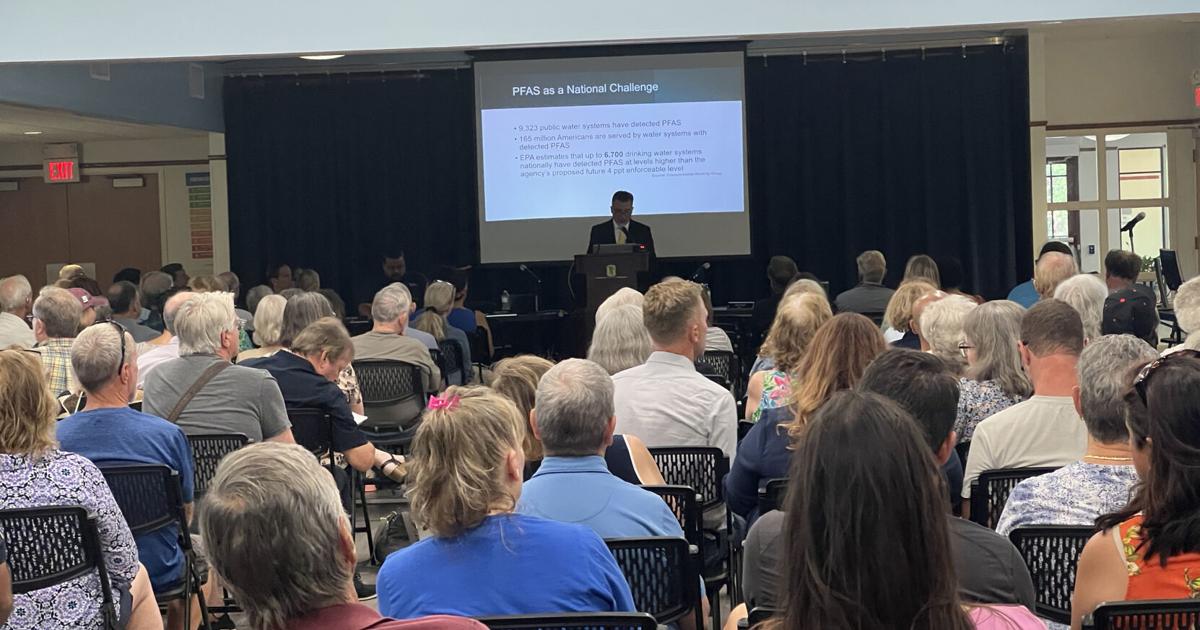
Tests in March found PFAS levels in Temple Terrace’s water above those limits, prompting public outcry, a standing-room-only council meeting in July, and a subsequent four-hour town hall.
Another town hall is expected this summer, after CHA delivers its findings.
Temple Terrace is just one of hundreds of cities across the country with elevated traces of PFAS and PFOA in its water — the result of decades of contributions into the water systems due to the production of nonstick coating, upholstery and carpets, fast food wrappers, pizza boxes and microwave popcorn bags, to name a few.
Most cities, like Temple Terrace, are scrambling to meet the 2031 deadline for compliance, with great costs likely involved.
While consultants continue their analysis, Temple Terrace has been pursuing other backup options with the city of Tampa and Hillsborough County, including connecting to their water systems or purchasing bulk water “to help reach the numbers for PFAS.”
Hillsborough County would be the most viable option when it comes to connecting to another water system, because they don’t have any restrictions on selling water like Tampa does.
“But Hillsborough County is also the longest run, and we’d probably need a three-mile run of pipe,” he said. “That is going to be very, very costly, and underground work … is not easy and can be complicated.”
Baia estimated the cost of connecting to the city or county at $25 million to $40 million.
Another possibility is adding a new storage tank, which would help with emergency capacity but would not replace the need for a long-term PFAS solution.
“So perhaps the tank will be another alternative, in addition to still looking at the PFAS solution,” Baia said.
Council member Gil Schisler said he is often asked why the process is taking so long, and he refers people to the city’s extensive water question-and-answer information on its website.
He understands the questions, and suggested gently nudging those developing the solution to “do it a little bit quicker, without jeopardizing or sacrificing quality for end result.”
Baia said there is a slim chance the water pilot being developed by CHA wraps up earlier in the spring, but he cautioned against raising expectations.
“Whatever solution we ultimately choose, and the Council supports, that’s the solution you’re going to have forever, probably,” he said. “So, you want to make sure that it’s done right. You only get to do this one time, hopefully this one time, because it is a huge, huge investment.”