
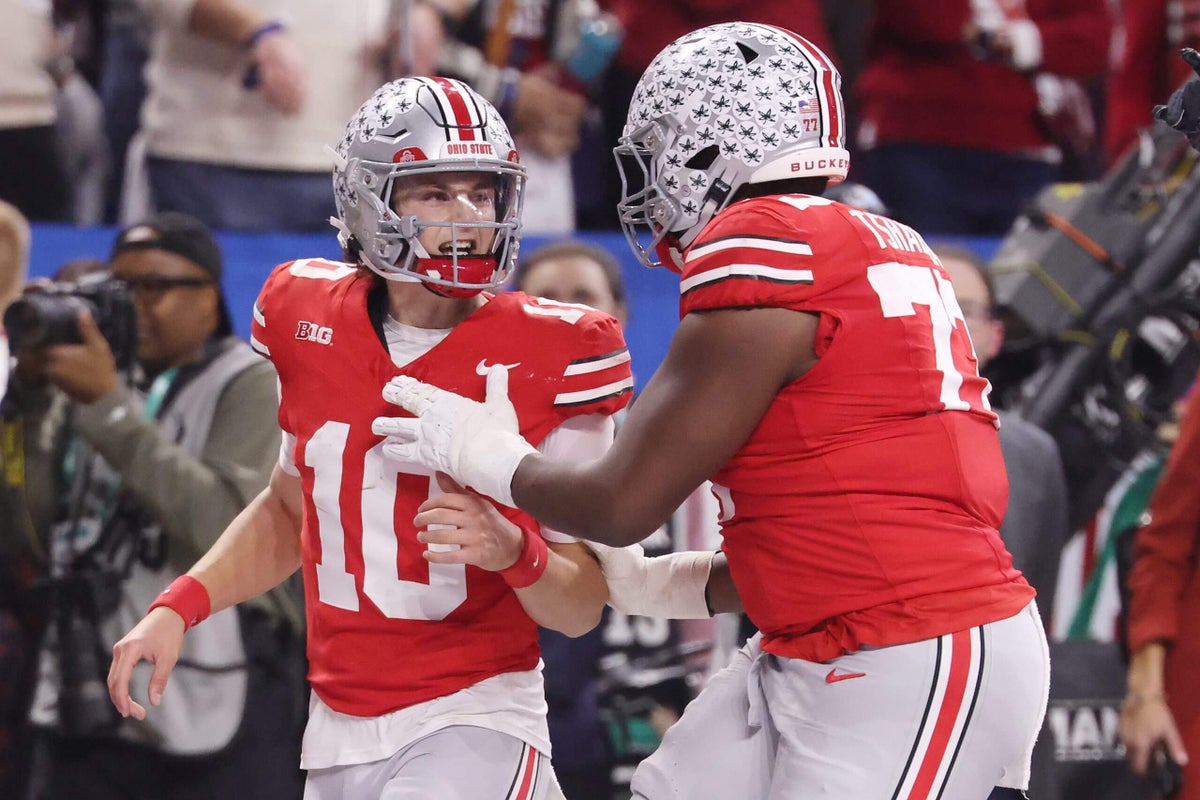
Ohio State is off for the next three weeks after earning the No. 2 seed in the College Football Playoff, where it will play the winner of Texas A&M vs. Miami in the Cotton Bowl on New Year’s Eve. Before then, quarterback Julian Sayin is heading to New York as a Heisman Trophy finalist, and there are plenty of questions to answer about the Buckeyes, who are coming off their first loss in more than a year.
If someone had told you how Ohio State’s season would play out so far on Aug. 15, what would you have been most surprised by? Would you have considered it a success as is, regardless of Playoff outcome? Just trying to keep perspective. My preseason expectations were to go 10-2, beat Michigan, and make the Playoff with a QF appearance. — Quintin M.
This is a great question to kick off the mailbag.
I expected the Buckeyes to be 10-2 and beat Michigan, and I thought a Playoff semifinal appearance would be a successful season. But if somebody would’ve told me they were going to be 12-1 and the No. 2 seed with a historically good defense, I would’ve been surprised.
I wasn’t quite sure about the running backs in the preseason. By the middle of camp, I started to hear that the defensive line was playing very well, but new coordinator Matt Patricia was also an unknown.
I think it’s fair to shift your expectations as the season progresses, though. It was around the midway point — maybe the Washington-Minnesota-Illinois run — when I was convinced that Ohio State was the best team in the country. At that point, I began to think that this team could win another national championship.
Does that mean it’s natty or bust, like last year? No. But when you are the No. 1 team in the country from Week 2 until the postseason, expectations shift a bit. Ohio State is still the favorite to win the national championship at 28 percent, according to The Athletic’s model, so anything less might feel like a letdown. Still, that’s merely 28 percent.
A quarterfinal loss would definitely be a disappointment, but a close loss to surging Georgia in the semifinals wouldn’t be so bad.
To me, there are only two teams where a loss wouldn’t feel like a disappointment: Georgia and Indiana — although two losses to Indiana, in two championship games, would not sit well with Buckeye fans.
Looking ahead to next year, which members of the offensive line do you expect to be back? — David
I think they’ll all be back. I thought there was a chance that center Carson Hinzman or left guard Luke Montgomery vaulted their way up the draft board with strong seasons, but I’d bet on all the starters returning. At right guard, Tegra Tshabola has eligibility left, but it’s just a matter of whether he wants to battle for his spot or transfer somewhere else.
Really, almost every offensive starter should be back with the exception of Carnell Tate and Will Kacmarek.
What is your take on why the offense is struggling so much in the red zone this year? Play calling, lack of execution or some combination of both? — Jeff M.
Saturday was the first time Ohio State failed to score more than one touchdown, and it was the first time it had a sub-30 percent touchdown rate in the red zone, reaching the end zone on just 1 of 4 trips inside the 20. For the season, Ohio State ranks 36th in the FBS in red zone touchdown rate at 66.7 percent.
I think Ohio State went into Saturday’s Big Ten title game with a poor plan. Ryan Day mentioned coaches made the decision to use two and three tight ends in the red zone. As I wrote on Tuesday, Indiana’s linebackers are too good to be consistently fooled against three tight ends, and they are quick to get in the backfield, too.
Not only did the plan play into Indiana’s strength, but it took Tate off the field. Ohio State’s only touchdown came in 12 personnel on a throw to Tate. After that touchdown, Ohio State played with more than one receiver in the red zone on just three snaps and Tate got no more red zone targets.
Looking back on past games, Ohio State is at its best when it has two, or even three, receivers on the field in the red zone. The three-receiver set gives Ohio State more flexibility with motions and rub routes like the Buckeyes perfected for a touchdown to Brandon Inniss against Michigan. It also allows for more RPO looks and more misdirection in the backfield.
Ohio State’s strength is its athleticism and talent on the outside. Use it.
So, why is Tegra Tshabola starting? What other options are there? — Ajblum
Tshabola has been struggling for much of the season, but it really became noticeable in the two-game stretch of Illinois and Wisconsin. Since then, Ohio State has been rotating at right guard, but it couldn’t find anybody ready to take the role from Tshabola full time.
He had his best game of the season against Michigan, so any conversation about benching him was seemingly done. Then the Indiana game happened. Tshabola was benched after giving up a first-down sack in the third quarter, on a play in which Sayin had a few options open deep. By the time Sayin turned to throw, Tshabola had lost his one-on-one and he was sacked.
There’s going to be some serious conversations over the next three weeks about right guard. It makes sense for Gabe VanSickle to start in the quarterfinals, barring a setback in practice.
I don’t recall Ryan Day holding a play sheet during any game this season prior to the Big Ten championship? Is that the case? – Craig U
Day has always carried a play sheet in his back pocket. He’ll look at it and put it away during the game.
To me, there’s not much to it other than when Brian Hartline is calling plays, Day is involved in the process — like he’s said all year.
Why can’t Day use one of our big tight ends as a fullback to run the ball in short-yardage situations? — Marvin G
Ohio State does use a tight end as a fullback — it’s freshman Nate Roberts. Defensive end Caden Curry played some fullback his freshman year, too.
Why do they keep teasing us with Lincoln Kienholz in the red zone against teams like Rutgers and Grambling, then never play him when it counts (zero touches against Texas, Michigan and Indiana)? — Jim K.
Day was asked about this Sunday and said it will be something they look into more as they begin to form a game plan.
My hypothesis is that they were scared off of it after Kienholz missed two throws against Rutgers, on top of him missing the correct gap on third-and-1 against Minnesota. It has worked a few times this year (he has two touchdowns), but Ohio State felt more comfortable with Sayin running the quarterback sneak.
If Ohio State is going to run the quarterback, I think Kienholz needs to be in. If it’s going to throw, Sayin needs to be in.
I’ve seen some chatter online that the difference in the game was a difference in preparation: Indiana was coming off a bye and hapless Purdue, so effectively had two weeks to prepare for us; whereas OSU had only the one week and was also dealing with multiple distractions (Michigan win hangover, Hartline leaving, Chris Henry Jr. drama, etc.). In a game that came down to the margins, how much credence do you give this theory? — Zac B
Saying that was the lone difference in the game would be a disservice to Indiana, which didn’t play perfect, but was really good and made the big plays when they needed to be made.
Still, I think it’s hard to look at everything that happened that week and then watch the team’s performance in the red zone and not think there were some preparation issues. I don’t think there was much of a Michigan game hangover, but I do think between Hartline leaving and the Henry drama, the coaching staff was pulled in a lot of directions.
A lack of preparation can show up everywhere, but it is heightened in the red zone. Beyond just the poor play calling, the Buckeyes just seemed a step slow and off on things that were called to begin with. Again, that’s not to take away from Indiana, but it is the reality of the situation.
With three weeks to prepare and Day involved in the offensive game plan heavily again, I think Ohio State should be able to come back strong.
Better matchup for us, Miami or Texas A&M? Who should I root for Dec. 20? — Zac B.
Miami every day of the week.
Both have elite defensive line units that generate a lot of pressure. Texas A&M ranks first in sacks and third in tackles for loss, and Miami is fourth in pressure rate, according to TruMedia.
On the other side, if you have a chance to go against Carson Beck over Marcel Reed, you take Beck.
Beck is second in the country in completion percentage, but he’s thrown for 25 touchdowns and 10 interceptions. In Miami’s two losses, he’s thrown six interceptions. He’s been really good in the four games since the SMU loss, throwing for 1,239 yards, 13 touchdowns and just one interception, but each of those wins came against passing defenses ranked 76th nationally or lower. In fact, Pittsburgh, Syracuse and NC State are ranked below the 100 mark and NC State is 134th.
Root for Miami, especially with the Cotton Bowl in Texas A&M’s home state.
Howard, McCarthy, Bennett, Young — it seems like the most successful teams have a quarterback that can be counted on to create yardage by running when games get tight. It introduces another variable for defenses. Sayin (who has admittedly been great) doesn’t seem to offer any of that. Do you see that as a potential fatal flaw of this year’s team? — DF
As somebody who was banging on the table yelling for Ohio State to run QB power more last year, there is a big difference. Running the quarterback allows for an extra blocker to be used, usually evening up the amount of blockers and defenders in the box.
Without that option, it raises the importance of the offensive line and tight ends to be fundamentally sound in their blocking techniques and be sure they are targeting the right people. The latter part of that sentence has been inconsistent for the Buckeyes this year.
The tight ends have improved in the blocking game, so much so that I think the 12 personnel — two tight ends, two receivers and one tight end — is their most balanced personnel package. That package worked well last weekend, especially in the second half.