
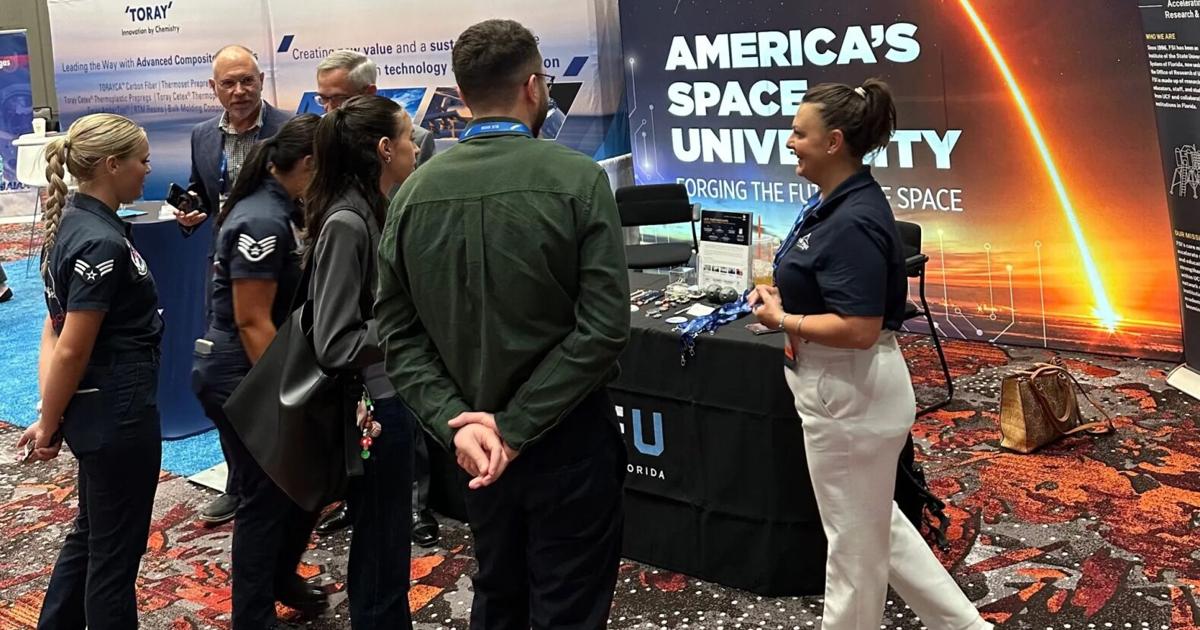

Dr. Greg Autry, associate provost for space commercialization & strategy, helps display the new offerings at the ASCEND Conference in Las Vegas in July.
Courtesy of Poets & Quants (via website)
UCF is looking to grow its offerings by developing two new programs within the space field: the first fully online space MBA program, which is set to launch in spring 2026, and an aerospace medicine program.
When the university first opened in 1968, it was known as Florida Technological University and was formed with the primary focus of supplying NASA and other Space Coast organizations with the next generation of interstellar talent.
Now, more than 50 years later, UCF is doing just that. According to Aviation Week Network, the university was named the No. 1 provider of talent to the aerospace and defense industries for the sixth consecutive year. This repeated success has earned UCF yet another title – SpaceU.
According to Space Florida, the aerospace business has provided nearly $6 billion to Florida’s economy since 2007, and Dr. Greg Autry, associate provost for space commercialization and strategy, believes that the MBA program is a great segue for people to learn management and financial skills while inserting themselves into that business.
“When you join the online space MBA, you’re not just becoming part of the College of Business,” Autry said. “But you’re becoming part of the university that has world-leading astrophysicists, planetary scientists, experts in hypersonics, AI and all the other tools that are required to keep the space enterprise moving forward at lightspeed.”
This program is a two-year, fully online offering that combines common MBA teachings such as finance, accounting and leadership with more specific classes such as space law, global space domain and space entrepreneurship.
In an informational YouTube video about the program, Autry highlighted what this combination of skills could mean for students.
Zaheer Ali, program director of space commercialization and strategy, spoke about the shift in focus on how commercializing space can be leveraged to benefit life on Earth.
“SpaceU has always been SpaceU from the technical side,” Ali said. “But, now we’re mainly focused on the commercialization.”
The program will feature many high-ranking individuals as guest speakers, including NASA Deputy CFO, Steven Shinn and Michelle Hanlon, executive director of the Air and Space Law Program at the University of Mississippi.
Hanlon, who is also a registered space lawyer, will teach space law. Shinn will share his expertise as a space finance professor.
Ali hopes that this lineup of impressive innovators, paired with the interdisciplinary classes being offered, will attract students of all majors, he said in a YouTube video for UCF College of Business.
“Our students are going to be given direct access to leaders in every aspect of space, creating a space network for them that will be unmatched by graduates of any other program,” Ali said in the video. “We can recruit students from every major and help them find their place in space.”
Junior finance major Kellen Gooch spoke about what intrigues him about the prospect of participating in the space MBA.
“As a finance major, I’m fascinated by the space MBA because it merges the advanced financial strategies that go along with such a wide-scale project,” Gooch said. “Considering the fact that space programs are starting to be more of a wide-scale project, it could allow us to go over some challenges that many people haven’t been able to solve over time.”
As astronauts spend more time in orbit and commercial spaceflight ramps up, UCF is responding by launching a new aerospace medicine program built to study and solve the medical questions that come with pushing further into space.
According to the UCF Aerospace Medicine homepage, the vision for the program is “to become a global leader in aerospace medicine, pioneering transformative solutions for the health challenges of space exploration while shaping the future of medical and technological advancements in support of human spaceflight and aviation.”
The current expected launch date for the master’s program is set for spring 2027, with the residency program being available in fall 2027. UCF has also partnered with Operator Solutions to develop a state-of-the-art aerospace medical lab at the College of Medicine.
This lab will allow students and faculty to study various ways to assist space travelers with the acclimation process and observe possible methods to replicate the environment of deep space on Earth.
Dr. Jennifer Fogarty, chief scientist for the Center for Aerospace and Extreme Environments Medicine, is one of the new faculty members tasked with carrying out this mission.
Fogarty has spent over 20 years studying the effects of deep space travel on the human body, working at NASA and the Baylor College of Medicine to experiment with ways to help space travelers acclimate to their new environments.
“So, my time at Baylor College of Medicine was really driving that portfolio to do things that we hadn’t done before and ask the hard questions,” Fogarty said. “Coming to UCF is really about taking that knowledge and experience base and creating an opportunity here.”
Fogarty said Baylor’s experimental environment allowed her to workshop bold, unconventional ideas, a stark contrast to her results-focused work at NASA, where trial-and-error was less encouraged. She believes UCF will allow some of the same opportunities.
“You’re going to get a lot more latitude to be self-directed from one or more of your investors who is excited to have something that’s more of a breakthrough and is aware of the risk posture,” Fogarty said.