
The Greater Orlando Aviation Authority recently showcased future initiatives to grow and evolve Orlando International (MCO) and Orlando Executive (ORL) airports over the next decade.
The Aviation Authority will focus on strategically achieving various five-year and ten-year goals. Some of these multi-year goals include:
Customer Experience
Support all activities and projects necessary to attain a 5-star Skytrax rating, a global rating system that ranks airports on quality of service and other standards.
By 2035, activate 60% of current vacant real estate assets at ORL while maximizing revenue.
Community
Develop at least one new cargo processing facility and complete an FAA-approved on-airport AAM vertiport by 2030, designed to accommodate multiple commercial operators and support the future of air mobility.
By 2030, increase non-aeronautical revenue by 30% compared to the revenue figures recorded for 2025.
Infrastructure
By 2030, several improvements are planned to:
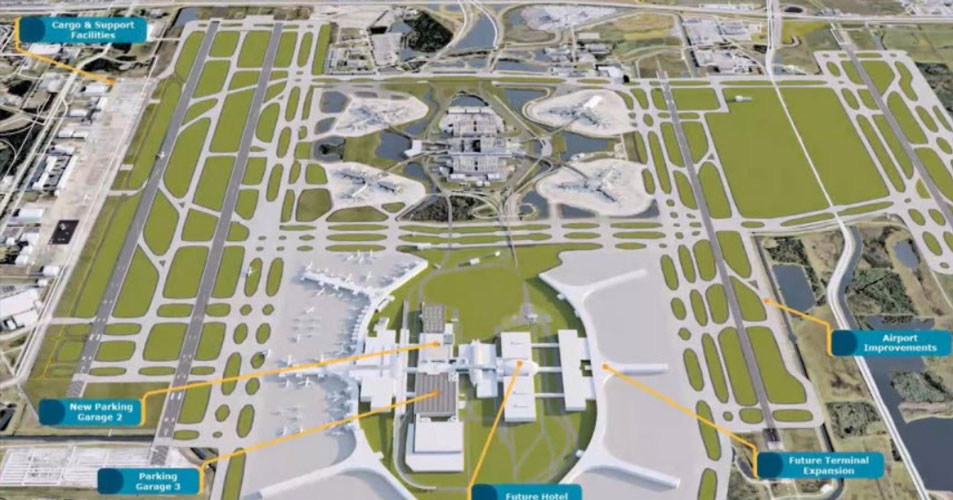
Increase available public parking by 8,000 spaces.
Complete the construction of a new Baggage Handling System for Terminals A & B.
Complete Airside 2 gate expansions.
Incorporate additional passenger conveyance in Terminal C from Palm Court to Gate C230.
By 2035, complete Terminal C, Phase 2, construction.
People
By 2030, launch a fully operational Business Incubator at MCO to drive innovation and strategic growth, including increasing the number of small businesses working with MCO by 40%.
By 2028, achieve a 20% increase over 2025 baseline employee engagement scores to attain an employee engagement score of 90% within 5 years.
Other vision initiatives range from restoring stormwater structures to a nomenclature project that will focus on renaming all terminals by numbering them Terminals 1, 2, and 3 to improve clarity and consistency.
In a nod to innovation and the future of aviation, the Greater Orlando Aviation Authority (GOAA) recently hosted Takeoff 2025 to highlight the plans for the two Orlando airports. The event, held at Magic Carpet Aviation, attracted business and community leaders from across Central Florida and provided an opportunity to network amongst the backdrop of planes and runway activity at Orlando International Airport. GOAA Board Chair Stephanie Kopelousos welcomed the audience and introduced GOAA CEO Lance Lyttle, who joined the Aviation Authority in April.
Building on GOAA’s four foundational pillars of Customer Experience, Community, Infrastructure, and People, Lyttle told the audience that GOAA plans to create places where technology and hospitality work to serve people better.
“Building the airport of the future is more than an aspiration. It’s part of who we are. It’s the essence of our work and the spirit that guides every decision we make,” Lance Lyttle said. “It means being smarter, more sustainable, and more connected. It means creating places where technology and hospitality work hand in hand to serve people better. It’s about moving from function to experience, from infrastructure to inspiration.”
Marc Randolph, Netflix Co-Founder & Former CEO, was the event’s guest speaker. He followed Lyttle’s remarks and encouraged the audience to push forward on their ideas, saying it’s hard to tell a good idea from a bad idea and that “nobody knows anything.”
“It is the key to understanding innovation. Because if nobody knows anything, you only have one thing to do, which is you’ve got to take that risk,” he said.
Following his remarks, Randolph sat down with Lyttle for a Q&A session. The two discussed how innovative companies and organizations don’t shrink from disruption but embrace it because disruption can be good for everyone.
The event briefly covered some of the initiatives GOAA will focus on during the next five to 10 years, including:
Building a reputation for hospitality and creating seamless journeys for travelers as staff aims for a 5-Star Skytrax airport rating.
Strengthening partnerships and expanding opportunity by developing new cargo facilities, advancing plans for an FAA-approved on-airport Advanced Air Mobility vertiport by 2030, and increasing non-aeronautical revenue to reinvest in Central Florida.
Modernizing Terminals A and B, complete with a new baggage handling system, continuing to expand Terminal C, and increasing parking by 8,000 spaces.
Launching a fully operational Business Incubator at MCO to drive innovation and strategic growth, including increasing the number of small businesses working with MCO by 40%.
These initiatives are part of GOAA’s Visioning Plan, which the Board approved.
Orlando International and Orlando Executive airports are two of Florida’s premier air travel gateways with a combined economic impact of $41 billion dollars. MCO served more than 57 million passengers in 2024 and is ranked the No.1 airport in Florida, the 9th airport in the U.S., and the 25th busiest airport in the world.