
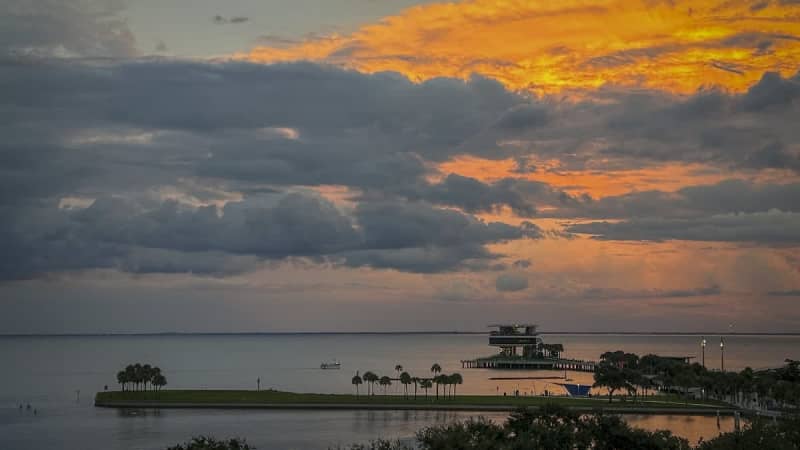
Thousands gathered at the St. Pete Pier this weekend for We Belong Here, a two-day electronic music festival that has played in Miami and New York City.
Some residents not in attendance to see ODESZA and Lane 8 offered a barbed review: They don’t belong here unless they turn it down.
“The constant, rhythmic, and physically jarring ‘banging noise’ from the event was distinctly, oppressively, and overwhelmingly audible inside my residence for the entire duration of the festival,” said an email from Andrea Manson, who lives west of St. Petersburg High School in the Historic Kenwood neighborhood.
At its Tampa Bay debut Saturday and Sunday, rotating DJs out on Spa Beach played melodic house and high-energy techno from 2 p.m. to 10 p.m. The constant bass, however, carried over the water and became too much for some residents as far away as Gulfport. That included St. Petersburg Mayor Ken Welch.
Complaints over the hours long music were all over Facebook, Nextdoor and in Welch’s email inbox. Welch answered Manson’s complaint by saying he agreed that the “noise from this weekend’s music festival is a concern.”
“It’s important that events respect the surrounding community,” he replied Monday. He said he has asked staff to review the issue immediately and take appropriate action to address the sound levels and prevent a recurrence.
In a statement, We Belong Here festival co-founder Charles Hochfelder said they worked with the city and the Pier throughout the event and immediately complied with requests. Festival organizers held a cleanup Tuesday beyond what they were obligated to do “because we truly want to be responsible, long‑term partners in the places that host us.”
“As with any inaugural event at a new venue, there’s always room for us to listen, learn, and improve together,” Hochfelder said. “We take neighbors’ concerns seriously and are committed to working with Mayor Welch, city staff, and the Pier team to make sure We Belong Here remains a positive, respectful part of the St. Pete and broader Tampa Bay communities for years to come.”
A summary report from St. Petersburg police said the event permit allowed sound to be clearly audible up to 5,000 feet, just under one mile. Officers determined the event was “in violation” when the music was “clearly audible at approximately 20,328 feet” — almost four miles away — “substantially exceeding permitted expectations.”
City spokesperson Samantha Bequer wrote that due to noise concerns during the event, officials asked event organizers to lower the volume, which they did. St. Petersburg police, according to the summary, issued a written noise warning when complaints continued.
“We recognize that despite the steps taken above, it’s clear the scope and distance of the sound impact still exceeded reasonable community tolerance,“ Bequer wrote. She said the mayor is meeting with staff and Police Chief Tony Holloway this week to figure out how to balance ”economic activity and event programming with the city’s responsibility to protect quality of life in St. Petersburg.”
Welch’s office initially posited that cloud cover may have helped carry the sound far. But Christianne Pearce, a meteorologist with the National Weather Service’s Tampa Bay office, said the observation tower at Albert Whitted Airport right next to the Pier observed scattered clouds to clear skies at around 5,000 feet.
“I don’t know how much that would’ve impacted anything,” Pearce said.
Police received 62 calls for service, the summary said. Police spokeswoman Yolanda Fernandez said there were no overdoses or deaths at the festival. That’s a sharp contrast from Sunset Music Festival in Tampa over the 2016 Memorial Day weekend, when two died and another 57 went to the hospital. Then-Mayor Bob Buckhorn said the festival shouldn’t return the following year, but it did.
“Overall, there were fewer issues at the event than at other large, permitted gatherings or events downtown,” Fernandez wrote in an email.
One of the noise complaints made to police came from Louise Kahle, who said her bungalow near Crescent Lake was rocking. She also emailed the mayor.
“It was really, really loud. Really loud. You couldn’t escape it,” Kahle said. “But I belong here too, and I’m trying to chill out.”
Manson, a former city planner in Historic Kenwood, wrote her email Sunday afternoon to Welch and the City Council “to register the strongest possible condemnation regarding the gross and unprecedented noise pollution generated by the ‘We Belong Here’ festival.”
“This abuse confirms a systemic failure within this administration and a pattern of favoring outsiders over the city’s taxpaying residents,“ Manson wrote. ”It is clear that the lack of oversight and control has resulted in what feels like a lawless city regarding quality-of-life issues, from out-of-control traffic to this egregious noise violation.”
“I hate to sound like an old lady,” Manson told the Tampa Bay Times on Tuesday. “This is clearly a show for very young people. Most of St. Petersburg is not that young.”
Gulfport Mayor Karen Love said she stepped outside ofher home to determine where the sound was coming from. She thought it might’ve been a neighbor or a passing car until she heard the breaks in between the bass in songs. She said she was going to reach out to Welch.
“We’ve never had an event like this. This was louder than the Grand Prix,” Love said. “I’m just glad to know we can hope to expect this will not be like this again next year or they won’t be invited back.”