
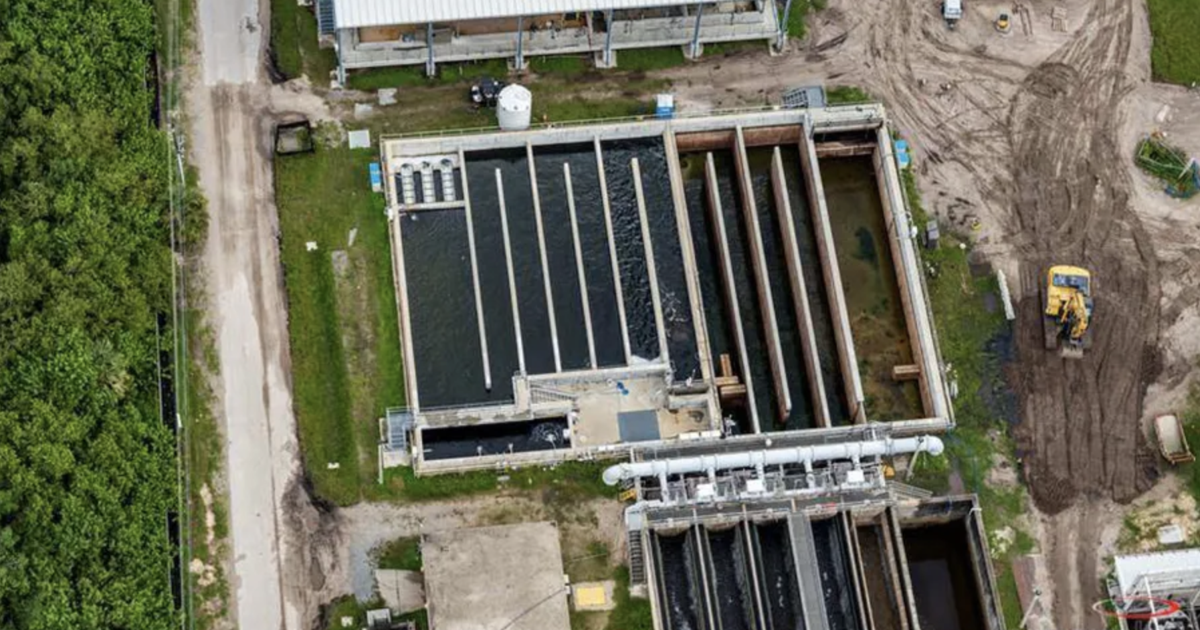
LARGO — The Largo City Commission recently approved two capital projects totaling $10.5 million aimed at improving the city’s wastewater treatment and public works operations.
During its Dec. 2 meeting, the board unanimously approved a four-year, $10 million contract with a national firm to treat and remove the city’s wastewater biosolids. The move comes as Largo’s current biosolids facility deteriorates after decades of use.
Wastewater Manager Kyle Hicks told commissioners the facility was built in the 1970s, with equipment installed between then and 1991.
“So, it’s definitely reached the end of its useful life and is showing its age,” Hicks said.
The facility suffered its first emergency shutdown this summer — an equipment failure that forced a three-week closure and cost the city $130,000 over four days to activate an emergency contractor.
“And we only expect these failures to become more frequent due to the age of the equipment,” Hicks said.
Hicks explained that the city’s water treatment process produces two main outputs: clean effluent discharge that goes into Old Tampa Bay or the reclaimed water system, and biosolids — solids separated from the wastewater stream.
The biosolids go through a digestion, dewatering and pelletizing process that produces a fertilizer product. The nutrient-rich material is pressed into cakes that the city sells for profit.
“We process 4.1 million gallons of sludge into 180 tons of biosolids a month,” Hicks said. The city recovers about $60,000 a year in revenue, which “barely offsets our costs.”
Hicks recommended awarding a bid of $2.53 million per year for four years to Synagro Technologies, which describes itself on its website as “North America’s leading provider of sustainable solutions for biosolids, organics and residuals.”
Under the contract, the city would decommission its current biosolids facility to avoid emergency shutdowns. Synagro would modernize the pelletizing process, take over the dewatering stage and haul the cake offsite for further processing.
“This contract will allow us to maintain consistent and reliable biosolids treatment and make informed decisions on our future,” Hicks said. “We believe this is the right way to move because it allows us flexibility and time to adapt to the changing biosolids environment in our area.”
The city plans to construct a new biosolids facility in its 2029 Capital Improvement Plan.
“So this (contract) will buy us time and help us make informed decisions and decide what to do,” Hicks said.
Commissioner Mike DiBrizzi said he doesn’t want to see wastewater fees increase because of the contract.
“That’s my fear,” he said.
Commissioner Curtis Holmes said the move was a no-brainer given the facility’s age and condition.
“There’s nothing new on this. It’s all old stuff,” Holmes said. “This is almost a discussion we shouldn’t have. But anyways, I’m in favor of this … because you’re actually buying time, and it’s a good investment.”
Holmes’ motion to approve the four-year, $10 million contract with Synagro passed 7-0.
Public Works Master Plan
The commission also unanimously approved a $500,000 agreement with St. Petersburg-based Harvard Jolly PBK to develop a Public Works Master Plan for the city’s 10.8-acre campus.
The plan would redesign the property in phases over several years to organize, align and improve city departments, equipment and community services.
Engineering Services Director Jerald Woloszynski outlined project goals including ensuring facilities align with long-term objectives and budgets and optimizing existing space. That could include relocating the parks department’s administrative buildings, staff and heavy equipment to the Public Works campus.
“There is synergy between what Public Works does and what (the) Parks (Department) does with their equipment, with their maintenance,” Woloszynski said. “It would be a benefit when all that equipment is all located together.”
The plan would also address adding a wastewater collection lift station, replacing onsite Public Safety modular structures with permanent buildings, and potentially expanding the city’s Public Safety training facility and moving the Emergency Operations Center to the campus.
“It may have the benefit of freeing up space here at 201 Highland Ave.,” he said. “And it would also build some synergy with the current mini-EOC that Public Works runs during emergency services events.”
Woloszynski said a key component involves determining the property’s condition from top to bottom, including subsurface investigations to assess soil conditions and below-ground issues.
“We want to make sure we know how much remaining life is in the current facility so we can plan accordingly, both financially and logistically, so we can prepare for those replacements in the CIP,” he said.
The 14-to-16-month process will include public and commission engagement through neighborhood canvassing and work sessions, with regular updates to the commission.
The board approved the item 7-0.