
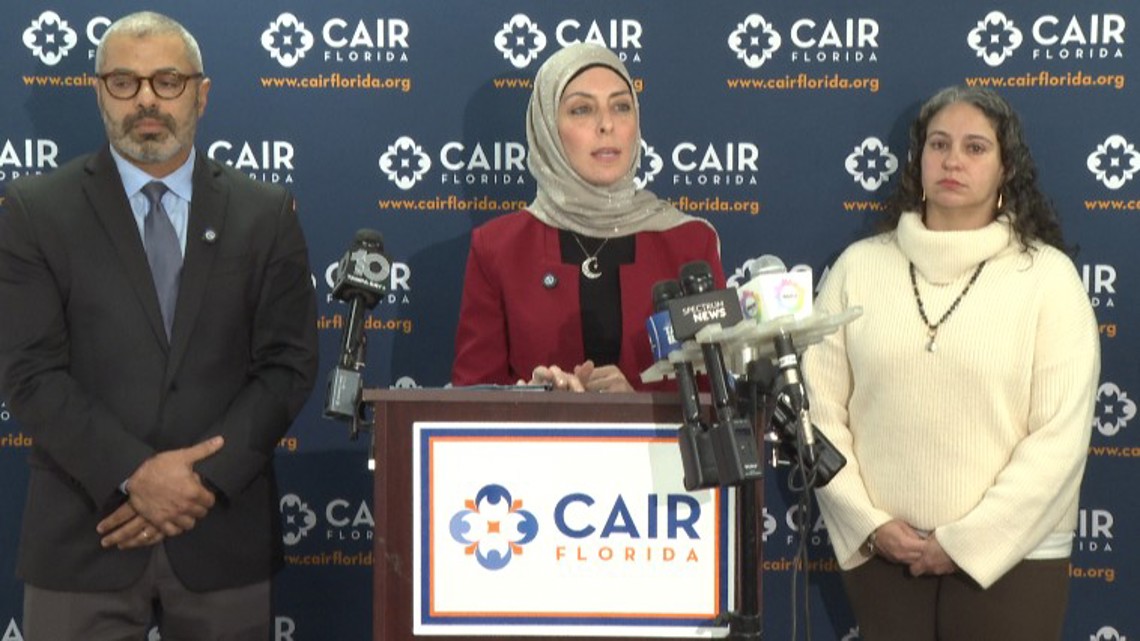
Speaking at a press conference in Tampa, CAIR Florida leaders said the order amounts to punishment without evidence or due process.
TAMPA, Fla. — The Council on American-Islamic Relations (CAIR) announced Tuesday it is suing Florida Gov. Ron DeSantis, arguing his recent executive order labeling the Muslim civil rights organization a “foreign terrorist organization” is unconstitutional, defamatory and already harming its work across the state.
CAIR and its Florida chapter filed the federal lawsuit just days after DeSantis issued an executive order directing state and local agencies to deny contracts, jobs, funding, benefits or other privileges to CAIR and to individuals accused of providing “material support” to the organization.
Speaking at a press conference in Tampa, CAIR-FL leaders said the order amounts to punishment without evidence or due process.
“This executive order does not represent facts,” Hiba Rahim of CAIR-FL said. “It does not cite investigations. It does not point to any criminal findings. It simply declares guilt by proclamation.”
Rahim said the lawsuit challenges what CAIR calls an unprecedented overreach of executive power.
“It does not matter whether you agree or disagree with our policies or our advocacy,” she said. “What should concern every American is the implication of allowing a government official to apply criminal designations without due process.”
According to the lawsuit, DeSantis exceeded his legal authority by unilaterally designating CAIR a terrorist organization — a power CAIR argues belongs exclusively to the federal government. The complaint also alleges violations of the Constitution’s guarantees of due process and free speech, saying the order retaliates against CAIR’s advocacy and chills lawful expression.
“Judges — not politicians — decide what is lawful,” Rahim said. “The American rule of law has been turned upside down. The governor issued the accusation and the punishment and skipped the courts entirely.”
CAIR attorney Omar Saleh said the case hinges on a fundamental constitutional principle.
“The power to designate a terrorist organization lies solely with the Secretary of State,” Saleh said. “It is not the governor’s power. We have a supremacy clause for that.”
Saleh also criticized language in the executive order directing the Florida Department of Law Enforcement and the Florida Highway Patrol to take unspecified “lawful measures” against CAIR.
“I thought we already had laws in place to prevent unlawful activity,” he said. “But the governor wants to add additional penalties just in case you’re Muslim or support a Muslim group. It doesn’t work that way in this country.”
CAIR-FL emphasized that it is a nonprofit civil rights organization, not a terrorist group, and pointed to its public advocacy, including support for a Florida teenager detained in Israel for nearly nine months and calls for accountability after Muslim students were allegedly harassed during prayer at the University of South Florida.
The organization also said the executive order is already having a chilling effect.
“What we are seeing already is what the intent of this executive order was for,” Thania Clevenger, chief operating officer of CAIR National, said. “The intent of this executive order is to cause a chilling effect.”
Clevenger said a planned podcast involving CAIR was canceled following the order, and that contractors and institutions with longstanding relationships with the organization are now seeking legal advice.
“We are getting questions from people — contractors wondering if the mere fact that they do business with CAIR somehow implicates them,” she said. “That chilling effect is happening.”
Rahim added that while some institutions are reassessing their relationships, CAIR has also seen strong community support.
“People are questioning and pausing,” she said. “But in almost every single case so far, we’ve seen incredible support from the community, where they’ve chosen to continue their relationships with CAIR Florida.”
Governor DeSantis has said publicly that he welcomes the lawsuit.
“This is something that I know our attorney general is ready, willing, and able to be fighting on this,” DeSantis said previously.
The governor has also suggested the legal challenge could allow the state to scrutinize CAIR’s finances.
“That will give the State of Florida discovery rights — to subpoena bank records,” DeSantis said.
CAIR attorneys dismissed that argument.
“I’m wondering what he thinks he’s going to find,” Saleh said. “We’ve been doing this work for 20 or 30 years. If there was something there, I think he would’ve found it already.”
Saleh accused the governor of using the order to score political points rather than address issues facing Floridians.
“Instead of focusing on housing and affordability, he’s trying to leave a legacy filled with hate and divisiveness,” Saleh said. “This case boils down to somebody trying to stop the work that we’re doing — and that tells you the work is effective.”
CAIR leaders framed the lawsuit as a broader test of constitutional limits on executive power.
“It’s about whether any governor can act like a king,” Rahim said. “It’s about whether dissent can be criminalized, and whether civil rights organizations can exist without the threat of political retaliation.”
The lawsuit seeks declaratory and injunctive relief to block enforcement of the executive order while the case proceeds. It also notes that the U.S. government has never designated CAIR a terrorist organization.
A similar lawsuit is already pending in Texas, where CAIR is challenging an almost identical designation issued by Gov. Greg Abbott.
CAIR leaders said they are confident the courts will ultimately rule in their favor.
“We are confident that the courts will once again affirm that you do not defeat civil rights by defaming those who defend them,” Rahim said.