
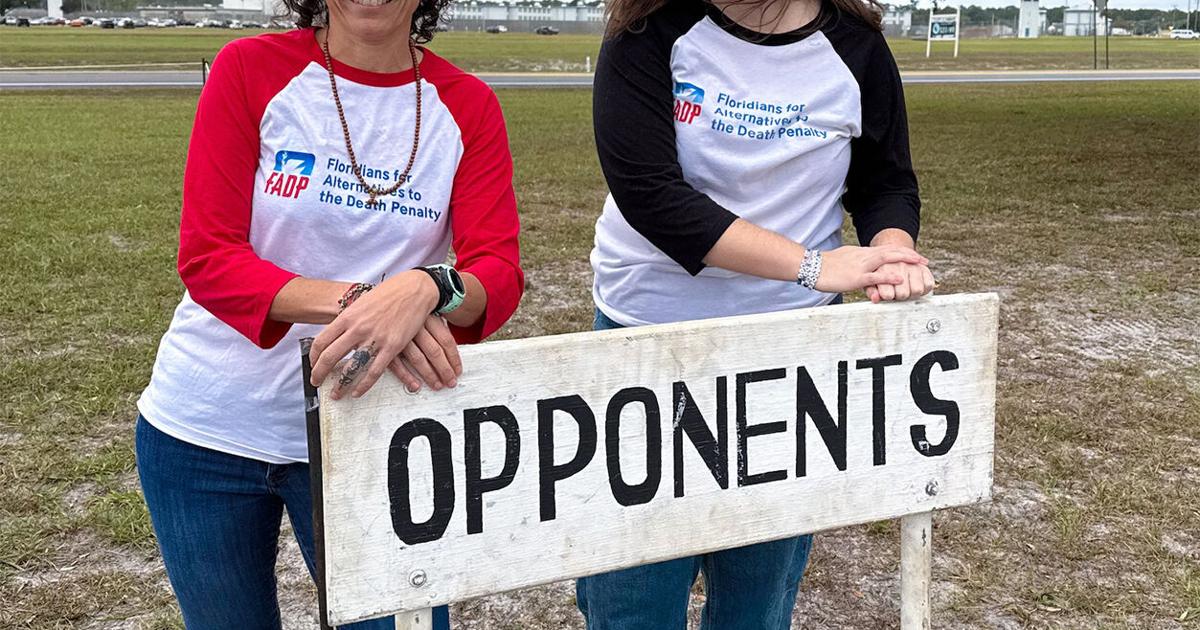

Maria DeLiberato, left, and Grace Hanna stand on the grounds across the street from Florida State Prison Oct. 28, 2025, during a prayer vigil. DeLiberato is stepping down as executive director of Floridians for Alternatives to the Death Penalty, and Hanna is stepping into that role full-time.
COURTESY | FAPD
ORLANDO | The year 2025 was the Jubilee Year of Hope. But does that hope extend to the death penalty, especially in Florida?
In 2024, 25 people were executed. In 2025, that number jumped to 47. The difference? According to the Death Penalty Information Center, it is the “dramatic increase” of executions in Florida, 19 in total, which accounts for 40% of the year’s total.
That stark number of 19 executions in one year — the most in Florida’s history since the reinstatement of the death penalty in 1976 — seems to contrast with public opinion about the death penalty. The Death Penalty Information Center cited a 2025 Gallup poll that found support for the death penalty is at a 50-year low — at 52 percent. To add to that, the Gallop also reported 44 percent of Americans oppose the death penalty — the highest level of opposition in polled data since May 1966. Taking into account age, the Gallop poll reported how younger Americans are opposed to the death penalty, at a rate of 50% of 35- to 54-year-olds and 52% of 18- to 34-year-olds.
Florida is without a doubt an outlier when it comes to the death penalty. Since 1976, 124 men and one woman have been executed. While life without parole is a legal option, a jury can recommend a death sentence with at least an 8 to 4 vote in favor of death. Under Florida law, a defendant can receive a death sentence for participation in a felony in which he or she was not responsible for the murder. This was the case for Anthony Wainwright, the sixth person executed in Florida in 2025. His co-defendant Richard Hamilton was on death row and wrote a signed affidavit that stated Wainwright did not participate in the murder of the victim, Carmen Gayheart. Hamilton was not executed but died on death row in 2023.
Florida’s record-number 19 executions are almost four times as much as the other top three states that carried out executions in 2025. South Carolina, Texas and Alabama each executed five individuals. Florida’s first execution of 2025 occurred Feb. 13, with the execution of James Ford, who — like the 18 men after him — was killed with a three-drug lethal injection that begins with Etomidate, an anesthetic agent used for the induction of general anesthesia and sedation. Ford’s execution became questionable because he was found to have an IQ within the range considered intellectually disabled, with the developmental function of a 14-year-old. He was not the only executed inmate who reportedly suffered from intellectual disabilities. Other executed inmates had histories that also included physical and sexual abuse, mental illness, including Post Traumatic Stress, and whose crime investigations and court filings were tarnished by racism and inadequate counsel. Executed inmates Victor Jones and Michael Bell were survivors of the Okeechobee School for Boys and the Dozier School for Boys, respectfully. Both of those state-run reform schools were known for their physical and sexual assaults committed on the students by staffers. According to the Marshall Project, at least 34 boys who stayed at Dozier and another 16 sent to Okeechobee ended up on Florida’s death row, including Jones and Bell.
“(Victor Jones was) an intellectually disabled Black man who survived horrific abuse at the Okeechobee School for Boys. He was beaten with leather straps, called racist slurs, locked in solitary, and forced to witness rapes. This trauma left him suicidal and hearing voices,” Floridians for Alternatives to the Death Penalty said in a statement before his death. This was a history of Jones’ life that never was offered to his original trial jurors.
Florida is also an outlier in who have been executed. Of the 10 military veterans who were executed this year, seven of them were in Florida. This was the highest number of veterans executed in almost 20 years. After warrants were signed for Edward James (U.S. Army), Jeffrey Hutchinson (U.S. Army ), Edward Zakrzewski (U.S. Air Force technical sergeant), Kayle Bates, (National Guard), Norman Mearle Grim Jr. (U.S. Navy), Bryan Jennings (Marine Corps) and Richard Barry Randolph (U.S. Army), veterans and veteran support groups wrote letter to Gov. Ron DeSantis, a former JAG officer, to spare the lives of these men who had served their country. The letters didn’t call for the release of the inmates, but for their death sentence to be commuted to life in prison without the possibility of parole.
The Death Penalty Information Center tallied more than 800 veterans sentenced to death in the U.S. since 1972. A report offered by the War Horse, an award-winning nonprofit newsroom that reports on the “human impact of military service,” stated while veterans represent an estimated 12% of Florida’s 252 death row inmates, they account for nearly 40% of the 19 death warrants that the governor has signed this year. The War Horse offered the example of Jeffrey Hutchinson, known as “Hutch” to his friends, was an Army Ranger who served in the Gulf War and traveled the “battlefield-to-prison” pipeline. In letters asking for mercy on Hutchinson’s life, opponents of the death penalty and everyday veterans pleaded for mercy based on the Post Traumatic Stress, traumatic brain injury and neurotoxin exposure he experienced in his service.
“Executing a man who was physically and psychologically shattered by war — a man who never got the treatment or understanding he needed and deserved — is not justice,” read a release offered by Floridians Against the Death Penalty following Hutchinson’s May 1, 2025 execution. “At Floridians for Alternatives to the Death Penalty, we oppose every execution because we believe that the death penalty creates more victims and perpetuates the cycle of harm.”
It can be difficult to ask for mercy for someone who committed the heinous crimes Hutchinson committed. On Sept. 11, 1998, he murdered his 32-year-old girlfriend Renee Flaherty and her three children — 9-year-old Geoffrey, 7-year-old Amanda and 4-year-old Logan. A horrific crime that is not discounted by those who do not support the death penalty. On the evening of each of the executions, opponents gather in front of Florida State Prison in Starke for a prayer vigil. They especially pray for not just the inmate being executed, but the victims of his crimes, their families and loved ones, and those of the inmate as well.
Opponents understand victims should not be forgotten. They were mothers, daughters, sons, husbands, wives, children, grandparents — none of whom deserved the violent ends to their lives. And in 2025, those victims’ names — almost three dozen — were recalled at each vigil:
• 25-year-old Gregory Philip “Quinn” Malnory and 26-year-old Kimberly Ann Malnory, who were murdered by James Ford April 6, 1997;
• 8-year-old Toni Marie Neuner and her grandmother, 63-year-old Betty Dick, who were murdered by Edward Thomas James Sept. 19, 1993;
• 49-year-old Janet Acosta, who was murdered by Michael Anthony Tanzi April 25, 2000;
• 34-year-old Tina Marie Cribbs, who was murdered by Glen Edward Rogers (who was also suspected in killing other people across the United States) Nov. 7, 1995;
• 23-year-old Carmen Gabriella Gayheart, who was murdered by Anthony Wainwright and Richard Hamilton (who died on death row in 2023) April 27, 1994;
• 27-year-old Michelle McGrath, who was murdered by Thomas Lee Gudinas May 24, 1995;
• 23-year-old Jimmy West and 18-year-old Tamecka Smith, who were murdered by Michael Bernard Bell Dec. 9, 1993. (Bell was also charged with first-degree murder of Michael John Aug. 19, 1993, and second-degree murders of Lashawn Cowart and her 2-year-old son, Travis, Sept. 25, 1989, but was not given death sentences for those counts);
• 34-year-old Sylvia Zakrzewski, 7-year-old Edward and 5-year-old Anna, who were murdered by Edward J. Zakrzewski II (the husband of Sylvia and father of Edward and Anna) June 9, 1994;
• 24-year-old Janet Renee White, who was murdered by Kayle Barrington Bates June 14, 1982;
• 27-year-old Valerie Davis, 41-year-old Mary Lubin and Johnnie Lee, who were murdered by Curtis Windom Feb. 7, 1992;
• 20-year-old Bonnie Knowles, 50-year-old Barbara Knowles and 60-year-old Clarence Knowles, who were murdered by David Joseph Pittman May 15, 1990;
• 67-year-old Jacob “Jack” Nestor and 66-year-old Matilda “Dolly” Nestor, who were killed by Victor Tony Jones Dec. 19, 1990;
• 24-year-old Denise Elaine Roach, who was murdered by Samuel Smithers May 12, 1996, and 31-year-old Christie Elizabeth Cowan, who was murdered by Smithers May 28, 1996;
• 63-year-old Cynthia Louise Campbell, who was murdered by Norman Mearle Grim Jr. Dec. 26, 2000;
• 62-year-old Minnie Ruth McCollum, who was murdered by Richard Barry Randolph (who now goes by Malik Abdul-Sajjad) Aug. 21, 1988;
• 33-year-old Tressa Lynn Pettibone, who was murdered by Mark Geralds Feb. 1, 1989.
On Dec. 18, 2025, those prayerful opponents of the death penalty gathered for the final time in 2025 when the state executed Frank Athen Walls. He received his death sentence for the murders of 22-year-old Edward Alger and 20-year-old Ann Louise Peterson July 22, 1987. Walls was 17 at the time of the first murder. He was labeled a teen serial killer as he was also linked to the March 26, 1985, murder of 19-year-old Tommie Lou Whiddon, and the May 20, 1987, murder of 24-year-old Cynthia Sue Condra.
But in the decades he has served on death row, Walls does not seem to be the same man who committed those horrific crimes. According to Floridians Against the Death Penalty, Walls relied on his Catholic faith and was known for his piety, helped fellow inmates, and shared devotions with fellow prisoners.
“Earlier this year, he completed the yearlong novitiate process to become a Benedictine Oblate. An Oblation is a formal, lifelong commitment that demonstrates mature, sincere, disciplined faith,” FADP wrote. “Yes, Frank committed monstrous acts, but he is not a monster. His life story, including his nearly four decades in prison, illustrates exactly why we do not execute people with intellectual disabilities: their limitations shape their behavior and their vulnerability, and none of the purported justifications for the death penalty are satisfied by their executions.”
Throughout September, October and November, days before an execution was scheduled, DeSantis would sign another warrant. At times two, even three men, would be moved from death row at Union Correctional Institute to Florida State Prison to await execution in the death house. It is the hope of FADP that opponents of the death penalty will continue to flood the governor’s office with phone calls and correspondence speaking out against capital punishment. According to Bridget Maloney, FADP communications director, creates a “historical record of opposition to this most gruesome year.”