
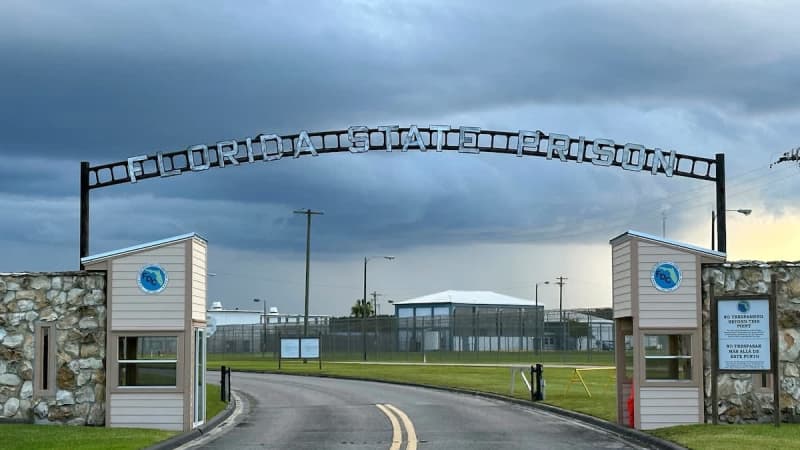
When the history of Florida’s modern era of capital punishment is written, 2025 will be marked as a year that saw an unprecedented embrace of the death penalty.
The state executed 19 prisoners this year — the most since the death penalty was reinstated in the 1970s.
Executions have been carried out in cases of defendants with intellectual disabilities and mental health issues,factors that previously would have prohibited the death penalty. At the same time, some state prosecutors are openly defying U.S.Supreme Court precedent as they seek capital punishment in cases of child sexual abuse.
Gov. Ron DeSantis, who had gone years without signing any death warrants, averaged two a monthin 2025. Asked about the reason for the recent surge during a Jacksonville news conference last month, the governor said it comes back to the families of the murder victims.
“There’s a saying, ‘Justice delayed is justice denied,’” DeSantis said. “I felt that I owed it to them to make sure that this ran very smoothly and promptly.”
So far, DeSantis has carried out 28 executions during hisseven years in office. With a year to go in his tenure, he will leave office as the governor who executed the mostprisoners.
It tookRick Scott all of his eight years in office to preside over 28 executions. Jeb Bush carried out 21.
DeSantis said in Jacksonville that when he took office, his administration “had to get our sea legs” on the death penalty. A year into his tenure, the COVID-19 pandemic disrupted the prison system, halting executions, he said. Three and a half yearspassed with no executions.
“But then I think what happened was, you know, we’ve heard from a lot of the family members of the victims over the years,” DeSantis said. “And if you think about it, some of these crimes were committed in the ’80s. And they wait, and there’s (an) appeal in this and that.”
The death penalty could be “a strong deterrent” to crime if it is carried out swiftly, DeSantis said.He mentioned getting “feedback” from the family members of murder victims.
“I kind of felt like I may have been letting some of them down,” DeSantis said. “It wasn’t intentional. There were a lot of other things that happened. So what we’re doing is, we’re doing it to be able to bring justice to the victims’ families. … Sometimes they’ll come to the office after and you can just see, after decades, the weight that’s kind of been lifted because, you know, they never fully had closure.”
Maria DeLiberato, the legal and policy director for the group Floridians for Alternatives to the Death Penalty, questioned the governor’s explanation. She noted that the victims’ families in at least two casesthis year opposed the executions.
“The only thing we can point to is politics,” DeLiberato said. “That’s the only thing that is different. He’s sort of figured out that this is something that appeals to his base.”
The age of some cases is a notabletrait. The 19 men executed so far this year spent an average of about 31 years on death row.
Bryan Jennings, who was executed in November, had been there longer than the others executed this year, having been sentenced to death 45 years ago.
As of this month, 251 people remain on Florida’s death row. All but one are men. One hundred fifty-four are white. Eighty-sixare Black. Ten are of other races.
Tommy Zeigler, who many believe is innocent, has been there longer than anyone, having been sentenced in 1976. Many believe that Zeigler was wrongfully convicted in the slayings of his wife, her parents and a man at his family furniture store near Orlando. Litigation continues over DNA testing his defense believes will prove him innocent.
Jennings was 20 in 1979 when he was accused in the Brevard County abduction, rape and murder of 6-year-old Rebecca Kunash. Jennings went to trial three times in the 1980s. Legal errors led tohis conviction and sentence getting repeatedly overturned.
A few of this year’s death warrants came in cases where defendants argued that intellectual disability prohibited the death penalty.
David Pittman, condemned for a 1988 triple murder in Polk County, had a well-documented history of intellectual impairments. Federal case law in the decades since he was sentenced forbids the execution of people with such disabilities.
Pittman was awaiting a full hearing on his own claims when the Florida Supreme Court, reversing an earlier decision, held that the bar against executing people with intellectual disabilities did not apply retroactively. He was executed in September.
Lawyers for Victor Tony Jones, condemned for a double murder in Miami, also argued claims of intellectual disability. He, too, was executed this fall.
The claims haven’t been limited to disability. Mental illness has been an issue as well.
Jeffrey Hutchinson, a Persian Gulf War veteran convicted in the shotgun slayings of his girlfriend and her three children, argued on appeal that his exposure to chemical weapons in combat resulted in a diagnosis of Gulf War illness. He unsuccessfully sought clemency last year.
He was executed in May.
The Florida Legislature in 2023 tweaked the state’s death penalty statute to allow capital punishment in cases of child rape.
That law runs afoul of well-established U.S. Supreme Court precedent, which forbids the death penalty for rape. In the 2008 case of Kennedy v. Louisiana, the high court’s 5-4 majority ruled that the death penalty for crimes other than homicide or certain offenses against the state is unconstitutional.
That hasn’t stopped some state attorneys from seeking death in child sexual battery cases.
In October, Palm Beach County prosecutors announced they’d seek death sentences for Josue Mendez Sales and Pablo Cobon Mendez, who are accused of sexually abusing a 6-year-old girl.
Last month, prosecutors in Hernando County announced they would seek death for Nathan Douglas Holmberg, who is accused of raping a child, among other crimes.
Florida Attorney General James Uthmeier acknowledged the Kennedy ruling, but he said he believes the Supreme Court should overturn that decision.
“We believe that today’s Supreme Court should reevaluate and reinterpret the law to allow this form of justice,” Uthmeier saidduring a news conference in Hernando County earlier this year.“You’re going to see a lot more of this.”
Two Hillsborough County cases were among those ending in executions this year.
Glen Rogers died in May, almost 30 years after he viciously stabbed to death Tina Marie Cribbs in a Tampa motel bathroom. Rogers, a drifter who traveled widely throughout the U.S., is believed to have killedin other states before he was arrested.
Samuel Lee Smithers died in September for the killings of two women whose bodies were found in 1996 in a pond behind an east Hillsborough County home. The victims, Denise Roach and Christie Cowan,were sex workers in Tampa before they vanished. Smithers had no final words before he was put to death.
The rest of the state’s executions came from outside the Tampa Bay area.
As the roster of executed inmates grew, so too did the amount of litigation related to the lethal injection process. Of note was a lawsuit filed earlier this month by Frank Walls, who was executed Thursday for a 1987 Okaloosa County double murder.
The lawsuit, citing Department of Corrections records, claimed the state used expired drugs and lower doses in some executions than are required under the state’s lethal injection protocol.
Walls’ attorneys accused the prison system of negligence and asserted that Walls could suffer severe pain akin to torture if he is executed. A federal judge quickly dismissed the case.