
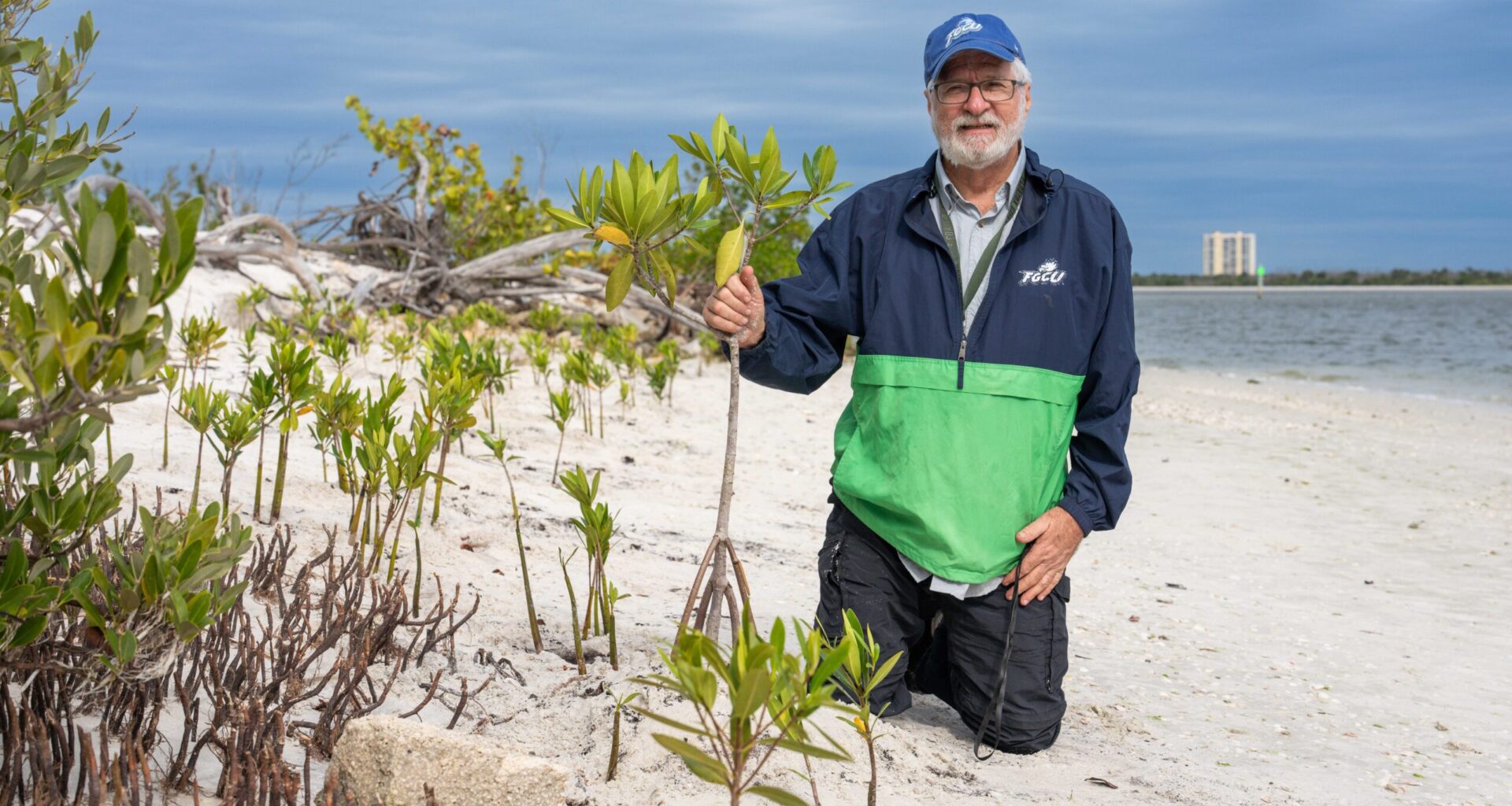
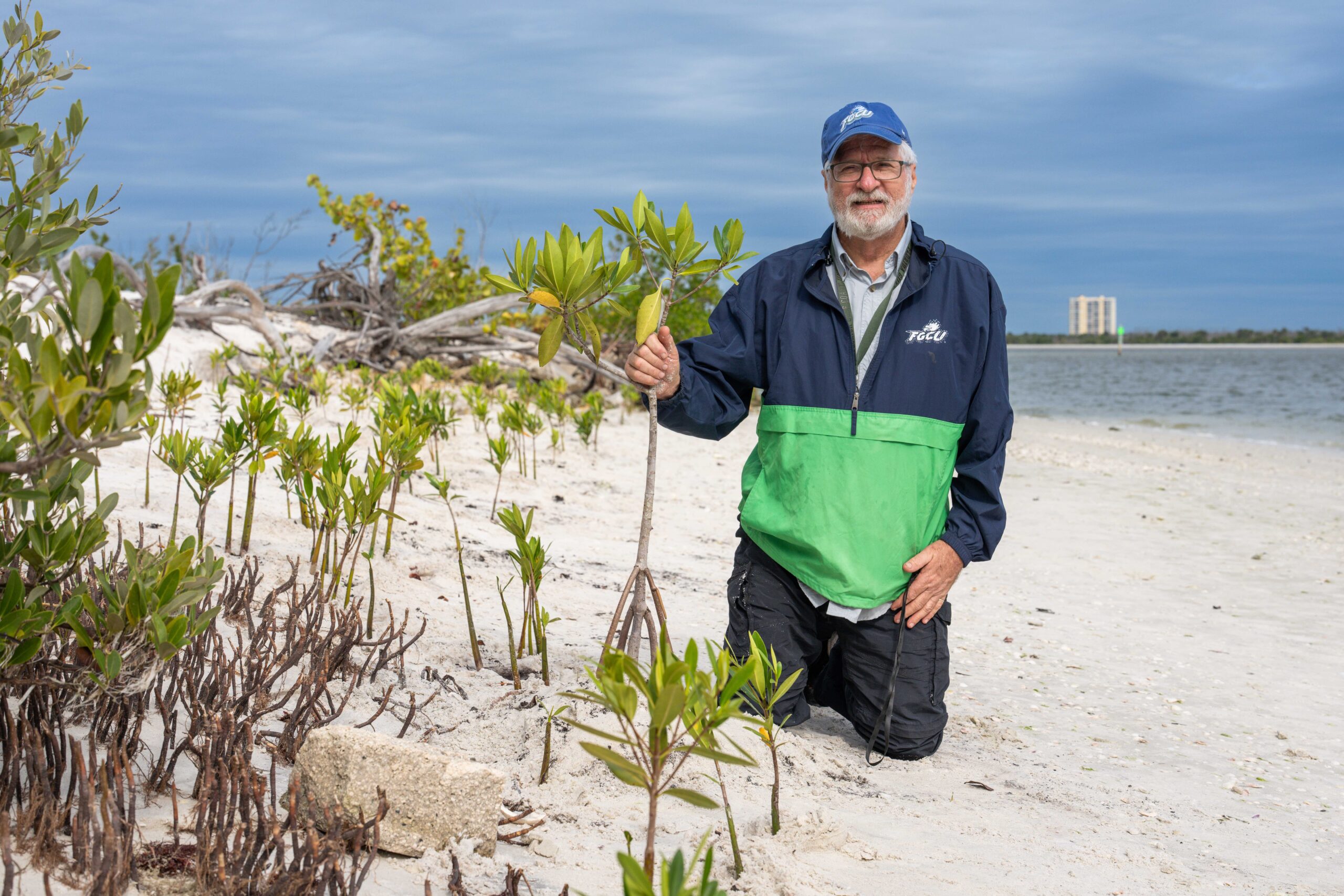
Professor Win Everham. -FGCU / COURTESY PHOTO
You’d think Professor Edwin “Win” Everham was just a nice-guy science teacher, bespectacled and mild mannered, maybe the Clark Kent of academic ecologists.
And he is. To start with.
Everham’s been teaching at Florida Gulf Coast University for a quarter of a century, now in the Department of Ecology & Environmental Studies at FGCU’s Water School.
There, people who know him have come to realize “nice-guy” is just first gear in the big Everham engine. Second, third, fourth and fifth gears will take you through knowledge, heart, grit, and passion, all fueled by a teaching pragmatism that reminds me of something my cowboy uncle believed about fence building in rocky terrain: “Just put both hands on it and give it hell.”
Everham in turn, with his students, just puts both hands on a mangrove forest and plants the propagules at sea level along hurricane-devastated coastal beaches. Ultimately, they may form a tenacious and resilient barrier to wind and surging water in storm conditions.
But he’s not just planting trees, he told me; he’s planting hope.
Contrary to the mild appearance, Everham is tough. When he was young, before he became a celebrated and sought after scientist and teacher, he joined the Peace Corps where you don’t stay in nice hotels, or any hotels. He spent about three years in Malawi, surrounded by places like Mozambique, Zimbabwe and Zambia.
Tough, committed and honest. So when Everham talks about how to save or restore beaches, people best listen.
Dunes with sea grasses and vines are the front line on a beach or an island where nature is enlisted in the resistance fight, he told me. We have those on both Florida coasts.
Mangroves back them up, because they blunt wind and wave action.
Bringing his own university students, Everham spent a recent day in the company of FGCU alumnus and Island Coast High School science teacher Joseph Mallon, and Mallon’s students, planting about 300 red mangrove propagules they’d spent the last year growing, at Bowditch Point on Fort Myers Beach.
Could have been anywhere with mangroves, though.
Those root-tangles of sultry green not only help communities, they can help each person who makes them part of the community. Planting them can become hurricane resistance at its most natural, and at its tenacious best.
“If you restore mangroves, they’ll restore you,” Everham explained simply.
His students love him in part for that attitude.
“His knowledge and passion keep me motivated to learn more and think deeper about the systems currently in place, and to question everything,” says Nina Lipka, one of his students.
“He also loves getting involved and making a difference in the community, big or small! He will take on a project and make the most out of it, such as the Bowditch Point mangrove planting, which empowered students from both Island Coast High School and FGCU. Overall, he reminds me to stay calm, empowered, and active in the community because any act can make a big difference.”
Some haven’t bought into those notions, however.
“Currently funding for mangrove restoration is being denied (which) led my college and the local high school to start gathering mangrove propagules and raising them to be implemented on the beach,” said Tristan Robbins, an FGCU senior majoring in Environmental Studies.
Everham had applied for and received a federal grant of $1.2 million to expand this program, but the grant was shut down suddenly with little explanation in April. The non-profit Miller Foundation in Naples stepped in to help with $100,000.
Growing red mangrove propagules as much as a year ahead of time isn’t hard. They can be started in fresh water if the grower adapts them to levels of salinity they’ll encounter as they mature, and the potential results can have an enormous impact.
Mangrove forests naturally proliferate, adapting to myriad challenges. But nothing in evolutionary history has prepared them to adapt to broad swaths of destruction created when recovery workers have to drag very large boats out of the mangroves after a devastating storm like Ian, Everham said.
So ecologists can step in and help, people like Tristan Robbins and Nina Lipka.
“We focused mostly on red mangroves, as they are naturally closest to the water, making them the first line of defense against storm surge and erosion, but we also planted black and white mangroves slightly higher on the beach,” said Robbins.
“They are just as important. Not only do they protect us from hurricanes, but they provide crucial habitat for fish and birds.”
Roger Williams. -COURTESY PHOTO
Long term?
“By planting these mangroves at Bowditch Point, the northern tip of (Estero) island will act as a natural buffer from storm surge and erosion damage,” Robbins explained.
So he’s looking down the road. Not just to the next hurricane season, but to the next 50 hurricane seasons.
Professor Everham puts it this way: “Putting sand back on the beach is like mowing your lawn. It’s a temporary solution. As long as you’re okay with that we can continue to spend millions of dollars.”
Or you can plant more trees, he concluded. And in that case, “even if all of our trees died, there’s still hope.”