
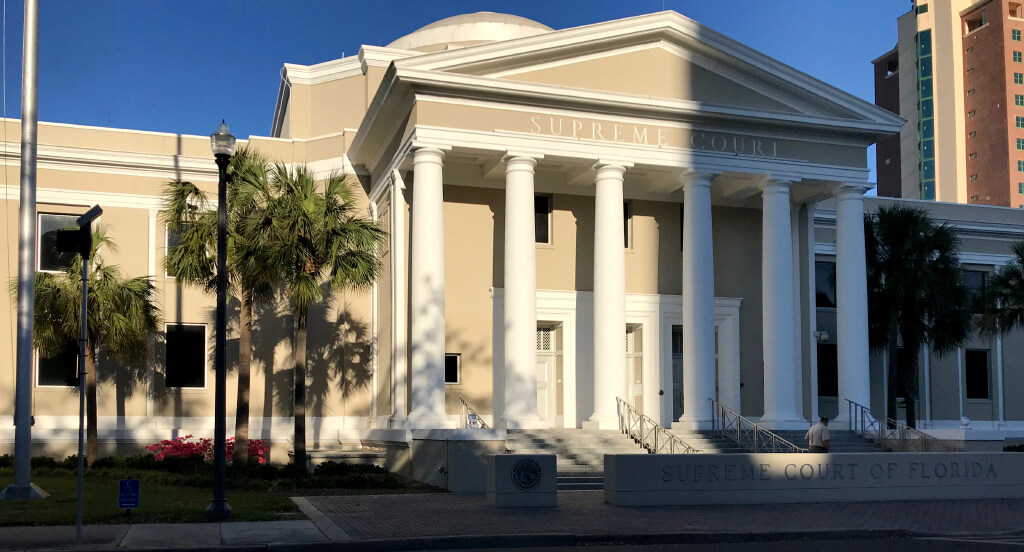
Five of the seven justices on the Florida Supreme Court owe their positions to Gov. Ron DeSantis.
Soon there will be a sixth. No other governor has ever appointed more than four or had so ruinous an impact on the state’s jurisprudence.
When DeSantis arrived in 2019, the court had long since lived down its corrupt and racist history. It had become a credit to Florida for its integrity and its generally progressive decisions.
After DeSantis came in, three liberal justices faced mandatory retirement; their replacements would be rigid right-wingers. He counted on that from the members he and his predecessor, Rick Scott, had carefully appointed to the Supreme Court Judicial Nominating Commission, which vets the applicants and selects finalists.
If history repeats, the next nominees — usually three — will all belong to the Federalist Society, as does DeSantis. Nine of the 10 applicants are members. They share his enthusiasm for the death penalty, his opposition to abortion, and his zeal to grow government and corporate power at the public’s expense.
No respect for settled law
The court’s two long-serving conservatives, Charles Canady and Ricky Polston, promptly enlisted the newcomers in repealing long-settled precedents they had opposed. Respect for settled law, a fundamental conservative principle, vanished.
Here are four of the new majority’s most drastic flip-flops:
— Repeal of a unanimous 1989 holding that Florida’s constitutional right of privacy protected the right to abortion. The new court upheld a near-total abortion ban that Canady’s wife, Jennifer, a state legislator, had co-sponsored (he did not recuse himself).
— Renouncing the court’s self-imposed duty to evaluate every death sentence for proportionality, the legal basis upon which it had upheld Florida’s 1973 death penalty law. The court no longer cares whether one perpetrator is sentenced to die while his co-defendants are spared.
— Overturning its own 2017 requirement of unanimous juries in death sentences, which led to the nation’s harshest death penalty regime. As few as eight of 12 jury votes for execution now suffice. In dissent, Justice Jorge Labarga objected that Florida was rejecting decency itself.
— Ignoring the voter-approved “Fair Districts” amendments to uphold a DeSantis gerrymander that got rid of the only Democratic congressman in north Florida, Al Lawson, who is Black.
A parade of horribles
In a cascade of decisions, the DeSantis court forbade the Florida Bar to promote diversity and fairness in the judiciary; protected the tobacco industry from lawsuits by requiring proof that a victim relied on tobacco advertising; and changed civil procedure rules to benefit corporate defendants.
The court upheld DeSantis’ unjustified suspension of Orlando-area state attorney Monique Worrell (later re-elected); said judges may impose harsher sentences on defendants who insist on their right to trial; blocked a citizens’ initiative to ban assault weapons from the 2022 ballot; and ordered the Florida Bar, an agency of the court, to elect no more delegates to the American Bar Association, which seems to be on the Republican Party’s political hit list.
The court also intends to stop the ABA from accrediting Florida law schools. The court could abolish the Florida Bar itself, if it objects too much.
The court’s three most recent death penalty decisions exemplify its lust for executions.
Frank Walls, a multiple murderer who died a week before Christmas, had at one point benefitted from the old court’s more liberal policy on proving intellectual disability. This court retracted it.
In two other appeals last week, the court upheld the new law allowing as few as eight jurors to support a death sentence and it applied the law retroactively to death row inmates who should have been tried under the standard unanimity.
These decisions drew more agonized remarks from Labarga, whose nemesis, Canady, is the departing justice.
A great reform, undone
All of this underscores a basic truth that a governor’s most enduring legacy can be seen in his judicial appointments.
The DeSantis revolution has betrayed one of Florida’s greatest reforms, which was meant to ensure the courts’ political independence.
When then-Gov. Reubin Askew created a merit selection system in 1972, he provided that he and his successors would appoint only three of nine members of each nominating commission. The Florida Bar would name three more, and those six would then appoint three non-lawyer public members. The goal was that no one could control them.
But in 2001, with Republicans in control, a new law enabled Gov. Jeb Bush and his successors to appoint all nine members of each commission — a dreadful retreat from reform.
As Rick Scott did before him, DeSantis used that power to stack the Supreme Court nominating commission with ideological soulmates. Three members are registered lobbyists. Two members practice before the court, including recently appointed Jason Gonzalez, an influential DeSantis ally, one of whose law partners is seeking Canady’s seat.
“I am certain that the current structure of the Judicial Nominating Commissions is not what Governor Reubin Askew ever envisioned,” observes retired Justice Barbara Pariente.
It would be futile to expect this Legislature to restore Askew’s system. To require Senate confirmation of appointed justices would probably be aimless, although it’s worth a try.
The most politically feasible solution is to elect Florida governors who treasure judicial independence as much as Askew did.
The Sun Sentinel Editorial Board consists of Opinion Editor Steve Bousquet, Deputy Opinion Editor Dan Sweeney, editorial writers Pat Beall and Martin Dyckman, and Executive Editor Gretchen Day-Bryant. To contact us, email at letters@sun-sentinel.com.