
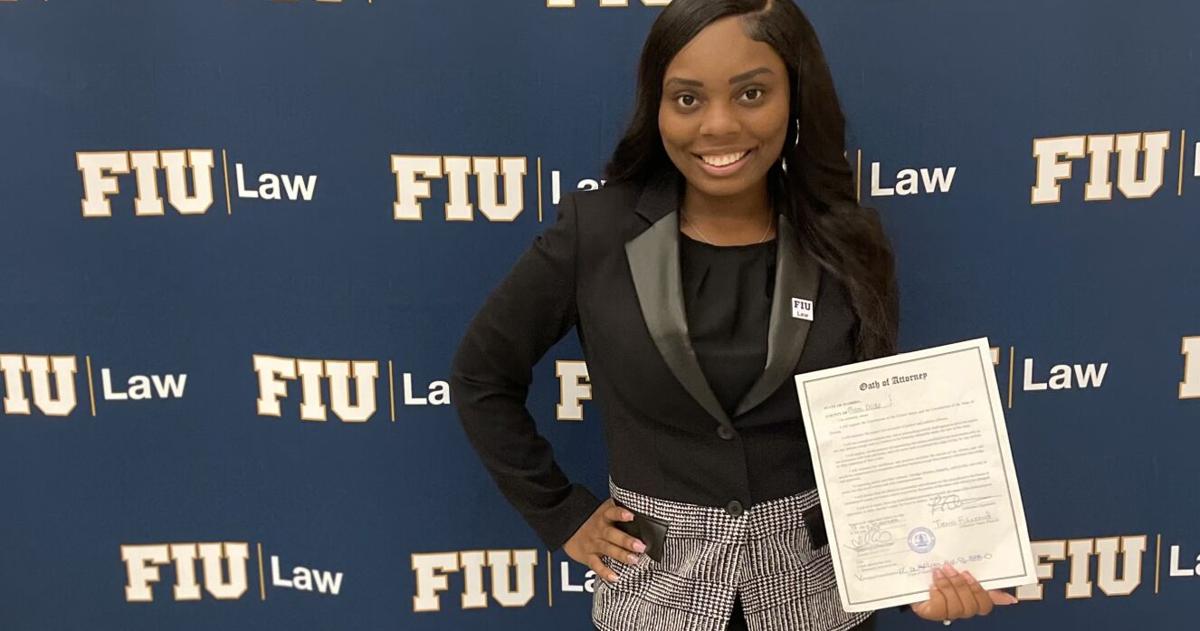
For Cassandra Zamor, a third-year student at FIU College of Law, the dream of becoming an attorney began in middle school while watching crime documentaries with her mother. But turning that dream into reality has come with a heavy price tag.
“I come from a single-parent household,” Zamor says. “I applied for scholarships, but they were small and didn’t renew. I thought about going out of state, but I got discouraged because it would be more money, so I stayed home to save as much as I could. I’ve basically gone to law school through loans.”
By graduation, she estimates her debt will total $75,000. Zamor’s experience reflects a broader crisis: as costs rise and federal supports like Grad PLUS loans face elimination, the pathway into the profession is narrowing, especially for minority students.


Cassandra Zamor, third-year law student at Florida International University.
(Courtesy of Cassandra Zamor)
The cost of entry

Olabisi Omoniyi-Alake is a first-year student at Georgetown Law.
(Courtesy of Olabisi Omoniyi-Alake)
The barriers begin long before the first day of class. Black, low-income, and first-generation students often face financial and logistical hurdles just to apply to law school. For Olabisi Omoniyi-Alake, a first-year student at Georgetown Law, the admissions process was both emotionally and financially exhausting.
“It was hard; not even studying for the LSAT, but registering for it was over $235,” she said. “Usually people take three or four exams, so that’s like $600 to $700 just to test.”
The costs quickly add up. Registering with the Credential Assembly Service (CAS) — which is required to send scores and transcripts — costs $207, plus $45 per school report, on top of application fees that average about $80 per school.
“Most people spend around $1,000 to $2,000, and it was a struggle for me because I didn’t have that in my bank account, and my parents couldn’t afford it,” Omoniyi-Alake said. “I looked for any way to get a fee waiver and even took a second job just to afford the application process.”
Beyond finances, Black students often lack access to mentorship and pre-law advising, making the process harder to navigate.
“I didn’t really know how to go about studying,” Zamor said. “I didn’t have anyone personally to advise me on what to do for law school or how to write a personal statement. I was basically learning as I went.”

Cassandra Zamor, left, with a judge and another classmate.
(Courtesy of Cassandra Zamor)
Paying for law school
Nationally, the average cost to attend law school is about $50,000 per year, with top programs reaching $70,000 to $90,000 annually. Tuition is compounded by housing, books, food, and living expenses.

Angelica Knight with an award for outstanding public service.
(Courtesy of Angelica Knight)
For Angélica Knight, now an attorney with the City of Miami Attorney’s Office and a single mother, finances shaped nearly every decision.
“When I started law school, they highly recommend that you do not work. I knew that couldn’t be the case for me.”

Angelica Knight with her son at St. Thomas University, where she earned her JD.
(Courtesy of Angelica Knight)
Knight enrolled in a flex program at St. Thomas University College of Law, allowing her to work while attending classes. When work conflicted with school, she left her job — a frightening but necessary decision, she said. Paid internships, contract legal work, and student loans carried her through until she graduated in 2023.
“I basically had to take out the full amount of loans, in private school, you can imagine,” Knight said. “I have a debt of student loans like the size of a house in Miami’s market right now.”
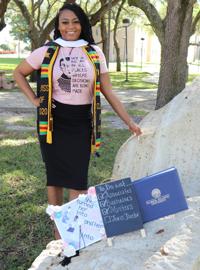
Angelica Knight on her way to obtain her law degree after achieving her master’s at Florida Atlantic University.
(Courtesy of Angelica Knight)
On average, law students borrow $119,292. Black graduates carry about 8% more debt than their white peers.

Tierra Fulwood obtained her law degree at Florida International University in 2023.
(Courtesy of Tierra Fulwood)
Tierra Fulwood, who graduated from FIU Law in 2023, first deferred law school to teach ninth-grade algebra through Teach For America at Northwestern Senior High. She wanted to serve her community, she said, but she lost a scholarship in the process. Later, when she enrolled at FIU, determined to avoid overwhelming debt, Fulwood worked full-time while also attending law school full-time — leaving class for work, studying until 3 a.m., then starting again at 8 a.m.
Because she worked multiple jobs, Fulwood said she often missed opportunities like law review, journals, and judicial internships, experiences that frequently open doors in the profession.
“That time kind of backfired once I got into practice,” she said. “I wasn’t able to build connections with judges or get these bigger lucrative jobs.”
Still, she graduated with roughly $22,000 in loans — far less than many.
Students often rely on federal aid through Grad PLUS loans due to a lack of generational wealth. However, these loans, which have no borrowing limit and are based on the graduate school’s cost of attendance, are set to be eliminated under the One Big Beautiful Bill Act by July 2026.
“Grad PLUS loans are how we get through law school. When you take that away, a lot of us will not be able to go because we’re going to be worried about how to fund our education,” Zamor said.
The bar prep
Even after three years of school, the bar exam remains an expensive gatekeeper. The total cost ranges from $2,860 to $6,660, including prep courses and fees.

Brianna Sainte, Shubin Law Group.
(Courtesy of Brianna Sainte)
“The emotional weight of taking the bar is real,” said Brianna Sainte, an associate at Shubin Law Group. “You could finish law school and still not practice.”
The intensity of preparation often makes full-time employment impossible.
“You can’t work a real job because you’re spending all your time studying. That is your job,” Sainte said. “I was waking up at 8 to start my 9 o’clock day, and I was not finished studying until 6 or 7 p.m., and the closer we got, it was 9 to 9, sometimes 9 to 10 p.m.”

Tierra Fulwood now practices commercial litigation and business law.
(Courtesy of Tierra Fulwood)
Sainte had her bar prep paid for by a firm — a benefit typically reserved for Big Law recruits — but, she acknowledged, many carry the burden alone. For Fulwood, bar prep marked the first time since her teens that she did not work.
“I remember my mom splitting the bar prep with me,” Fulwood said. “But other than that, then it was really all of the money that I had worked for.”

Florida International University Mock Trial Team members with the Bedell Trophy. From left: Coach Chandler Lefevere of the 17th Circuit State Attorneys Office; Evan Thomas; Natalia Cruz; Christopher C. Chillingworth; Victoria Thacker; Tierra Fulwood; Jonathan Gonzalez; Forrest J. Wilson; Stephanie Pena; Alexander A. Pollock; Coach Justin J. Duran of Meltzer & Bell; and Coach Ari S. Goldberg of Meltzer & Bell. Not pictured is Professor H. Scott Fingerhut, FIU’s head coach.
(Florida Bar)
Entering the market
Still, passing the bar does not erase structural barriers. Fulwood began her career as a public defender, earning $69,000, only about $15,000 more than she made before law school.
“It was very discouraging,” she said. “You get out of law school, you want to buy a house, you’re going to start a family, but you realize the job that you got really doesn’t allow you to do those things.”

Cassandra Zamor, fourth from left, back row, as as summer associate at Sioli Alexander Pino offices in Miami.
(Courtesy of Cassandra Zamor)
She also described being offered lower pay than her white counterparts and walking away out of self-respect.
“I realized the value they were paying me wasn’t that far off from the highest paralegal there,” Fulwood said. “It’s because I’m a female. It’s the color of my skin.”
After applying to more than 30 jobs, Fulwood recently secured a position in commercial litigation and business law — the highest-paying role of her career so far. Still, the journey nearly pushed her out of the profession.
“I really had to consider whether or not I was going to even continue and be a lawyer, because of the financial challenges, and even the burdens that you face trying to get jobs,” she said. “I’ve given my blood, sweat, and tears to this.”
For many, debt continues to shape daily decisions.

“I have a debt of student loans like the size of a house in Miami’s market right now.” -Angélica Knight, Esq
(City of Miami)
“It absolutely plays some part in my life and making daily decisions,” Knight said. “Now I’m transitioning to being ready to purchase a home, and I know that this student loan debt is going to play a role in what I can qualify for, regardless of how much I make.”
Even after earning her JD and becoming licensed, Knight chose to continue her education — not because it was required, but because she felt it was necessary.
“I could have just said, ‘I’m an attorney now. I don’t have to do anything else,’ but part of why I continued was because I never wanted somebody to tell me I’m not qualified or I’m not capable.”
Pipelines at risk
To make matters more difficult, the job market is tightening just as diversity efforts roll back. According to the National Association for Law Placement, summer associate diversity peaked in 2024 at 43.07%, driven mainly by Asian and multiracial hires. Meanwhile, the share of Black summer associates dropped by 1.5 percentage points. Today, only 5% of U.S. lawyers are Black.
With DEI programs under attack, many fear the consequences.

“We’ve got to prove to them each and every day that we belong where we belong. I have something only 2% of Black women have: a law degree. No one can ever take that away from me.” -Tierra Fulwood, Esq.
(Tierra Fulwood)
“There’s a sudden silence or a sudden shift now, and it’s kind of frightening,” says Omoniyi-Alake. “How is this going to impact the way people see me when I go into an interview? I don’t know how my Blackness and my womanhood fit into things now.”
Sainte sees the retreat from diversity as a loss.
“Diversity is something companies are shying away from through certain verbiage,” Sainte says. “But as a Black woman, I offer perspectives other people don’t.”
Fulwood’s advice for first-generation Black law students is blunt but resolute.
“Nothing in life worth having comes easy,” Fulwood said. “We’ve got to prove to them each and every day that we belong where we belong. I have something only 2% of Black women have: a law degree. No one can ever take that away from me.”
This story is the fourth and last in The Miami Times’ series, Justice, Interrupted, exploring how local Black lawyers are navigating the 2025 legal landscape. Visit miamitimesonline.com for more.