
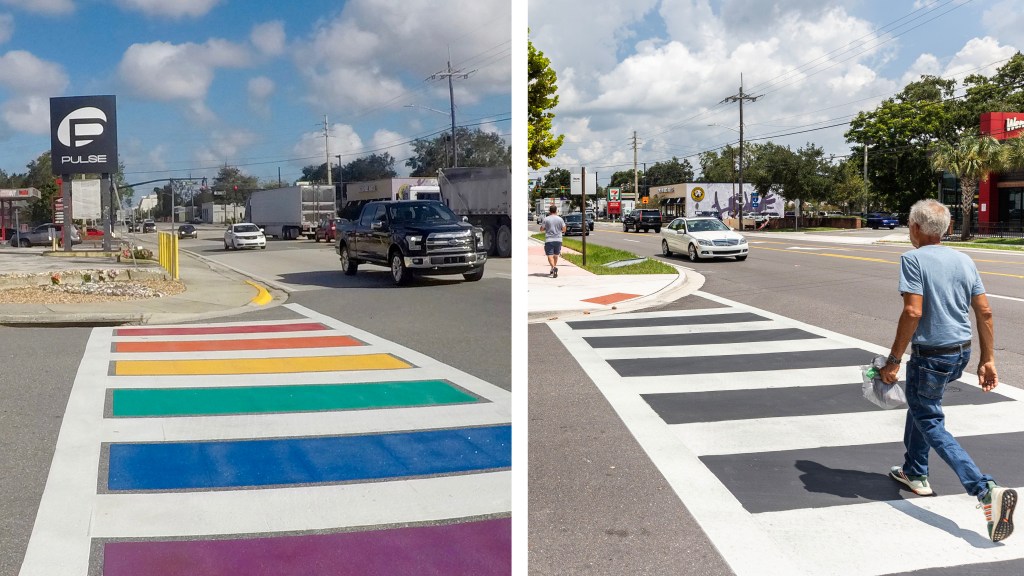
Without warning, without a word to Orlando officials, the state Department of Transportation sent a work crew into the SODO neighborhood with a directive: Blacken out the rainbow-painted crosswalk that marked the place where emergency crews once carried the wounded and dying victims of the Pulse nightclub massacre.
It was sacrilege on sacred ground, carried out in such close proximity to the Pulse site that the work crews would have been able to read the memorial signs that adorned the nightclub property itself. It left city officials and Orlando residents wondering: Why the sneak attack? Why didn’t Orlando get the chance to appeal, as other cities were granted? Most compelling: Why did the DOT destroy a crosswalk that the department itself installed just a few months prior, complete with the rainbow colors — and even boasted about on social media?
Orlando’s artistic crosswalks boosted safety. Florida ordered them painted over
When the Sentinel and other media outlets asked the state for records that would answer those questions, the only response was silence — even as the state continued to escalate its attack on street art of all kinds.
This act of authoritarian vandalism came out of the blue, though there were hints of trouble. On July 1, U.S. Transportation Secretary Sean Duffy issued a letter to states declaring decorative elements on roads to be dangerous and distracting — a theory he apparently pulled out of thin air, since there’s a massive body of research suggesting that road art actually makes intersections more safe. About a week later, the state sent out a vague memorandum that echoed those thoughts but contained no specific instructions.
On August 20, after FDOT sent warnings to two other cities with rainbow road decorations, Orlando City Commissioner Patty Sheehan talked to the Sentinel editorial board about her confidence that the Pulse crosswalk would be safe, since the state had just installed it weeks prior. The crosswalk traversed city-owned Esther Street, near its intersection with Orange Avenue, which is owned by the state. But the city had worked extensively with the state to make sure the crosswalk was installed correctly and met all regulations. The result was compliant but still striking: A standard white-barred crosswalk, with each space filled in with a different color of the rainbow.
Later that afternoon, Sheehan talked with the mayor of Key West about ways that city might make its rainbow pavement markings acceptable to the state as well.
Early the next morning, she learned that the Pulse crosswalk’s brightly colored squares of paint had been covered with black. It was a devastating blow. Sheehan, the city’s first openly gay commissioner, was in office at the time of the Pulse tragedy. Along with Orlando Mayor Buddy Dyer and other city leaders, she arrived on the scene in the predawn hours of June 12, 2016, and spent most of that day comforting families while struggling to make sense of an attack that killed 49 people. By deciding to creep into town surreptitiously in the dead of night to destroy the crosswalk, state leaders must have known they were raising echoes of the original attack. Orlando’s wounds have not healed, though they have drawn many in the City Beautiful closer together.
Orlando Mayor Buddy Dyer said the city has yet to receive an explanation, let alone an apology. That apology is long overdue, but we doubt Gov. Ron DeSantis can muster the grace to offer it.
The records, however, are a different matter. By law, the public is entitled to them. Every time we’ve sued the state to get records that should have been freely available, we’ve won — as have other media outlets and individuals.
So now the Sentinel is suing the state again, for the records it requested four months ago. We’re confident that there’s a paper trail to be viewed here: It beggars imagination that the state coordinated the destruction of the crosswalk without a single text, email, memo or legal opinion — especially since it seems apparent that the orders to carry out this desecration came from Tallahasssee, not the DOT’s District 5 office in DeLand where most state decisions regarding Orlando-area roads are made. We are equally confident that the plain language of Florida’s open-records laws gives us — gives anyone — the right to access these records.
Maxwell: Orlando’s Pulse rainbow crosswalk erasure — lies, bigotry and danger
And we are sick and tired of a state administration that treats open-records laws as mere fluff that can be blown away if it annoys them or contradicts their political narrative.
That certainty was only underscored Wednesday. After our lawsuit was filed, the state grudgingly released several social-media entries, including one post dated July 8 that boasted about the Orange Avenue improvements, and mentioned “decorative elements” at the Pulse crosswalk. But we’ve also requested any internal memos, reports or other documents related to the decision to remove the crosswalk, as well as any work orders, cost estimates and bids, along with records of any meetings where the Pulse crosswalk was discussed. The state is denying that any of those records exist. We don’t believe that.
And we’re ready, once again, to hold them to account.
The Orlando Sentinel Editorial Board consists of Opinion Editor Krys Fluker, Executive Editor Roger Simmons and Viewpoints Editor Jay Reddick. Use insight@orlandosentinel.com to contact us.