
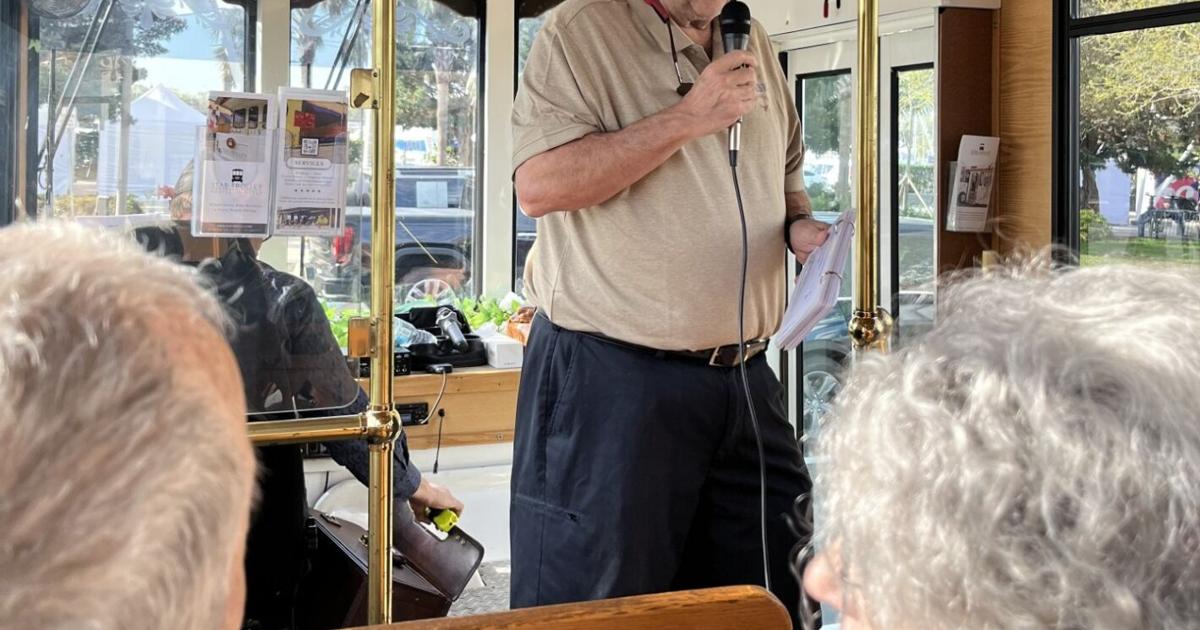
ST. PETERSBURG — Once a month, Ken Clawson takes baseball enthusiasts on a trip back in time, offering a history lesson on ballparks in St. Petersburg. Not just any ballpark, but those that major league teams used during spring training, dating to 1914.
The trolley tour, presented through the St. Petersburg Museum of History, takes visitors to sites around the city, past and present, where teams trained and played games. The idea, which came to fruition last year, stems from Clawson’s love of baseball history.
A former high school coach and current teacher in the area, Clawson approached the museum about the tour, and it has since become popular with residents and tourists alike.
“It’s a part of St. Petersburg’s history, and much of the information isn’t even known to people who have lived here forever,” said Clawson, who has resided in Pinellas County since 1987 and now lives in Clearwater.
“My wife and I enjoy visiting cities, and one of our first activities will be to join a hop-on, hop-off tour to get a lay of the land,” Clawson said. “I was always intrigued with the idea of being a tour guide on something like that. Given the rich history of spring training, I thought marrying the two ideas was a natural way to promote our area’s baseball richness.”
The first team to use St. Petersburg as its spring training home was the St. Louis Browns in 1914. The team, managed by Branch Rickey, played its games at Coffee Pot Park (until 1919) in the Grenada Terrace section of St. Petersburg. Keeping in mind this was the dead ball era, the ballpark dimensions were nothing like today’s — 240 feet to left field, 290 to center and 265 to right. The innovative Rickey expanded the complex to include a batting cage, bullpen mounds, slide pits, running lanes and handball courts.
Over the years, some ballparks had short runs, such as Moorefield Park in 1920. Others lasted longer, including Waterfront Park and Al Lang Field. Some are still used in different capacities: Al Lang Stadium for soccer, Huggins-Stengel Field as the home field for St. Petersburg High School, and Oliver Field at Campbell Park as a community field.
Teams that have trained in St. Petersburg besides the Browns include the New York Yankees, New York Mets, St. Louis Cardinals, Boston Braves, Baltimore Orioles and Tampa Bay Devil Rays.
In 1951, the New York Giants and Yankees swapped training camps, with the Yankees going to Arizona and the Giants to St. Petersburg. Clawson relates a host of historical tidbits during the tour: Nine different franchises called St. Petersburg their spring training home. St. Petersburg teams would amass 40 pennants and 28 World Series titles, 16 of them by the Yankees. Ironically, the year the Giants and Yankees traded spring training homes, they met in the World Series, won by the Yankees. For 58 springs, two teams shared St. Petersburg facilities. More than 200 Hall of Famers played or coached here.
Oliver Field, among other uses, was the home field of the St. Petersburg Pelicans of the Florida State Negro League. The renowned Homestead Grays and Indianapolis Clowns were among many Negro League teams to play at the field.
In addition to talking about baseball, Clawson mixes in details about the general history of St. Petersburg, including segregation.
Clawson has his own baseball history. Over the years, he has been an assistant coach and, for 10 years, a head coach — three years at Pinellas Park, two at Palm Harbor University and five at Clearwater. Among the players he coached are future major leaguers Tyler Clippard and Nick Masset. In an interesting twist, the two made their major league starts on the same day.
“May 20, 2007, was a magical day for an old coach like me,” Clawson said. “I heard that Tyler was called up and would make the start against the Mets in Shea Stadium on Sunday Night Baseball. That got me excited. Sunday morning when I got home from church, I flipped on ESPN, and Peter Gammons announced that Nick would be making an emergency start for the White Sox that afternoon at Wrigley against the Cubs. Nick threw in relief for the Rangers in ’06 and was traded to the Sox in the offseason and continued to throw in relief. Now they both were making their first major league start on the same day. How many high school coaches can claim they had two former players make their first MLB starts on the same day and both credited with the win?”
“At Wrigley in the afternoon, Masset went 5 2/3 innings, giving up two runs, both earned, on three hits and three walks with three strikeouts in what turned out to be a 10-6 win over the Cubs,” Clawson said. “At Shea, Clippard’s debut also went well, with the Yankees winning 6-2. He threw six complete innings of one-run ball, also on three hits and three walks, while striking out six. At the plate, Tyler got his first career hit, a double.”
He added that both eventually became closers during their careers. Nick closed for the Reds and Tyler for the Nationals.
Clawson, who also coached golf, volleyball, girls’ basketball and track and field in the school system, graduated from the University of Alabama. While he did not play baseball for the Crimson Tide, he did have the distinction in 1983, when Alabama finished second in the College World Series, of operating the scoreboard for a number of home games during the season.
Clawson would like to expand his trolley tours to other areas.
“I hope to develop more if we can find the right partners,” he said. “Tampa, North Pinellas, Bradenton/Sarasota all could support a nice tour. The most intriguing one for me may be Polk County: Lakeland, Winter Haven, Bartow, Fort Meade, the old Baseball City. I have some limitations timewise on St. Petersburg, but I think some could be supplemented with A/V, slideshow-type presentations.”
In the meantime, Clawson’s St. Petersburg baseball tour offers a fascinating look into the past and a history lesson worth checking out.
For more information about the trolley tour or to register, visit spmoh.com.