
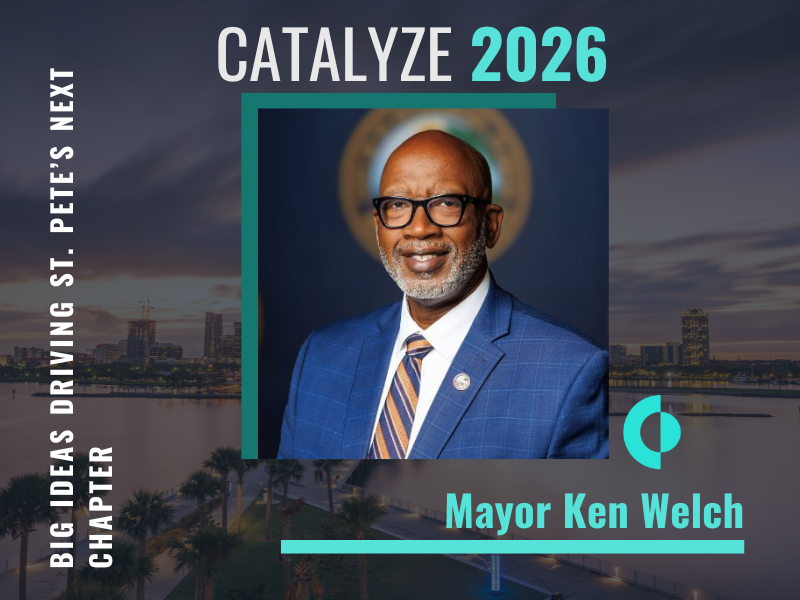
We’re asking thought leaders, business people and creatives to talk about the upcoming new year and give us catalyzing ideas for making St. Pete a better place to live. What should our city look like? What are their hopes, their plans, their problem-solving ideas? This is Catalyze 2026.
The former Coquina Key Plaza became a debris management site following Hurricanes Helene and Milton. Less than a year later, it housed Christmas floats.
Mayor Ken Welch said the staging area for a recent holiday parade showcased St. Petersburg’s resiliency and progress following a devastating 2024 storm season. He believes 2025 showed how “we’ve faced some tough challenges, but we’ve come through, and we’re getting better every day.”
A local development firm will soon transform the beleaguered plaza into a “beautiful” mixed-use development with affordable housing, and Welch eagerly anticipates several other long-awaited projects coming to fruition in 2026. Perhaps none are more monumental than the Historic Gas Plant District’s redevelopment.
“I’m excited, quite frankly, about our position today – where we own the land, where we are in a stronger position,” Welch said of the area surrounding Tropicana Field. “The one proposal that we have so far actually increases the amount of affordable housing, increases the minority participation.
“So, it’s actually stronger than what we had with Hines and the (Tampa Bay) Rays.”
ARK Investment Management, Ellison Development and Horus Construction submitted a $6.8 billion redevelopment proposal in October. Welch’s administration is currently considering the bid and will formally open a 30-day window for additional offers Jan. 4.
He has made it his mission to help fulfill 40-year-old promises of economic revitalization to the Black community that once called the Gas Plant home. Welch remains undeterred by the Rays exiting an arduously negotiated deal in March – and undaunted by the magnitude of a decision he will make in early 2026.
“It’s a privilege to do that,” Welch said. “The focus hasn’t changed from those principles that we laid out … the jobs, the housing, the opportunities, the shared progress and honoring those promises. So, that is a promise we will fulfill.”
He pledged that residents will also see movement on several other important initiatives in the new year. Those include Pelican Place, which will provide 40 new affordable homeownership opportunities in an underserved area of South St. Petersburg.
Habitat for Humanity Tampa Bay Gulfside recently broke ground on the townhome community. Welch noted that the former city-owned site has “long been just an open parcel.”
The historic Manhattan Casino is receiving $4.8 million in upgrades and will soon reopen as an event space on the 22nd Street South (Deuces) corridor. Welch said residents on the city’s west side can also look forward to construction commencing on the Science Center, another facility with a rich history, in January.
“Those are areas of focus for us that we’re going to see significant progress on,” he added. “Certainly on resiliency.”
Welch noted the city is investing $33 million into the Shore Acres Flood Mitigation Project. That is one of many planned throughout St. Petersburg that will address increasing and evolving environmental threats.
Storm victims should also begin receiving checks from the $160 million Sunrise St. Pete program in the new year. Officials continue waiting for the U.S. Department of Housing and Urban Development (HUD) to offer its final approval, and Welch said they are “very optimistic that’s going to happen.”
“And later in the year, we’re going to ask voters to invest in SPAR (St. Pete Agile Resiliency) funding,” he said. “To fund $600 million in stormwater and water projects to make us the resilient city that we need to be.”
Voters will decide in November whether the city issues general obligation bonds to support those initiatives. Many council members prefer that financing mechanism over continuously increasing utility rates.
“So, I’m excited on all those fronts,” Welch said. “There are many more that would take too long to name, but in each of our Pillars for Progress, we’ve got significant projects going forward.”
Behind-the-scenes work on tap for 2026 includes updating technological systems that affect “everything from billing to permitting.” Welch said a city task force will also explore how to best utilize artificial intelligence (AI) in local government.
He believes AI “can be a game-changer for us, in terms of how efficient we are and how we interact.” However, Welch also stressed the importance of first understanding the rapidly advancing technology.
The mayor wants constituents to know that fostering inclusive progress remains a priority. Welch understands that housing affordability, “a pillar for us since day one,” is a top concern for many residents.
He also realizes that many people focus on the luxury condominiums rising downtown and the increasingly expensive apartments popping up throughout the city. However, Welch noted that hundreds of subsidized units are on the way or have recently opened.
“It’s not a zero-sum game,” he said. “We do need that market-rate development, but that doesn’t mean that we’ve forgotten about the affordable side of the house. We need both.”