
Adriana Boscarolo couldn’t sleep Friday night.
Instead, she scrolled Instagram at 3 a.m., where news spread that the U.S. military had captured Venezuelan President Nicolás Maduro and his wife, Cilia Flores. By 6 a.m., she saw that President Donald Trump had confirmed it.
So Boscarolo woke up her family, blasting the popular anthem “Venezuela” and telling them, “turn the lights on, we are free!”
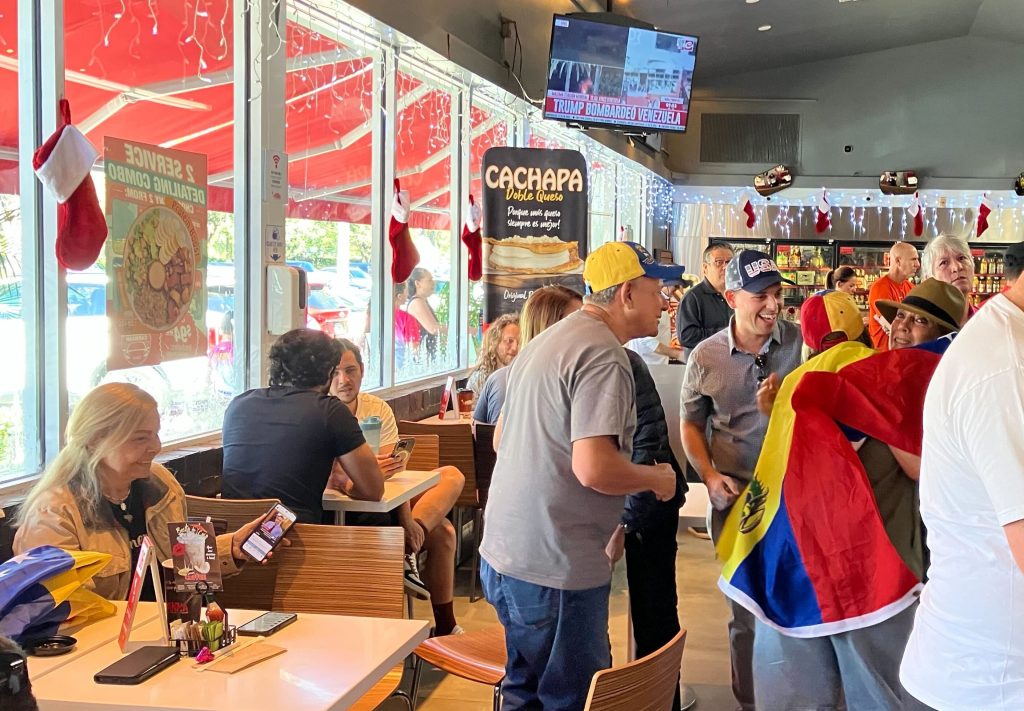
Similar celebrations were happening in other South Florida homes as news of Maduro’s capture overnight spread. By late Saturday morning, several Venezuelan Americans had gathered at PANNA, a popular Weston restaurant, embracing and watching the news, where updates continued to stream in. Some carried the Venezuelan flag; others wore flags painted on their faces or embroidered on their shirts.
The mood was largely hopeful, but there was also some apprehension around a key question: what comes next?
Many in South Florida’s Venezuelan community fled Maduro’s regime but still have family in the country, and are now anticipating the next chapter. Several said they hoped to see power go to Edmundo González, who is widely viewed as the true winner of the 2024 presidential election, and Venezuelan opposition leader Maria Corina Machado.
Janet Guzman, 67, said her family in Venezuela could hear explosions near the home where she used to live before she fled eight years ago. They are now waiting inside for more information.
But Guzman said she wasn’t too worried and believes Trump and Venezuelan opposition leaders have a plan.
“I’m just waiting for what is coming, what is going to happen,” she said. “But it’s all written. Everything is really very well prepared.”
Several in the community said Maduro’s capture was only the first step towards real change.
Ricardo and Gisa, who asked that their last names not be used, also came to the U.S. eight years ago, shortly before their daughter was born. They no longer felt safe in their home or walking down the street, they said. Both have friends and family back in Venezuela.
Gisa said she had “mixed emotions” about Maduro’s capture.
“I’m just hoping from this point on there is a peaceful transition,” she said. “People in Venezuela have suffered enough.”
“Right now the regime is still in place,” Ricardo added. “Maduro has been taken out but the regime still has to fall down.”
Javier Alegre, 50, who left the country 36 years ago at the age of 14, said that the corruption in Venezuela is “way deeper” than Maduro and Flores.
His family fled when Venezuela was still considered a democratic nation, he said, but corruption and a lack of security were rampant. Then Maduro took power, and it became “unbearable.”
“People would kill you to steal a pair of shoes,” he said.
Alegre said he hopes people see what happened in Venezuela as a warning.
“Let’s make sure that we learn from what happened,” he said. “And prevent that from happening in this country. A lot of people have given everything to come here. This is one of the last lifeboats on earth, and it needs to be preserved as well.”
While many Venezuelan South Floridians celebrated, local Democratic political leaders and advocates criticized the Trump administration for acting without approval from Congress, and for the president’s comments during a press conference at Mar-a-Lago Saturday that the U.S. would “run” Venezuela temporarily.
“This action offers beleaguered Venezuelans a chance to seat their true, democratically elected president, Edmundo González,” U.S. Rep. Debbie Wasserman Schultz said in a statement. “I’ll demand answers as to why Congress and the American people were bypassed in this effort. The absence of congressional involvement prior to this action risks the continuation of the illegitimate Venezuelan regime.”
State Sen. Shevrin Jones, who represents parts of Miami-Dade County, also celebrated Maduro’s removal but condemned the Trump administration.
“While it is encouraging to see the removal of this dictator, bombing a sovereign nation without congressional approval is unacceptable,” he said in a statement.
Meanwhile, South Florida Republicans championed the military action.
“This extraordinary action sends a clear message: the United States will not tolerate narco-terrorism in our hemisphere,” U.S. Rep. María Elvira Salazar, who represents parts of Miami-Dade county, said in a statement.
“This is a historic day in Florida, home to the largest Venezuelan, Cuban, and Nicaraguan exile communities in the nation,” U.S. Rep. Carlos Giménez, who also represents parts of Miami-Dade, said in a post on X. “We are forever grateful to President Trump and to the men and women of the United States Armed Forces.”
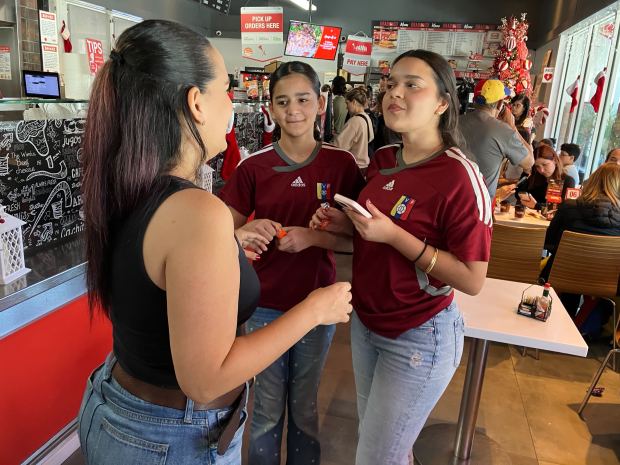 Mayra Bermudez, Fiorella Ramirez and Fabiana Ramirez gather wearing shirts at PANNA on Saturday, following the capture of Maduro. (Shira Moolten/South Florida Sun Sentinel)
Many younger South Floridians had never visited Venezuela or only had distant memories from when they were children. They hoped Maduro’s capture could mean finally visiting the country, where their friends and family still live.
Outside the restaurant, Mariana Boscarolo hugged her 11-year-old daughter, Isabella, who began to cry.
“I never really got to go to Venezuela because of Maduro, and I’ve always wanted to go and I’ve always waited for the moment to be free,” Isabella said, adding that her great-grandfather, Alberto, had been waiting for Venezuela to be freed from Maduro but died last year.
Inside, Fiorella Ramirez, 12, gathered with her family, some wearing shirts reading “Venezolana soy.”
Ramirez was 3 years old when she came to the U.S. Her sister woke her up Saturday morning with the news.
“It felt like I could finally go back home,” she said.