
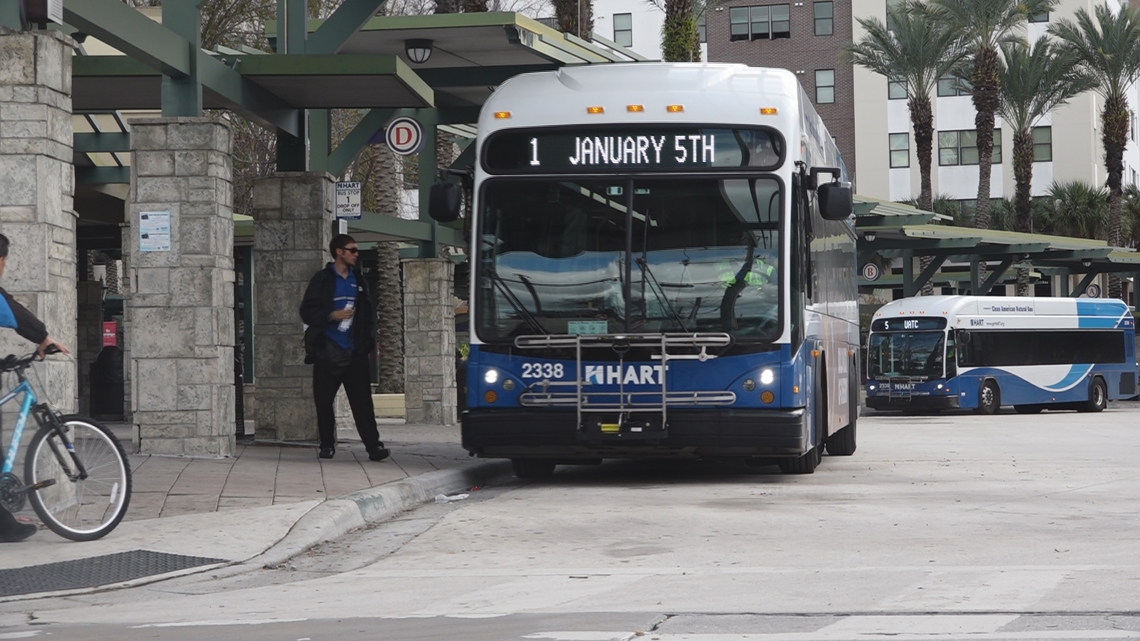
The program’s free fare pilot program was not renewed, as the city is investing in the bus route in a different way.
TAMPA, Fla. — Starting Monday, riders on HART’s Route 1 will need to start pulling out their wallets.
For the last year, HART riders have been a part of an experiment, benefitting from a one-year pilot program where the city offered riders free fares on Route 1, which runs from downtown Tampa to USF, to see the appetite for public transit.
It’s been a welcome change for riders like Eddie Perez, who have come to rely on the program. And he’s not the only one, with ridership jumping by more than 45% since the pilot’s implementation, making Route 1 the most popular route in HART’s system.
“When you’re in this situation, every penny counts,” Perez said. “There’s times where I go into the bus, and it’s completely full. People that carry their stuff, people that do groceries, they got all their bags.”
But on Monday, the real test of demand begins when the city will begin charging for the route once again. Passengers will have to pay $2 per ride, but for frequent riders that use digital payments, their fees will be capped at $4 per day or $65 per month.
“It’s bittersweet,” said Dayne Lazarus, the Co-Founder of Transit Now Tampa Bay. “We’re disappointed that we’re not going to see the fare free be a permanent program for Route 1.”
Lazarus’ organization was a part of the push ahead of Tampa’s 2025 budget approval, working with councilwoman Lynn Hurtak to implement the free fare program. She says Transit Now Tampa Bay pushed the city to make it permanent — or to experiment with making the program free on other routes. But in September during the 2026 budget meetings, Tampa elected not to do so.
Lazarus says the program was successful because it’s now prompting the city to look towards larger investments in public transit as a whole, unanimously approving $1.35 million in the 2026 budget to expand the frequency of HART’s Route 1.
The buses will continue to run every 15 minutes from 6 a.m. to 6 p.m. Monday through Friday, but will increase to every 20 minutes from 6 p.m. to 9 p.m. on weeknights and 6 a.m. to 9 p.m. on weekends. Currently, the buses run every 30 minutes to one hour on those weeknight and weekend times.
“Now I hope we’re moving into, hey, maybe we should fund the bus better, just generally,” Lazarus said. “That does start with increasing the frequency, so we’re taking logical steps right now.”