

With plans for more construction of Roberto Clemente Park, a render provides a general outlook of what is to be achieved. New projects such as the new office and museum as well as the covered courts can be seen. -COURTESY PHOTO
With the official reopening on Dec. 5, 2025, Roberto Clemente Park is once again able to host families and fun through its incredible renovations. Closed since March, Roberto Clemente Park has undergone substantial changes that leave it unrecognizable from its previous design. Funding for the renovation came in the form of a Fort Myers capital improvement fund of $1.375 million with another $1 million from the state due to the efforts of State Representative Jenna Persons-Mulicka, a claim she made on X.
Previously, Roberto Clemente Park featured both basketball and tennis courts, pavilions and a playground, as well as the Williams Academy Museum. Today, a new million-dollar playground has taken the place of the previous one as well as the construction of a new amphitheater that will allow events to be held at park just as they have been before. The main feature of the playground is the new 21-foot-tall slide, the largest in Southwest Florida, with an obstacle course built within it, requiring anyone who dares to traverse its fun path to then enjoy the ride down. Portraits of African American idols are plastered throughout the playground on its many other attractions. Slides, play sets, obstacle courses, everything a kid could need to have a blast. And the kids do enjoy the park, with their laughter filling the air.
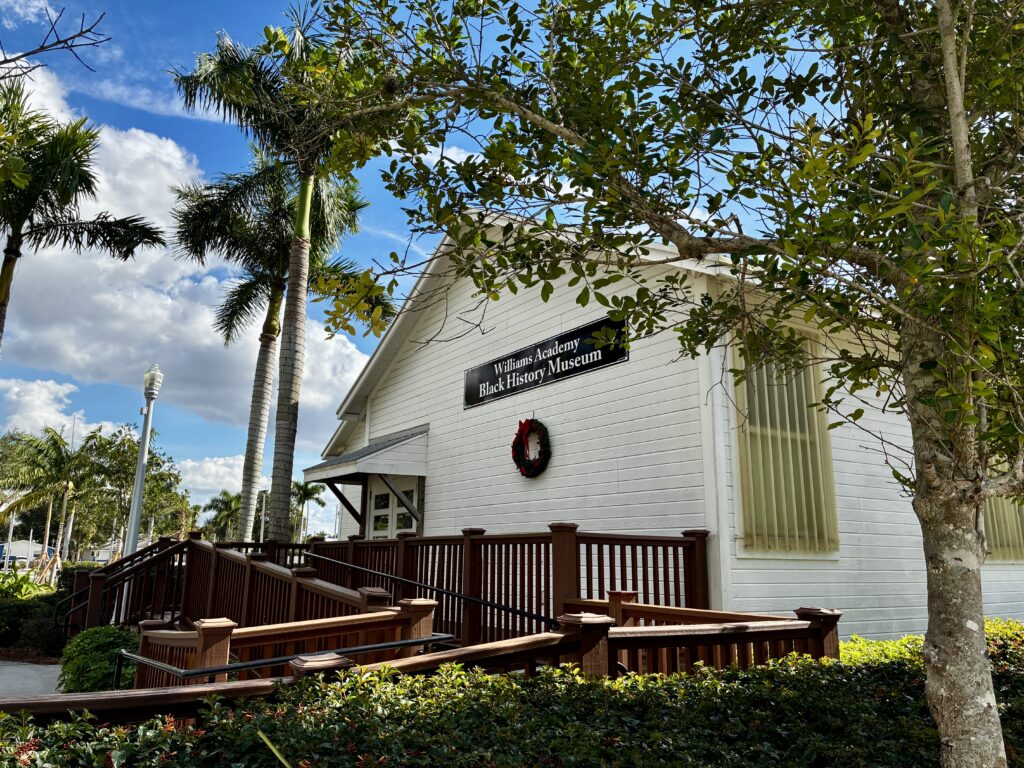
Built in 1942 and relocated in 1994, the Williams Academy lives on a serves a new purpose of teaching black history to the Fort Myers area. -SOLOMON BRISTOW / FLORIDA WEEKLY
Chairperson of the Lee County Black History Society, Charles Barnes Jr, said, “What does the park do for the community? It should be what does the park do for the whole city!” He stated that families and children of all backgrounds have come to enjoy the park. “That’s the whole goal: to bring people together,” said Barnes.
The plans for construction and renovation are far from over. The Lee County Black History Society has a vision board that helps to visualize what they have planned. During the playground construction, the basketball and tennis courts had been removed, but there are plans for a new court to be built where the current office is located. This new court would include a roof to provide shade. Based on the render provided, an array of solar panels will be put on the roof of this new court. As for the office, a new Cultural Center will be built closer to Martin Luther King Jr. Boulevard that will also be used as a new base of operations for the Lee County Black History Society and its mission.
The Lee County Black History Society is a non-profit organization whose mission is to promote black history and culture. One instance of achieving this mission dates to 1994, when Lee County School Board slated the last building remaining of the Williams Academy for demolition. The segment dates to 1942, but the original structure dates further back to 1913. The Williams Academy was the first government-funded school for African Americans in Fort Myers. When the Lee County Black History Society heard of this planned demolition, a plan to move the building from its previous location of Blount Street all the way to its present location on Martin Luther King Blvd.
Now utilizing one of the buildings that once made up the Williams Academy, the society created a detailed museum about African American history locally and nationally. The museum showcases national athletes but primarily focuses locally on black history within Fort Myers, dating back to the first African American to settle who is named Nelson Tillis. Roberto Clemente is also a focal point for the museum as his story is powerful and inspiring.
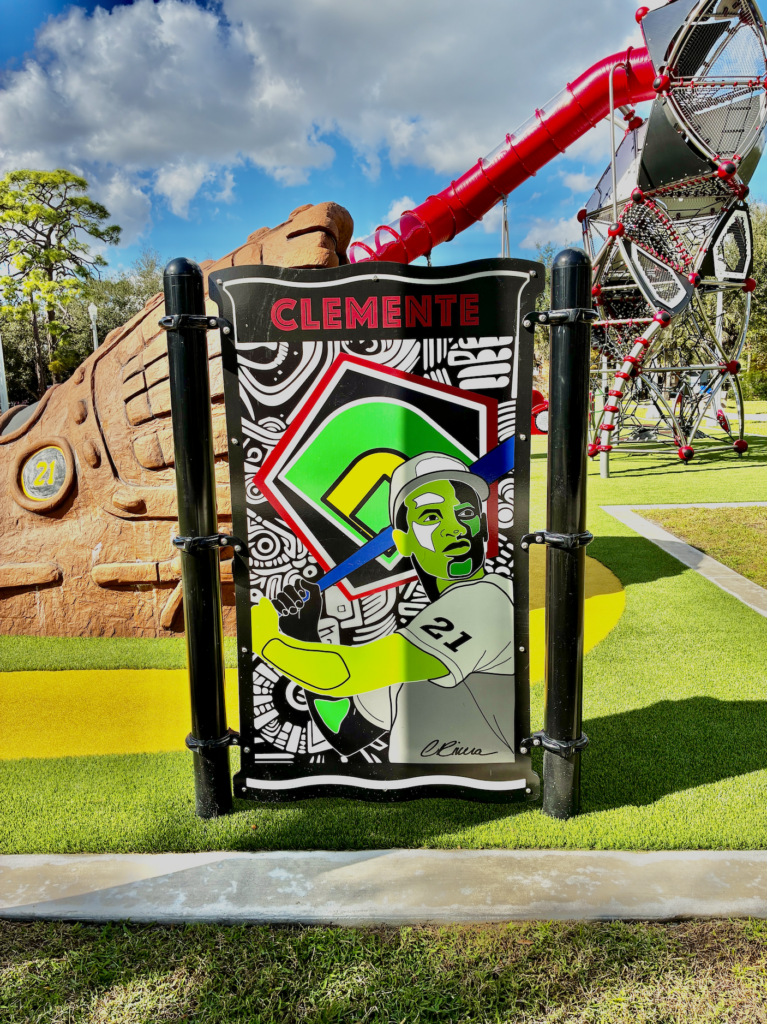
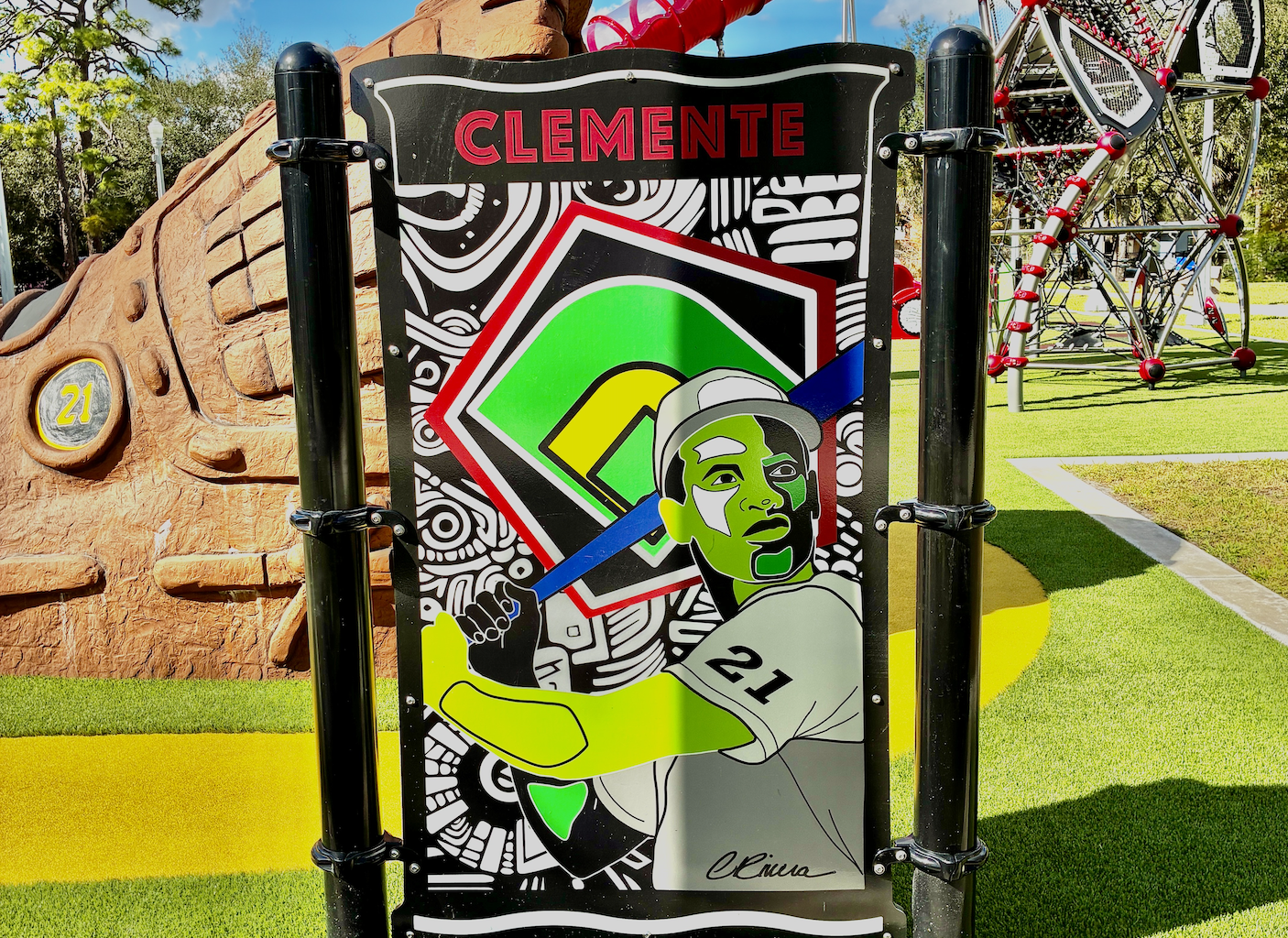
Images of impactful black figures are integrated throughout the playground’s design. A slide custom-built to appear as a baseball glove can be seen behind the sign that shows Roberto Clemente. -SOLOMON BRISTOW / FLORIDA WEEKLY
Roberto Clemente was a legendary baseball player whose story is an example demonstrating how kindness in the face of discrimination has a lasting impact that can be remembered still 50 years after his death. Born in Carolina, Puerto Rico, on Aug. 18, 1934, Clemente grew up as a baseball fanatic. At seventeen years old, he got signed to play in the Puerto Rican Winter League in 1952, being the youngest to be signed in this league’s history. In 1954, Brooklyn Dodgers scout Al Campanis scouted Clemente and drafted him. However, according to the Roberto Clemente Foundation, the Dodgers administration believed there were “too many minorities” on the team and would “upset white players and fans,” so the Dodgers assigned him to play for a minor league team, the Montreal Royals. This resulted in a limited playing time, only 87 games, which hindered his performance, hitting .257.
Roberto Clemente’s baseball career took a dramatic turn when the Pittsburgh Pirates drafted him in 1955 to play, acquiring the jersey number 21. This was the team Clemente carried out the rest of his career with, playing for 18 seasons. It was at this time that Clemente would go on to cement his legacy as one of the greatest baseball players of all time. Before he reached this status, Clemente had to battle through the Jim Crow South and segregation.
At this time, the Pirate Spring training was held at Terry Park in Fort Myers. Roberto Clemente was forced to live away from his white teammates due to the Jim Crow laws that segregated the Southern United States, forcing him to live within the Dunbar community of Fort Myers. When comparing Clemente’s experience living in Puerto Rico, a fully integrated society, adjusting to the Jim Crow South would have been a dramatic shift. According to the MLB, Roberto Clemente in 1972 said, “My parents never taught me to hate anyone, or dislike anyone because of their race or color.” Although Clemente was marginalized, he would remain kind to those around him with many claims supporting his kindness with children and fans. Kindness and service were two of the most prominent character traits Clemente had, prompting him to carry it out locally and abroad.
From 1958 to 1964, Roberto Clemente served in the Marine Corps in the 3rd Marine Division. The Clemente Museum, through Google Art and Culture, claims that Clemente went on to say how training in the Marine Corps helped to correct issues with his back that appeared after a car accident, allowing him to have a heavier bat and better offense. In 1964, when his service had ended, Roberto Clemente was back in Puerto Rico during the baseball off-season when he met his Vera Cristina Zabala. They were married until his death in 1972, having three children.
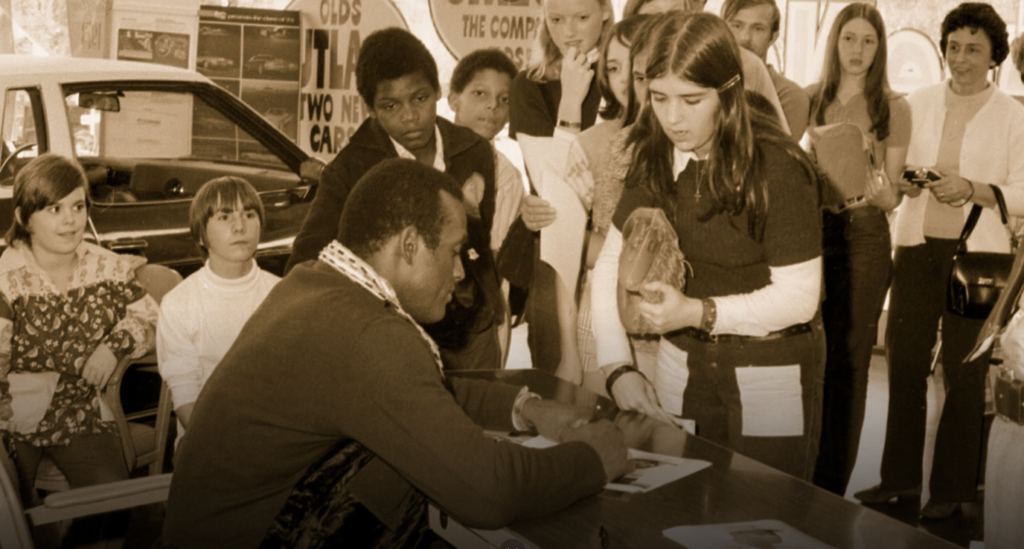
While in Pittsburgh, Roberto Clemente signs autographs, always taking the time and attention to interact with his fans. -COURTESY PHOTO
On the 23rd of December 1972, Nicaragua experienced 6.2 magnitude earthquake, a figure supported by the US National Science Foundation. 6000 people lost their lives with 200000-250000 thousand more people being displaced. The Nicaraguan people needed help, a call that Roberto Clemente was eager to answer. He gathered food, clothing and medical supplies and used his own resources to pay and coordinate the shipments. The first shipment had been lost due to the chaos of the situation, prompting Clemente to personally escort the next shipment. On Dec. 30, 1972, Clemente took off on a cargo plane that immediately crashed off the coast of Puerto Rico, with Clemente never being seen again.
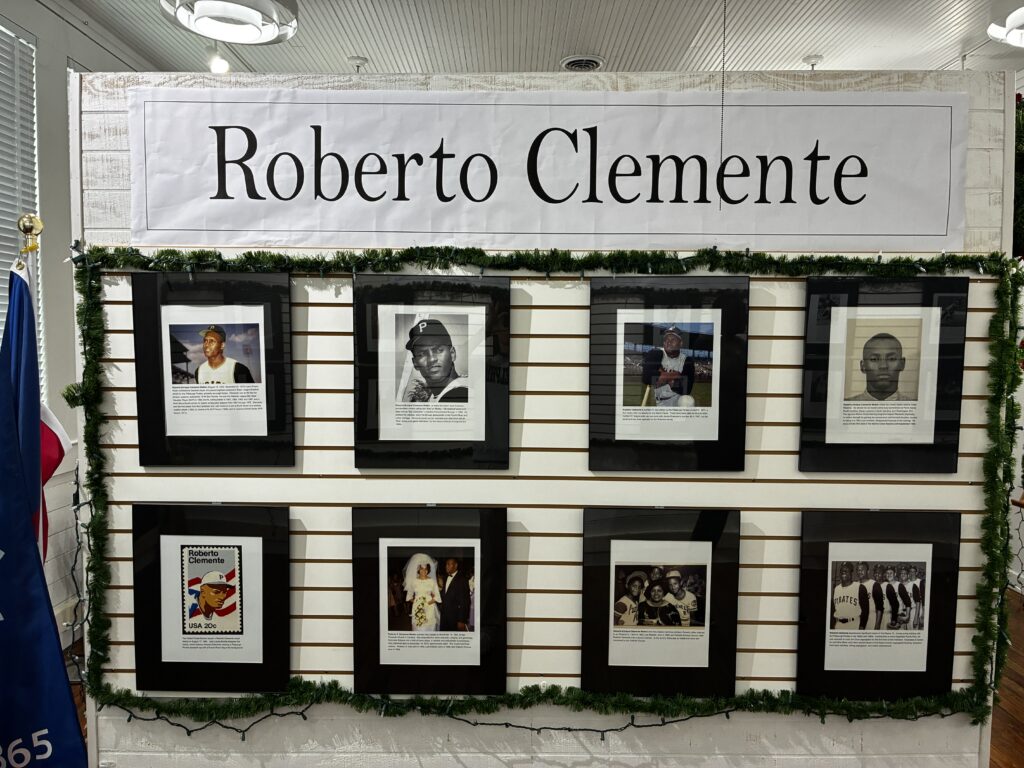
Within the Willaims Academy Museum, a wall filled with Roberto Clemente’s life teaches his story to visitors. -SOLOMON BRISTOW / FLORIDA WEEKLY
Roberto Clemente had earned 12 Golden Gloves, appeared in 12 All-Star Games and was the National League batting champion 4 times, with a .317. In 1999, Clemente was ranked 20th in The Sporting News list of the 100 Greatest Baseball Players. His legacy of servicing others lives on within the lives he’s inspired as well as organized groups such as the Roberto Clemente Foundation, a nonprofit organization that pursues humanitarian projects just as Clemente did himself.
The future of Roberto Clemente Park is nothing less than a bright one. Future constructions will improve the parks service for the entire Fort Myers community as well as preserve black history and celebrate black culture.
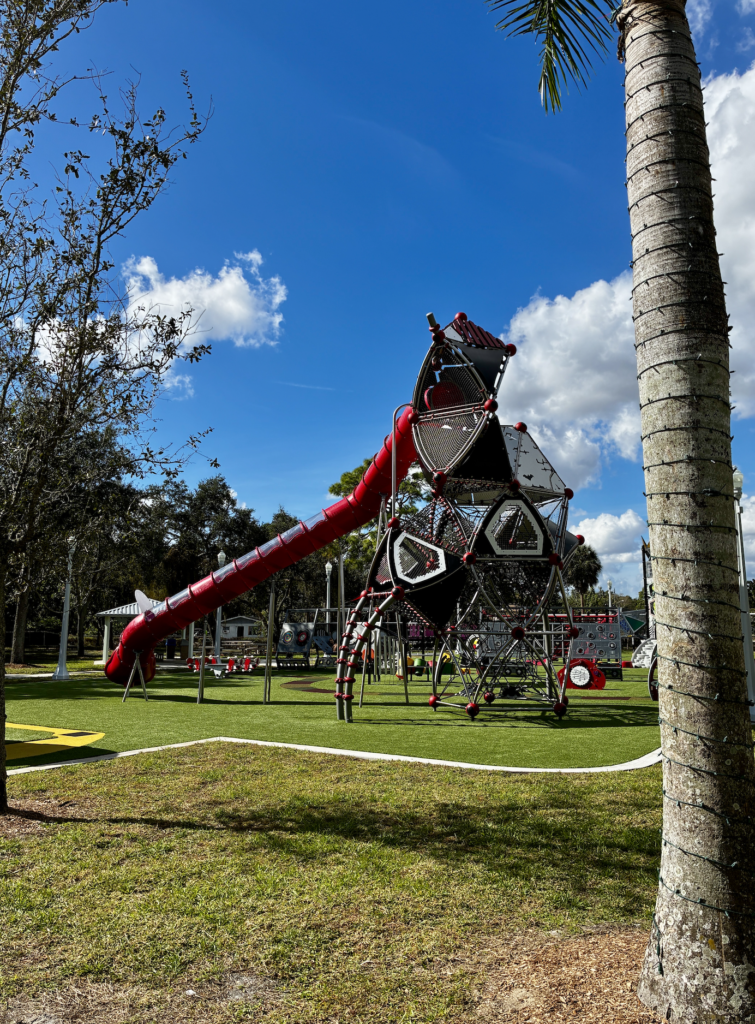
Towering 21 feet tall, the new slide at Roberto Clemente Park provides fun for children and families all around Fort Myers. The slide is the tallest in Southwest Florida but also represents Clemente’s baseball number, 21. -SOLOMON BRISTOW / FLORIDA WEEKLY