
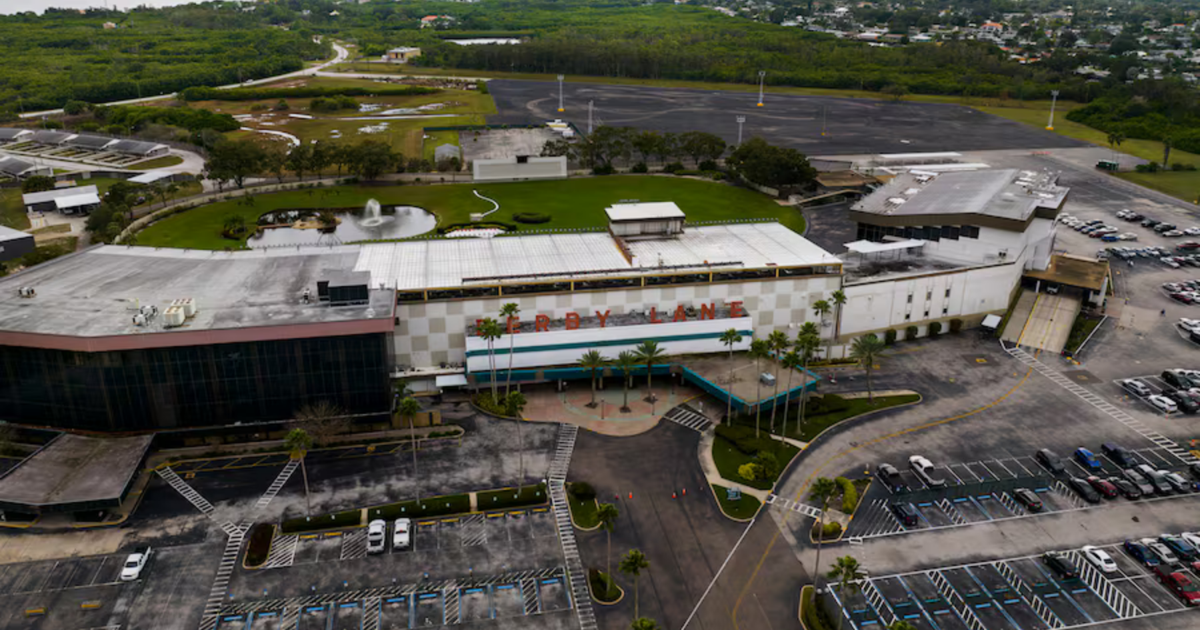
When Florida outlawed dog racing in 2018, questions swirled about the fate of Derby Lane, the country’s longest continually running greyhound track.
Set on 130 acres near the Gandy Bridge in unincorporated Pinellas County, the site seemed destined for a major transformation. But for years it lingered in obscurity.
Meager crowds gathered for poker and simulcast betting in a dated game room. The parking lot was filled mostly with vehicles from Amazon and other companies who paid to store their fleets overnight.
Now, an investment firm that bought the complex in April is on a mission to restore it to its former glory.
Sagi Genger, the CEO of Rally Development, said the company has already taken measures to boost the gaming business and attract new clientele for a variety of events.
The next step? Turning the massive property into Tampa Bay’s premier entertainment destination.
In an interview with the Tampa Bay Times, Genger laid out his vision for the future of the century-old racetrack and how his company plans to get it done.
This interview has been edited for clarity and length.
What attracted you to Derby Lane in the first place?
We found out about it because we were interested in the parimutuel gaming business. This is one of about 20 operators in the state of Florida. They’re not generally up for sale.
It happened to come with a significant piece of real estate. But our interest came through the gaming side, not the real estate side.
What was the state of the business when you took over?
This was a niche gaming business that was really underperforming compared to what it could have been on an operating basis. As a consequence it was also significantly undervalued.
My experience is that when we took over, most people in St. Petersburg knew what Derby Lane was and thought that it was closed. So we’ve just been getting the word out that we’re open and happy to entertain customers.
So far, we have had dramatic success in operating the business.
Last year at this time we were doing about 6,500 people showing up per week. This year we have anywhere from 9,500 to 16,000 people showing up a week.
You don’t normally see that kind of swing in attendance in this industry. If you can take the bull by the horns and better manage it and make a better experience for customers, it brings in other customers and all the good things that come with that.
You’re located on a huge piece of property. Have you thought about keeping the gaming license but selling the land to an outside developer?
We had to figure out very quickly whether or not we were going to be in a position to monetize the land.
Fortunately for us, the business worked out extraordinarily well. The experience we’ve had over the last seven months significantly solidified our balance sheet and put us in a position where we can choose what to do.
I wouldn’t say that a sale of the land is out of the question. It’s certainly possible at the right price. But I would say it’s probably more likely that we’re going to be partnering with someone in development long term.
What do you think could be built on this site?
The options are unending.
The gaming business generates more cash flow per square foot than pretty much anything else that you might think of putting there.
We’re probably going to want to keep the gaming business there and put other things around it that are complimentary to it.
Entertainment and retail will most likely be the focus of the development.
You have a dramatically under-retailed space. And significantly less entertainment opportunities in St. Petersburg than you might think for a city that size.
Maybe someone will come up with a proposal that we haven’t thought of that will change our mind. I’m certainly open to it.
How will you attract a wider audience to this site that’s always just been used for gambling?
We have opened up the property to all sorts of community events.
There’s a weekly flea market, which used to be called the Wagon Wheel market. That’s bringing in a few thousand people a week. And those people don’t even necessarily walk through the gaming operation.
We have a regularly occurring Asian food festival. We’ve had a food truck event, an event for Jeep owners.
The key for us is to just be a part of the community. We want people to think of this as a place to go and get together. Maybe some of them will use our gaming services and some of them won’t.
So just raising the general awareness that we’re open so that people think of us as an entertainment option.
Eventually we can add other things that will attract people. Some people have mentioned an amphitheater. We spoke with a company that was very interested in building a sort of sports and leisure, outdoor entertainment center.
I’m not saying that’s necessarily what we’re going to do, but there are lots of things like that.
What are some of the challenges that you foresee in developing this site?
Like any property, there are issues with it. You’re not going to have a property this big where just everything’s perfect.
Some parts of it are low lying so it has a flooding issue.
When you have a property this size, it’s not all going to be used uniformly for one purpose. So almost by definition, you’re going to have some uses that don’t fit squarely into the present zoning, and that will require some sort of approval process.
When we have a complete picture of what we want to do, we’ll approach the appropriate jurisdiction and work with them.
It’s going to impact the quality of life there, hopefully in a very positive way. It’s clearly going to have to be a back and forth. It’s too large to just do what we want without consulting the community at large.
Your background is mostly in gaming. Have you ever worked on a project of this magnitude?
I haven’t but my partners have.
One of my partners is one of the principles of Hornrock Properties which has done over $1 billion of real estate development.
We have an eclectic group of shareholders. Everything from one of the former chief executives of Mohegan Sun, to a retired partner at Apollo Global Management who was responsible for their entertainment division.
So everyone is coming with their own experiences. It’s a very active board. I mean that in a good way.
Have you gotten interest from any potential development partners so far?
It’s enormous.
We’re speaking to sort of a who’s who of the real estate development community.
We’re actually running a formal process and asking people to make proposals. I think we’ll be selecting a partner in the first quarter of next year.