
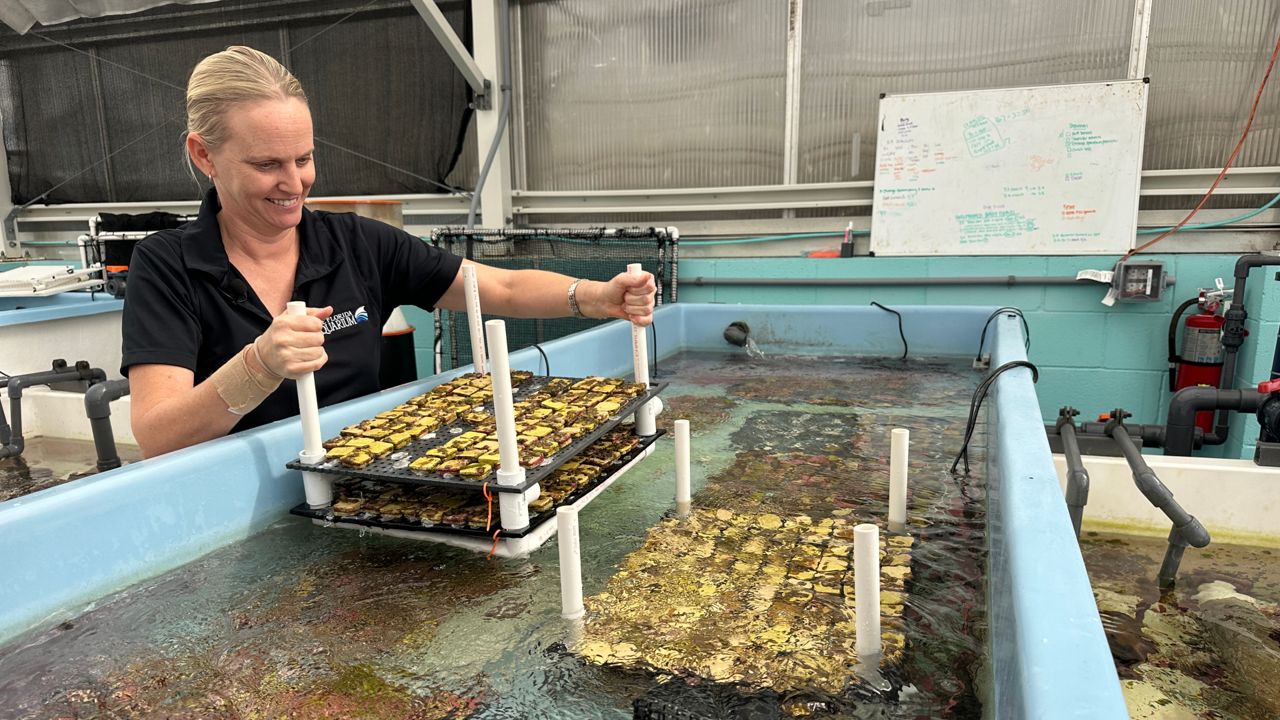
APOLLO BEACH, Fla. — The Florida Aquarium transferred out 9,000 juvenile corals to two restoration partners on Wednesday. It’s all part of Florida’s Coral Reef Restoration and Recovery Initiative, which is funded by the Florida Department of Environmental Protection in an effort to restore reefs in the Florida Keys.
What You Need To Know
The Florida Aquarium transferred 9,000 lab-grown corals to partners for maturation to restore at least 25% of the Florida Keys’ reefs.
Florida’s coral reef is an $8.5 billion state asset that supports tourism, provides critical habitats for fisheries, and protects beaches.
Scientists warn that current project funding is set to expire in 2027.
The baby corals transferred were all born and grown at the Florida Aquarium’s Coral Conservation and Research Center.
Scientists say Florida’s coral reef system is a huge asset to our state, and they hope to help restore at least 25% of the reefs in the Keys through projects like this.
“We’re looking at a tile with multiple small corals on it, so each one of these is a coral baby,” said Keri O’Neal, who is the Director and Senior Scientist for the Florida Aquarium’s Coral Reef Conservation Program.
“These corals will be given to our partners to grow out until they get to a little bit bigger size, and then they’ll be put back out on Florida’s coral reef,” she said.
On Wednesday, biologists used special reef glue to secure each tile for transport, then loaded them into coolers filled with water so they’d stay safe until they reached their next destination. Some of the baby coral went to the Reef Institute in West Palm Beach, and others will be at Reef Renewal in Ruskin.
“They’ll stay at the facility until they’ve covered the plug, and then at that point they will be sent back down to the Florida Keys to go out for our planting on the five different iconic reef systems,” said Martha Campbell with Reef Renewal Land Based Farm.
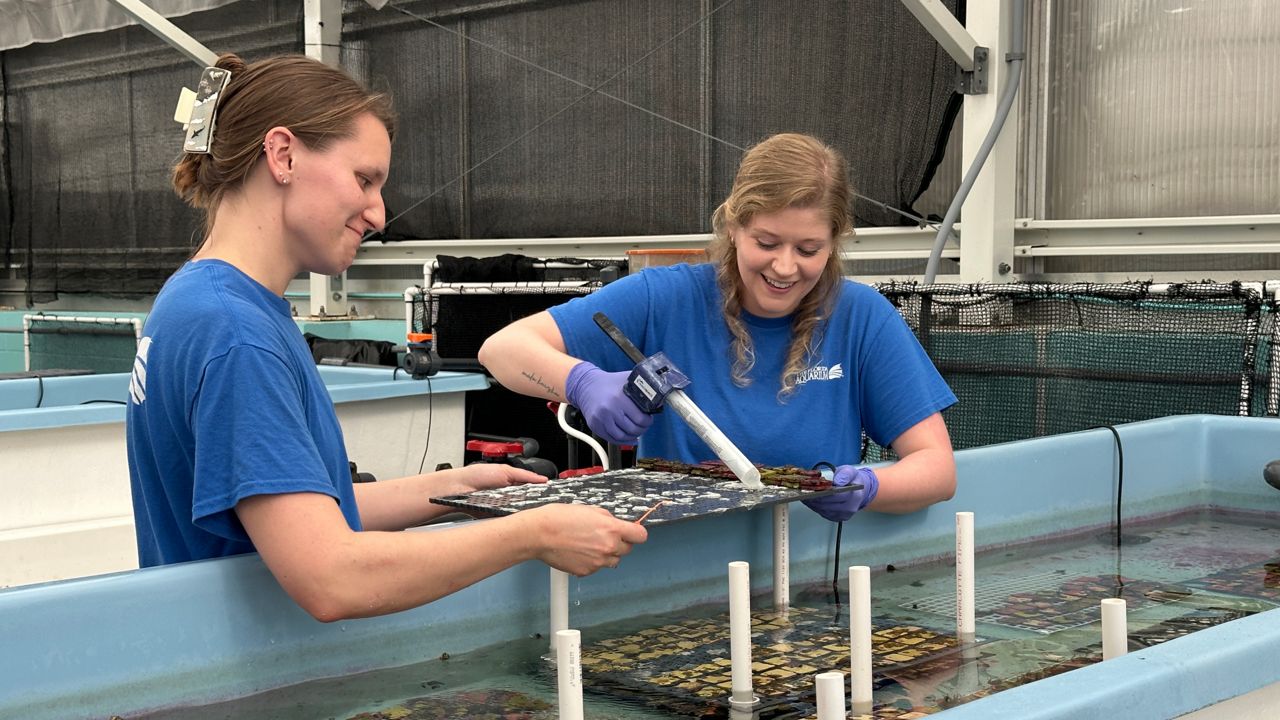
Scientists say Florida’s coral reef system is a huge asset to our state, and they hope to help restore at least 25% of the reefs in the Keys through projects like this. (Spectrum News/Fallon Silcox)
Once they’re adults, they’ll look like their parents, which O’Neil says stay here at the research facility.
“We maintain these parent corals here and induce them to spawn once a year on their annual cycle, and then we raise tens of thousands of them here at our facility every year,” said O’Neil.
O’Neil says thanks to this initiative, they’re able to continue this work, but right now, they are concerned about funding; theirs is set to expire in 2027, which she says could be detrimental to our state.
“Our reef is a $8.5 billion asset to the state of Florida. It protects our coastlines, it supports our fisheries, and it supports our tourism. It’s really critical,” she said.
The baby corals transferred on Wednesday should be ready for out plant in the Florida Keys within a year.
Part of the initiative is also working with state universities to create more heat tolerant and disease resistant corals.